

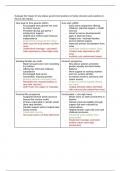
Evaluate the impact of new labour government policies on family structure and practices in
the UK (30 marks)
New deal for lone parents (2001) Sure start (1999)
- Encouraged lone parents into work - Early years programme offering
to reduce poverty childcare, parental support + health
- Provided training, job advice + services
employment support - Aimed to narrow developmental
- Helped lone mothers gain financial gaps in deprived areas
independence - Helped lone + blended families
- Empowered women (lib fem view) access tailored support
- Didnt save the dual burden (rad fem - Improved primary socialisation (func
view) view)
- Undermined marriage + promoted - Supported working mothers (fem)
state dependency (New Right view) - Created state dependency (NR
view)
- Austerity cuts undermined impact
Working families tax credit Feminist perspective
- Made low-paid work more rewarding - New labour policies promoted
for mothers gender equality and work family
- Offered tax relief and childcare ballance
subsidiaries - More support for working mothers
- Encouraged dual earner and non-nuclear families
households, reducing poverty - Increased women's autonomy and
- Boosted women's economic roles career access
- Rewarded non married families (a - Progress towards equality (liberal
new right criticism) fem view)
- Didn't solve low wages or inequality - Unpaid domestic labour persisted,
with insecure jobs (radical fem view)
Personal life perspective Functionalist + new right views
- Supported diverse family structure - Mixed views on state involvement in
beyond the nuclear model families
- Policies responded to real life needs - Policies improved stability through
(lone-step families) support but were criticised by
- Flexible support options helped tailor conservatives
family choices - Helped families cope with work and
- Celebrated diversity childcare pressures
- Structural issues not fully addressed - Enhanced social stability (func
perspective)
- Weakened marriage, promoted
welfare culture (new right
perspective)
the UK (30 marks)
New deal for lone parents (2001) Sure start (1999)
- Encouraged lone parents into work - Early years programme offering
to reduce poverty childcare, parental support + health
- Provided training, job advice + services
employment support - Aimed to narrow developmental
- Helped lone mothers gain financial gaps in deprived areas
independence - Helped lone + blended families
- Empowered women (lib fem view) access tailored support
- Didnt save the dual burden (rad fem - Improved primary socialisation (func
view) view)
- Undermined marriage + promoted - Supported working mothers (fem)
state dependency (New Right view) - Created state dependency (NR
view)
- Austerity cuts undermined impact
Working families tax credit Feminist perspective
- Made low-paid work more rewarding - New labour policies promoted
for mothers gender equality and work family
- Offered tax relief and childcare ballance
subsidiaries - More support for working mothers
- Encouraged dual earner and non-nuclear families
households, reducing poverty - Increased women's autonomy and
- Boosted women's economic roles career access
- Rewarded non married families (a - Progress towards equality (liberal
new right criticism) fem view)
- Didn't solve low wages or inequality - Unpaid domestic labour persisted,
with insecure jobs (radical fem view)
Personal life perspective Functionalist + new right views
- Supported diverse family structure - Mixed views on state involvement in
beyond the nuclear model families
- Policies responded to real life needs - Policies improved stability through
(lone-step families) support but were criticised by
- Flexible support options helped tailor conservatives
family choices - Helped families cope with work and
- Celebrated diversity childcare pressures
- Structural issues not fully addressed - Enhanced social stability (func
perspective)
- Weakened marriage, promoted
welfare culture (new right
perspective)


