

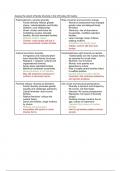
Assess the extent of family diversity in the UK today (30 marks)
Postmodernism- growing diversity Role of women and economic change
- Family diversity reflects greater - Women's employment has changed
choice, individualisation and fluidity gender roles and delayed family
- Giddens- pure relationships formation
- Smart- chosen and fictive kin - Gershuny- rise of dual earner
- Cohabiting couples, blended, households, modified extended
families, divorce-extended families families
- Reflects modern values - Later marriage, fewer children,
- Chester- most people still live in walking mothers
neo-conventional nuclear families - Facilitates new family types
- Oakley- women still face dual
burden
Cultural and ethnic diversity functionalist/new right diversity as decline
- Immigration and multiculturalism - Traditionalists see the nuclear family
have diversified family structures as essential for social order
- Rapoport + rapoport- cultural and - Murdock- four functions
organisational diversity - Murray- lone parents and
- South Asian extended families dependency culture
- Matrifocal caribbean households - Rise in single parent families linked
- Shows pluralism in UK families to welfare policies
- May still experience pressure to - Nuclear family provides stability
conform to dominant norms - Feminists- this reinforces patriarchy
and ignores progress
Feminist critique- diversity as liberation Life course and structural perspectives
- Family diversity promotes gender - Diversity is dynamic and shaped by
equality and challenges patriarchy life events, not fixed types
- Liberal feminists- dual income - Haraven- life course perspectives
families - Rapoports- five types of diversity
- Radical feminists- critique the (clogs)
nuclear family - Families change overtime due to
- Same sex families, single mothers age, culture or experience
by choice - Captures fluid nature of modern
- Reflects social progress families
- Inequalities still persist in some - Hard to generalise patterns across
diverse forms society
Postmodernism- growing diversity Role of women and economic change
- Family diversity reflects greater - Women's employment has changed
choice, individualisation and fluidity gender roles and delayed family
- Giddens- pure relationships formation
- Smart- chosen and fictive kin - Gershuny- rise of dual earner
- Cohabiting couples, blended, households, modified extended
families, divorce-extended families families
- Reflects modern values - Later marriage, fewer children,
- Chester- most people still live in walking mothers
neo-conventional nuclear families - Facilitates new family types
- Oakley- women still face dual
burden
Cultural and ethnic diversity functionalist/new right diversity as decline
- Immigration and multiculturalism - Traditionalists see the nuclear family
have diversified family structures as essential for social order
- Rapoport + rapoport- cultural and - Murdock- four functions
organisational diversity - Murray- lone parents and
- South Asian extended families dependency culture
- Matrifocal caribbean households - Rise in single parent families linked
- Shows pluralism in UK families to welfare policies
- May still experience pressure to - Nuclear family provides stability
conform to dominant norms - Feminists- this reinforces patriarchy
and ignores progress
Feminist critique- diversity as liberation Life course and structural perspectives
- Family diversity promotes gender - Diversity is dynamic and shaped by
equality and challenges patriarchy life events, not fixed types
- Liberal feminists- dual income - Haraven- life course perspectives
families - Rapoports- five types of diversity
- Radical feminists- critique the (clogs)
nuclear family - Families change overtime due to
- Same sex families, single mothers age, culture or experience
by choice - Captures fluid nature of modern
- Reflects social progress families
- Inequalities still persist in some - Hard to generalise patterns across
diverse forms society


