Week 7 – Public Opinion
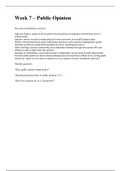
Revision presentation overview:
Page and Shapiro- impact of PO on policy from perspective of congruence (found there were in
original study)
Simpson- moods, not direct relationship but broad constraints of mood/PO shapes policy
Wlezien- thermostat theory, policy itself shapes opinion as well as opinion shaping policy (public
spending on defence, people think spending too much, spending goes down)
Gilens and Page- spurious relationship, any relationship mediated through elite opinion (PO only
influences when it aligns with elite opinion)
Question of methodology, cannot tell precisely a relationship, narrow range of policy about which
we know public opinion on (bias towards studying issues we know there is likely to be a strong public
opinion on, might not even have an opinion on it e.g. taxation of senior consultants' pensions)
Moodle questions:
-Does public opinion shape policy?
-Should politicians listen to public opinion? ( E )
-How does opinion act as a ‘thermostat’?
,Class discussion:
-Does the apparent swing against austerity in the UK prove the ‘thermostat’ model of the
effect of public opinion?
-Source 1: Piece in The Conversation (Bartle 2015), wrote when Conservatives and Labour
were “neck-and-neck” in opinion polls. Argues that despite the “electoral stars” aligning in
favour of the Conservatives, namely, low inflation and unemployment in a growing economy,
their electoral success would be limited because of a fundamental shift in public opinion
against austerity. “Policy mood” as measured thousands of standardised survey responses of
Gallup, Ipsos Mori, YouGov etc. on the “average position on the average mood” had shifted
rightwards in the financial crisis period (Labour’s perceived incompetence- Labour
government kept spending constant and even cut some taxes as the economy shrunk 6%,
budget deficit skyrocketed) but left since 2010 (David Cameron’s victory in GE). Fairly
consistent pattern that the mood “has generally moved in the opposite direction to policy”
(first identified by Wlezien), idea of policy being a thermostat - when unemployment and
inequality increase PO for more spending (but author notes that unemployment decreased,
~8% in 2010 to 5-6% in 2015, also inequality has not increased- Financial Times (Tetlow
2016), though “perception” may be of “rising income inequality among Britons”, suggests
this was a “contributing factor” for the Brexit vote- PO relies after all on perception), sends
signal to government. And similarly when spending and taxes PO may move away and signal
need to spend less. He claims that this public resistance was the reason Osborne quietly
revised down his austerity programme set out in the autumn statement of the previous year.
But actual results in GE- Opinion polls were eventually proven to have underestimated the
Conservative vote as the party unexpectedly won an outright majority
-Source 2: Financial Times (Blenkov 2017)- British Social Attitudes Survey finds support for
ending austerity at 10 year high (48% said increase taxes/spend more; 44% said keep
taxes/spend the same; 4% said reduce taxes/spend less- but then same combined number of
people say keep the same or less than spend more? Aggregate public opinion is indifferent?).
Varies by sector- 83% want increase in health spending, 69% on education and 58% on law
enforcement. Labour planned to make a Queen’s Speech amendment (failed to commend
response of emergency services to terrorist attacks/Grenfell, continuation of public sector pay
cap), supported by Lib Dems (“The government must listen to the overwhelming tide of
public opinion and give our police, firefighters and nurses a pay rise”- MP Alistair
Carmichael).
-Source 3: The Spectator (June 2017 issue), counterargument that the Conservatives’
disappointing performance in election was because “the public have voted against
‘austerity’”, “why would voters who two years ago rejected Labour spending plans now
accept Jeremy Corbyn’s much more irresponsible plans”? (but this is exactly what thermostat
theory predicts?). May didn’t provide proper costings in her manifesto, “robbed her of any
authority to criticise Labour’s figures” (if she had, the scale of Labour’s tax plans might have
“focused minds”)
, Current news! (Lockdown support)
-(Sky News, April 2020)- A YouGov poll asked 1,646 adults between Friday and Sunday for
their views on the police's handling of the new laws and government guidance to keep people
indoors and slow the spread of COVID-19. It found that 42% of respondents fully support the
approach taken by the police, but a further 32% felt they had gone too far in some cases
-(Smith, March 2020) for YouGov, initial. 93% of Brits support government’s Lockdown
measures (only allowed to leave the house to shop for basic necessities, exercise once a day,
seek help for a medical need, provide medical care or help a vulnerable person)- 76%
“strongly support” and 17% “somewhat support” (extremely high!!)
- Again from YouGov survey. 82% were comfortable with ‘stop and account’ powers which
allow the police to ask people to provide a valid reason for being out of their home while
14% were uncomfortable;
72% were comfortable with the police arresting people who failed to comply with an
instruction to return home while 22% were uncomfortable;
75% were comfortable with the police issuing fines to people who breached the lockdown
while 19% were uncomfortable;
50% were comfortable with using drones to photograph people making unnecessary journeys
while 43% were uncomfortable; 38% were comfortable with naming and shaming people on
social media while 54% were uncomfortable. People are, broadly speaking, comfortable with
face-to-face police enforcement up to and including tactics such as roadblocks which are
themselves highly unusual. However, public support starts to fall when people are asked
about more remote, less human tactics such as the use of social media to name and shame
those flouting social distancing rules, or new technology such as drones to photograph
people. Support may shift if support for government policy changes, frustration grows at the
economic and social impact or even if continued good weather encourages people to leave
their houses unnecessarily (The Derbyshire police and crime commissioner, Hardyal
Dhindsa, said “isolation fatigue” could set in and pose a genuine threat to the lockdown,
especially after the likely decision to extend the measures beyond the current three-week
period)
-Chile- President Pinera has not bowed to pressure to place country on lockdown, despite 56
majors from central Chile writing him an open letter asking him to do so. Aljazeera- Nearly
two-thirds of Chileans do not think the government's response to coronavirus has been timely
or adequate (64%), according to a poll Monday, but other leadership has emerged. The
authorities the public most trusts to manage the situation are mayors, with 75 percent support,
followed by the National Doctor's Association.
Several mayors, most of them from political parties belonging to Pinera's ruling alliance,
have been in the spotlight, enacting local restrictions before and beyond the national
government, which has pushed back against attempts to close shopping malls.
Revision presentation overview:
Page and Shapiro- impact of PO on policy from perspective of congruence (found there were in
original study)
Simpson- moods, not direct relationship but broad constraints of mood/PO shapes policy
Wlezien- thermostat theory, policy itself shapes opinion as well as opinion shaping policy (public
spending on defence, people think spending too much, spending goes down)
Gilens and Page- spurious relationship, any relationship mediated through elite opinion (PO only
influences when it aligns with elite opinion)
Question of methodology, cannot tell precisely a relationship, narrow range of policy about which
we know public opinion on (bias towards studying issues we know there is likely to be a strong public
opinion on, might not even have an opinion on it e.g. taxation of senior consultants' pensions)
Moodle questions:
-Does public opinion shape policy?
-Should politicians listen to public opinion? ( E )
-How does opinion act as a ‘thermostat’?
,Class discussion:
-Does the apparent swing against austerity in the UK prove the ‘thermostat’ model of the
effect of public opinion?
-Source 1: Piece in The Conversation (Bartle 2015), wrote when Conservatives and Labour
were “neck-and-neck” in opinion polls. Argues that despite the “electoral stars” aligning in
favour of the Conservatives, namely, low inflation and unemployment in a growing economy,
their electoral success would be limited because of a fundamental shift in public opinion
against austerity. “Policy mood” as measured thousands of standardised survey responses of
Gallup, Ipsos Mori, YouGov etc. on the “average position on the average mood” had shifted
rightwards in the financial crisis period (Labour’s perceived incompetence- Labour
government kept spending constant and even cut some taxes as the economy shrunk 6%,
budget deficit skyrocketed) but left since 2010 (David Cameron’s victory in GE). Fairly
consistent pattern that the mood “has generally moved in the opposite direction to policy”
(first identified by Wlezien), idea of policy being a thermostat - when unemployment and
inequality increase PO for more spending (but author notes that unemployment decreased,
~8% in 2010 to 5-6% in 2015, also inequality has not increased- Financial Times (Tetlow
2016), though “perception” may be of “rising income inequality among Britons”, suggests
this was a “contributing factor” for the Brexit vote- PO relies after all on perception), sends
signal to government. And similarly when spending and taxes PO may move away and signal
need to spend less. He claims that this public resistance was the reason Osborne quietly
revised down his austerity programme set out in the autumn statement of the previous year.
But actual results in GE- Opinion polls were eventually proven to have underestimated the
Conservative vote as the party unexpectedly won an outright majority
-Source 2: Financial Times (Blenkov 2017)- British Social Attitudes Survey finds support for
ending austerity at 10 year high (48% said increase taxes/spend more; 44% said keep
taxes/spend the same; 4% said reduce taxes/spend less- but then same combined number of
people say keep the same or less than spend more? Aggregate public opinion is indifferent?).
Varies by sector- 83% want increase in health spending, 69% on education and 58% on law
enforcement. Labour planned to make a Queen’s Speech amendment (failed to commend
response of emergency services to terrorist attacks/Grenfell, continuation of public sector pay
cap), supported by Lib Dems (“The government must listen to the overwhelming tide of
public opinion and give our police, firefighters and nurses a pay rise”- MP Alistair
Carmichael).
-Source 3: The Spectator (June 2017 issue), counterargument that the Conservatives’
disappointing performance in election was because “the public have voted against
‘austerity’”, “why would voters who two years ago rejected Labour spending plans now
accept Jeremy Corbyn’s much more irresponsible plans”? (but this is exactly what thermostat
theory predicts?). May didn’t provide proper costings in her manifesto, “robbed her of any
authority to criticise Labour’s figures” (if she had, the scale of Labour’s tax plans might have
“focused minds”)
, Current news! (Lockdown support)
-(Sky News, April 2020)- A YouGov poll asked 1,646 adults between Friday and Sunday for
their views on the police's handling of the new laws and government guidance to keep people
indoors and slow the spread of COVID-19. It found that 42% of respondents fully support the
approach taken by the police, but a further 32% felt they had gone too far in some cases
-(Smith, March 2020) for YouGov, initial. 93% of Brits support government’s Lockdown
measures (only allowed to leave the house to shop for basic necessities, exercise once a day,
seek help for a medical need, provide medical care or help a vulnerable person)- 76%
“strongly support” and 17% “somewhat support” (extremely high!!)
- Again from YouGov survey. 82% were comfortable with ‘stop and account’ powers which
allow the police to ask people to provide a valid reason for being out of their home while
14% were uncomfortable;
72% were comfortable with the police arresting people who failed to comply with an
instruction to return home while 22% were uncomfortable;
75% were comfortable with the police issuing fines to people who breached the lockdown
while 19% were uncomfortable;
50% were comfortable with using drones to photograph people making unnecessary journeys
while 43% were uncomfortable; 38% were comfortable with naming and shaming people on
social media while 54% were uncomfortable. People are, broadly speaking, comfortable with
face-to-face police enforcement up to and including tactics such as roadblocks which are
themselves highly unusual. However, public support starts to fall when people are asked
about more remote, less human tactics such as the use of social media to name and shame
those flouting social distancing rules, or new technology such as drones to photograph
people. Support may shift if support for government policy changes, frustration grows at the
economic and social impact or even if continued good weather encourages people to leave
their houses unnecessarily (The Derbyshire police and crime commissioner, Hardyal
Dhindsa, said “isolation fatigue” could set in and pose a genuine threat to the lockdown,
especially after the likely decision to extend the measures beyond the current three-week
period)
-Chile- President Pinera has not bowed to pressure to place country on lockdown, despite 56
majors from central Chile writing him an open letter asking him to do so. Aljazeera- Nearly
two-thirds of Chileans do not think the government's response to coronavirus has been timely
or adequate (64%), according to a poll Monday, but other leadership has emerged. The
authorities the public most trusts to manage the situation are mayors, with 75 percent support,
followed by the National Doctor's Association.
Several mayors, most of them from political parties belonging to Pinera's ruling alliance,
have been in the spotlight, enacting local restrictions before and beyond the national
government, which has pushed back against attempts to close shopping malls.