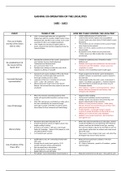
GAINING CO-OPERATION OF THE LOCALITIES
1485 - 1603
EVENT THINGS IT DID HOW DID IT HELP CONTROL THE LOCALITIES?
1535 - Cromwell split Wales into 12 regions like ended traditional power of marcher lords
England was split into counties, English system of gov control of the marcher regions most susceptible to
introduced (JPs, Sheriffs in each county), each county invasion (wales was where Henry VII had landed to usurp
The Law in Wales Richard III)
could elect 2 MPs to sit in English parliament
Act/Act of the Union 1542- English law introduced, English spoken in The president and vice president of the council of Wales
1535 & 1542 courts, council of the marches reorganised to be the were chosen by the monarch
Council of Wales Wales went from a lawless society to one of improved
law and order
By Elizabeth’s time, Wales had Lord Lieutenants
= Wales caused very little trouble after once being
promlematic
Extended the authority of the council - governed not Limited the traditional power of Northern nobles
only Yorkshire but now Northumberland, (Cliffords etc)
Re-establishment of
Cumberland and Westmoreland Elizabeth tried to get more southerners into the council =
the Council of the Got a permanent HQ in York resentment and 1969 rebellion = shows council not
North 1537 President was a bishop or noble who went South completely in control
regularly (e.g Bishop of Llandaff) However, 1572 remodelling made it stable again
Instead of each county sending to MPs to the House People sought to be elected for career development,
of Commons, each borough could send 2 (191 wanted to advance so would look to work in monarch’s
bouroughs sending 2 each by 1603) best interests
Increased borough expansion of the H.o.C, retraction of H.of Lords Made people feel like they had a voice, involvement in
representation (1547 - Lords = 84, Commons = 342) system = less likely to go against it. However elections
Allowed townsmen to get voices heard (Under were often fixed so trusted men got chosen (e.g. Sir
Edward, York ensured laws were passed to save local Christopher Hatton)
woodland) More opinions = harder to control parliament - radical
thinkers like Peter Wentworth and Anthony Cope
emerged under Elizabeth
When the monarchy rewarded people for their Stopped nobles rebelling
loyalty with good political positions, perhaps money Got favoured candidates elected to parliament
or land. Nobility’s power once based on land ownership, now
Many MPs elected were controlled by a noble who in based on links/loyalty to the monarchy
turn was controlled by the monarch through Relied on a strong monarch however - under young
Use of Patronage patronage (e.g Duke of Norfolk ensured his clients Edward, Seymour was powerful because of Henry VIII’s
were elected in Great Yarmouth and Castle Rising) giving of past patronage to him
Created factions - not enough money to reward
everyone & people felt jealous of others/left out (e.g.
William Cecil vs Earl of Essex under Elizabeth)
Elizabeth’s use caused resentment - plot of Northern
Earls against Cecil
Humanism advocated ‘education for all’ Before they had increased literacy & education, yeomen
Growth of grammar schools & ‘English schools’ that usually led rebellions (e.g Cornish Rising 1497) However
taught reading & writing yeomen could now be included in local gov, meaning
Growth in uni numbers - still only 2 unis though - they were less likely to attack it & more likely to use it to
Literacy Rates Oxford & Cambridge (Oxford 1150 students in 1550 solve disputes rather than use violence and cause unrest
and 2000 students in 1603) like earlier years
½ of students were yeomen There weren’t many risings in later years, and when they
did happen they weren’t led by yeomen
Qualification to be a JP = ownership of land worth Being a JP was a good was to advance = JPs were
£20 a year committed to job
Average size of county bench grew by 15-25 JPs = Reps of monarchy - growth in JP numbers = greater
Use of Justices of the members between Wolsey and Elizabeth representation
Peace (JPs) Role increased due to reformation
JPs enforced the 2nd prayer book in 1552
Raised military for war with Spain
Pre-subsidy = tax or extraordinary income based on Reduced resentment from the poor - they paid less and
1485 - 1603
EVENT THINGS IT DID HOW DID IT HELP CONTROL THE LOCALITIES?
1535 - Cromwell split Wales into 12 regions like ended traditional power of marcher lords
England was split into counties, English system of gov control of the marcher regions most susceptible to
introduced (JPs, Sheriffs in each county), each county invasion (wales was where Henry VII had landed to usurp
The Law in Wales Richard III)
could elect 2 MPs to sit in English parliament
Act/Act of the Union 1542- English law introduced, English spoken in The president and vice president of the council of Wales
1535 & 1542 courts, council of the marches reorganised to be the were chosen by the monarch
Council of Wales Wales went from a lawless society to one of improved
law and order
By Elizabeth’s time, Wales had Lord Lieutenants
= Wales caused very little trouble after once being
promlematic
Extended the authority of the council - governed not Limited the traditional power of Northern nobles
only Yorkshire but now Northumberland, (Cliffords etc)
Re-establishment of
Cumberland and Westmoreland Elizabeth tried to get more southerners into the council =
the Council of the Got a permanent HQ in York resentment and 1969 rebellion = shows council not
North 1537 President was a bishop or noble who went South completely in control
regularly (e.g Bishop of Llandaff) However, 1572 remodelling made it stable again
Instead of each county sending to MPs to the House People sought to be elected for career development,
of Commons, each borough could send 2 (191 wanted to advance so would look to work in monarch’s
bouroughs sending 2 each by 1603) best interests
Increased borough expansion of the H.o.C, retraction of H.of Lords Made people feel like they had a voice, involvement in
representation (1547 - Lords = 84, Commons = 342) system = less likely to go against it. However elections
Allowed townsmen to get voices heard (Under were often fixed so trusted men got chosen (e.g. Sir
Edward, York ensured laws were passed to save local Christopher Hatton)
woodland) More opinions = harder to control parliament - radical
thinkers like Peter Wentworth and Anthony Cope
emerged under Elizabeth
When the monarchy rewarded people for their Stopped nobles rebelling
loyalty with good political positions, perhaps money Got favoured candidates elected to parliament
or land. Nobility’s power once based on land ownership, now
Many MPs elected were controlled by a noble who in based on links/loyalty to the monarchy
turn was controlled by the monarch through Relied on a strong monarch however - under young
Use of Patronage patronage (e.g Duke of Norfolk ensured his clients Edward, Seymour was powerful because of Henry VIII’s
were elected in Great Yarmouth and Castle Rising) giving of past patronage to him
Created factions - not enough money to reward
everyone & people felt jealous of others/left out (e.g.
William Cecil vs Earl of Essex under Elizabeth)
Elizabeth’s use caused resentment - plot of Northern
Earls against Cecil
Humanism advocated ‘education for all’ Before they had increased literacy & education, yeomen
Growth of grammar schools & ‘English schools’ that usually led rebellions (e.g Cornish Rising 1497) However
taught reading & writing yeomen could now be included in local gov, meaning
Growth in uni numbers - still only 2 unis though - they were less likely to attack it & more likely to use it to
Literacy Rates Oxford & Cambridge (Oxford 1150 students in 1550 solve disputes rather than use violence and cause unrest
and 2000 students in 1603) like earlier years
½ of students were yeomen There weren’t many risings in later years, and when they
did happen they weren’t led by yeomen
Qualification to be a JP = ownership of land worth Being a JP was a good was to advance = JPs were
£20 a year committed to job
Average size of county bench grew by 15-25 JPs = Reps of monarchy - growth in JP numbers = greater
Use of Justices of the members between Wolsey and Elizabeth representation
Peace (JPs) Role increased due to reformation
JPs enforced the 2nd prayer book in 1552
Raised military for war with Spain
Pre-subsidy = tax or extraordinary income based on Reduced resentment from the poor - they paid less and