Primary and secondary deviance
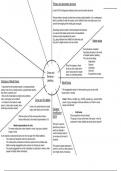
Lemert (1951) distinguishes between primary and secondary deviance.
Primary refers to deviant acts that have not been publicly labelled. It is so widespread
that it is pointless to seek the causes, and is unlikely to have one single cause, such
as train fare dodging which mostly goes uncaught.
Secondary deviance refers to the development of behaviour
in a person that violates social norms and expectations
because society stigmatizes the person
E.g. gang members who shifted from dishonesty and
Master status
drug use to illegal deviance such as murder.
Some deviance is labelled.
Secondary deviance is the result
of societal reaction; labelling.
This can involve being:
- Stigmatised
Once this happens, others - Shamed
fail to see him outside of the - Humiliated
label. It becomes his ‘master - Shunned
Crime and - Excluded from society
status’ or controlling identity.
Deviance -
Criticisms of Moral Panics Labelling
Moral Panics
- It assumes that the societal reaction is a disproportionate
reaction, but who is to decide what is a proportionate reaction ↑ An exaggerated reaction or fear towards a group or issue that
and what is a panicky one? causes panic in society.
- Why are the media able to amplify some problems
into a moral panic but not others? Cohen: “When a condition (e.g. COVID), episode (e.g. London Riots),
Crime and The Media
- It is harder for the media to create person or group emerges to become defined as ‘a threat’ to social
panics. In late modern society, there Crime is the central theme of media values and interests”.
is little idea of what is deviant. output, both fiction and non-fiction. Deviance
Amplification - Folk Devils
What we know (or think we know) about crime is Spiral These people are who are blamed.
heavily influenced by the media’s representation of it. “The group or issue at the heart of the panic - which is
condemned, feared, labelled as deviant and/or blamed”
This term is used to
- Media representations of crime
describe a process in
The news media show a keen interest in crime, they give a distorted
which the attempt to
image of crime.
control deviance leads to
As an example, comparing the picture of crime we gain from official statistics: an increase in the level of
- The media over-represent violent and sexual crime. deviance.
- The media portray criminals and victims as older and more middle-class
- Media coverage exaggerates police success (in clearing up cases) This leads to greater attempts to
- The media exaggerate the risk of victimisation (in particular to women, white control it, and in turn this produces
people and higher status individuals) even higher levels of deviance.
Lemert (1951) distinguishes between primary and secondary deviance.
Primary refers to deviant acts that have not been publicly labelled. It is so widespread
that it is pointless to seek the causes, and is unlikely to have one single cause, such
as train fare dodging which mostly goes uncaught.
Secondary deviance refers to the development of behaviour
in a person that violates social norms and expectations
because society stigmatizes the person
E.g. gang members who shifted from dishonesty and
Master status
drug use to illegal deviance such as murder.
Some deviance is labelled.
Secondary deviance is the result
of societal reaction; labelling.
This can involve being:
- Stigmatised
Once this happens, others - Shamed
fail to see him outside of the - Humiliated
label. It becomes his ‘master - Shunned
Crime and - Excluded from society
status’ or controlling identity.
Deviance -
Criticisms of Moral Panics Labelling
Moral Panics
- It assumes that the societal reaction is a disproportionate
reaction, but who is to decide what is a proportionate reaction ↑ An exaggerated reaction or fear towards a group or issue that
and what is a panicky one? causes panic in society.
- Why are the media able to amplify some problems
into a moral panic but not others? Cohen: “When a condition (e.g. COVID), episode (e.g. London Riots),
Crime and The Media
- It is harder for the media to create person or group emerges to become defined as ‘a threat’ to social
panics. In late modern society, there Crime is the central theme of media values and interests”.
is little idea of what is deviant. output, both fiction and non-fiction. Deviance
Amplification - Folk Devils
What we know (or think we know) about crime is Spiral These people are who are blamed.
heavily influenced by the media’s representation of it. “The group or issue at the heart of the panic - which is
condemned, feared, labelled as deviant and/or blamed”
This term is used to
- Media representations of crime
describe a process in
The news media show a keen interest in crime, they give a distorted
which the attempt to
image of crime.
control deviance leads to
As an example, comparing the picture of crime we gain from official statistics: an increase in the level of
- The media over-represent violent and sexual crime. deviance.
- The media portray criminals and victims as older and more middle-class
- Media coverage exaggerates police success (in clearing up cases) This leads to greater attempts to
- The media exaggerate the risk of victimisation (in particular to women, white control it, and in turn this produces
people and higher status individuals) even higher levels of deviance.