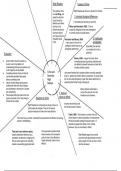
Right Realists Causes of Crime
They believe crime Right Realists see crime as a product of 3 factors:
is a real thing, and
reject the idea that 1. Individual biological differences
is put forward by
Marxists and others
↑ Essentially the idea that you are thick.
as they do not Wilson and Herrnstein (1985) - Crime is
believe structural or caused by biological (some more predisposed
economic factors to commit crime) and social factors.
such as poverty and
inequality cause Herrnstein and Murray (1994) 2. Inadequate
crime. – main cause of crime is low socialisation
intelligence which they see as (Essentially the idea that
biologically determined. your parents did not do a
good job.)
Evaluation
Murray (1990) – argues that crime rate is
● Ignores wider structural causes e.g. increasing because of growing underclass who
poverty. Lack of sympathy and are defined by deviant behaviour and who fail to
understanding that laws and policies such socialise children properly.
as the Vagrancy Act are flawed.
● Overstates rational choice and how far Crime and Lone parent families fail to socialise children correctly, especially
cost-benefit calculation takes place Deviance - boys (i.e. absent role models, fathers in particular). So young males
before committing crime. Right turn to crime and delinquency to gain their status rather than by
● Idea of criminals being rational actors supporting their family through a steady job.
Realism
conflicts with their own idea of biology
and socialisation, meaning the 3 causes Murray believes underclass is
are contradictory. not just the cause of crime but
3. Rational
● Preoccupied with petty street crime and threatens social cohesion.
ignores corporate crime. Only acting on Solutions to Crime choice to offend
crimes that are visible.
Assumes the individual has
Right Realists are not focused on solving crime as it
free will and power of reason.
cannot easily be changed. They aim to develop
practical measures to make crime less attractive.
Clarke (1980) - The decision to commit crime is a
Their main focus is control, containment and punishment of offenders not solving choice based on rational calculation of consequences.
causes or rehabilitating. Perceived rewards outweigh perceived costs or if
rewards are greater than those of non-criminal
behaviour, they are more likely to offend.
They want a zero tolerance policy Crime prevention policies should
towards undesirable behaviour (e.g. reduce rewards and increase the Right Realists argue that currently
prostitution, drunkenness, begging etc). costs of crime to the offender by perceived costs (punishment and risk of
Role of police needs to be controlling ‘target hardening’ (make it more being caught) of crime are low so crime
streets so law-abiding people feel safe. difficult). rate has increased.
They believe crime Right Realists see crime as a product of 3 factors:
is a real thing, and
reject the idea that 1. Individual biological differences
is put forward by
Marxists and others
↑ Essentially the idea that you are thick.
as they do not Wilson and Herrnstein (1985) - Crime is
believe structural or caused by biological (some more predisposed
economic factors to commit crime) and social factors.
such as poverty and
inequality cause Herrnstein and Murray (1994) 2. Inadequate
crime. – main cause of crime is low socialisation
intelligence which they see as (Essentially the idea that
biologically determined. your parents did not do a
good job.)
Evaluation
Murray (1990) – argues that crime rate is
● Ignores wider structural causes e.g. increasing because of growing underclass who
poverty. Lack of sympathy and are defined by deviant behaviour and who fail to
understanding that laws and policies such socialise children properly.
as the Vagrancy Act are flawed.
● Overstates rational choice and how far Crime and Lone parent families fail to socialise children correctly, especially
cost-benefit calculation takes place Deviance - boys (i.e. absent role models, fathers in particular). So young males
before committing crime. Right turn to crime and delinquency to gain their status rather than by
● Idea of criminals being rational actors supporting their family through a steady job.
Realism
conflicts with their own idea of biology
and socialisation, meaning the 3 causes Murray believes underclass is
are contradictory. not just the cause of crime but
3. Rational
● Preoccupied with petty street crime and threatens social cohesion.
ignores corporate crime. Only acting on Solutions to Crime choice to offend
crimes that are visible.
Assumes the individual has
Right Realists are not focused on solving crime as it
free will and power of reason.
cannot easily be changed. They aim to develop
practical measures to make crime less attractive.
Clarke (1980) - The decision to commit crime is a
Their main focus is control, containment and punishment of offenders not solving choice based on rational calculation of consequences.
causes or rehabilitating. Perceived rewards outweigh perceived costs or if
rewards are greater than those of non-criminal
behaviour, they are more likely to offend.
They want a zero tolerance policy Crime prevention policies should
towards undesirable behaviour (e.g. reduce rewards and increase the Right Realists argue that currently
prostitution, drunkenness, begging etc). costs of crime to the offender by perceived costs (punishment and risk of
Role of police needs to be controlling ‘target hardening’ (make it more being caught) of crime are low so crime
streets so law-abiding people feel safe. difficult). rate has increased.