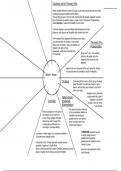
Capitalism and the Protestant Ethic
Weber studied different countries in Europe, as he was trying to discover why certain
countries developed capitalism before others.
The key thing he saw in common with countries that did develop capitalism was that
they all followed one specific religion - it was a form of Christianity (Protestantism)
called Calvinism - based on the beliefs of John Calvin.
It involved leading a very strict lifestyle with abstinence from life’s
pleasures, with rigorous self discipline and constant hard work.
The Protestant Ethic displayed that making money was a
concrete indication of success in one’s career. The extent of the
Money was not spent on luxury or material, but
instead in the ‘glory of God’
Protestant Ethic
(essentially, profits were reinvested into
the business). There was no fun. Time wasting,
laziness, idle gossip and more
sleep/rest than necessary was
attacked.
Impulsive fun and enjoyment of the pub, dance hall, theatre
and casinos were all prohibited to ascetic Protestants.
Beliefs - Weber
‘The Elect’ Calvin thought there was a distinct group of people
called ‘the elect’ who are those chosen to go to
heaven, and that they were chosen by God even
before their birth.
Discipline among Calvinists
Weber’s theory complemented the ‘spirit of
capitalism’, and so the
Conclusion of rationality
mindset of ‘time is money’
(Rationalisation) was adopted.
This theory has been influential
Many sociologists do now accept in the secularisation debate; as
that religion can be a force for capitalism has developed,
social change, despite examples people became more rational,
that can be used to support the which ironically meant they
Functionalist and Marxist view became less religious.
that religion promotes stability.
THEREFORE Calvinism has led
Examples of where religion has undermined stability or
to social change in that it
promoted social change include:
enabled/encouraged the
- Archbishop Tutu’s Christian approach towards being an development of capitalism across
opponent of apartheid in South Africa Western Europe
- Martin Luther King and the Southern Christian Leadership Council (Also led to secularisation; further
played a leading role in reducing racial discrimination. social change).
Weber studied different countries in Europe, as he was trying to discover why certain
countries developed capitalism before others.
The key thing he saw in common with countries that did develop capitalism was that
they all followed one specific religion - it was a form of Christianity (Protestantism)
called Calvinism - based on the beliefs of John Calvin.
It involved leading a very strict lifestyle with abstinence from life’s
pleasures, with rigorous self discipline and constant hard work.
The Protestant Ethic displayed that making money was a
concrete indication of success in one’s career. The extent of the
Money was not spent on luxury or material, but
instead in the ‘glory of God’
Protestant Ethic
(essentially, profits were reinvested into
the business). There was no fun. Time wasting,
laziness, idle gossip and more
sleep/rest than necessary was
attacked.
Impulsive fun and enjoyment of the pub, dance hall, theatre
and casinos were all prohibited to ascetic Protestants.
Beliefs - Weber
‘The Elect’ Calvin thought there was a distinct group of people
called ‘the elect’ who are those chosen to go to
heaven, and that they were chosen by God even
before their birth.
Discipline among Calvinists
Weber’s theory complemented the ‘spirit of
capitalism’, and so the
Conclusion of rationality
mindset of ‘time is money’
(Rationalisation) was adopted.
This theory has been influential
Many sociologists do now accept in the secularisation debate; as
that religion can be a force for capitalism has developed,
social change, despite examples people became more rational,
that can be used to support the which ironically meant they
Functionalist and Marxist view became less religious.
that religion promotes stability.
THEREFORE Calvinism has led
Examples of where religion has undermined stability or
to social change in that it
promoted social change include:
enabled/encouraged the
- Archbishop Tutu’s Christian approach towards being an development of capitalism across
opponent of apartheid in South Africa Western Europe
- Martin Luther King and the Southern Christian Leadership Council (Also led to secularisation; further
played a leading role in reducing racial discrimination. social change).