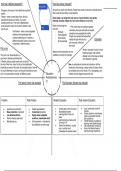
How has it affected education? How has society changed?
Changes to the nature of work affect the education We now have much more diversity. People have chosen to become individuals and do
system. what is best for them (there is less tradition)
Fordism - needs a mass labour force, like that Social class is no longer the main source of social division, now gender,
described by Bowles and Gintis. E.g. bored, ethnicity, sexuality, religion etc. have more influence on our lives.
accepting orders etc. They need a standardised
mass education system to accustom students to this Rapid social change has →This means that we experience greater
type of work. occurred:
uncertainty. New jobs and skills are needed,
Post-fordism - needs a more adaptable - Politically
alongside more geographical mobility.
workforce with transferable skills, - Technologically
People now express themselves/their
constant restraining etc. It requires a - Economically
different education system, that is more
identity through what they buy Education
- Environmentally
and consume, rather than
customised to different needs.
their work.
Pick n mix ‘Modern’ education involved a more
Marxism and functionalism are now traditional aspect, with children
The ‘pick n mix’ demonstration is a outdated as society has changed. obliging more to the rules and being
good way to illustrate postmodernism. more obedient in general.
In Modern society, people would work one job for
the rest of their lives, marry for life and live traditionally. Now, in postmodernist schools and education, with the
Essentially we were all the same; all chocolate buttons. Now we introduction of technology, a larger variety of subject choice
live much differently and due to us being all individuals we are a has surfaced such as the choice of IT or photography, and
pick n mix postmodernist society; all different sweets. Education - children are less obligant towards the rules.
Postmodernism
(1)
The nature of work has changed The Education System has changed
Fordism Post-Fordism Modern Education Post modern Education
● Assembly line production ● Flexible specialisation ● Central state control of schools ● Local, community control of
● Mass production of products ● Customised production ● Standardised system schools
● Learning fixed in time and ● Diverse system to meet diverse
● Low skilled workforce ● Highly skilled, adaptable needs e.g specialist schools,
● Workers closely supervised workforce, transferable skills place
faith schools etc
● Learning during a fixed period ● Flexible learning e.g distance
● Motivated by pay ● Self supervision – motivated by
of life e.g 5-16 learning, work based learning
job satisfaction as well as pay ● Teacher led learning – jug and ● Life long learners, re-training
mug – teacher pours ● Active, self directed learner,
knowledge into passive learner learning through experience
Changes to the nature of work affect the education We now have much more diversity. People have chosen to become individuals and do
system. what is best for them (there is less tradition)
Fordism - needs a mass labour force, like that Social class is no longer the main source of social division, now gender,
described by Bowles and Gintis. E.g. bored, ethnicity, sexuality, religion etc. have more influence on our lives.
accepting orders etc. They need a standardised
mass education system to accustom students to this Rapid social change has →This means that we experience greater
type of work. occurred:
uncertainty. New jobs and skills are needed,
Post-fordism - needs a more adaptable - Politically
alongside more geographical mobility.
workforce with transferable skills, - Technologically
People now express themselves/their
constant restraining etc. It requires a - Economically
different education system, that is more
identity through what they buy Education
- Environmentally
and consume, rather than
customised to different needs.
their work.
Pick n mix ‘Modern’ education involved a more
Marxism and functionalism are now traditional aspect, with children
The ‘pick n mix’ demonstration is a outdated as society has changed. obliging more to the rules and being
good way to illustrate postmodernism. more obedient in general.
In Modern society, people would work one job for
the rest of their lives, marry for life and live traditionally. Now, in postmodernist schools and education, with the
Essentially we were all the same; all chocolate buttons. Now we introduction of technology, a larger variety of subject choice
live much differently and due to us being all individuals we are a has surfaced such as the choice of IT or photography, and
pick n mix postmodernist society; all different sweets. Education - children are less obligant towards the rules.
Postmodernism
(1)
The nature of work has changed The Education System has changed
Fordism Post-Fordism Modern Education Post modern Education
● Assembly line production ● Flexible specialisation ● Central state control of schools ● Local, community control of
● Mass production of products ● Customised production ● Standardised system schools
● Learning fixed in time and ● Diverse system to meet diverse
● Low skilled workforce ● Highly skilled, adaptable needs e.g specialist schools,
● Workers closely supervised workforce, transferable skills place
faith schools etc
● Learning during a fixed period ● Flexible learning e.g distance
● Motivated by pay ● Self supervision – motivated by
of life e.g 5-16 learning, work based learning
job satisfaction as well as pay ● Teacher led learning – jug and ● Life long learners, re-training
mug – teacher pours ● Active, self directed learner,
knowledge into passive learner learning through experience