

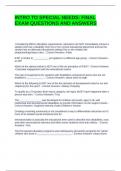
INTRO TO SPECIAL NEEDS: FINAL
EXAM QUESTIONS AND ANSWERS
Considering IDEA's discipline requirements, educators can NOT immediately remove a
student who has a disability from his or her current educational placement and put the
student into an alternate educational setting if he or she violates the
weapons/drugs/injury rules. - Correct Answers -False
IFSP is similar to ___________ yet applies to a different age group. - Correct Answers -
an IEP
Which of the options below is NOT one of the six principles of IDEA? - Correct Answers
-Corporate engagement with the educational system
The rate of suspensions for students with disabilities compared to peers who are not
disabled is ____________ . - Correct Answers -about twice as high.
Which of the following is NOT one of the five domains of development noted in our text
chapter(s) for this quiz? - Correct Answers -Dietary Propriety
To qualify as a Traumatic Brain Injury category, the injury MUST have happened after a
person was born. - Correct Answers -True
The ________________ was developed for children and youth, ages 5-16, with
intellectual and developmental disabilities to provide information on the support needs. -
Correct Answers -Supports Intensity Scale-Children's Version
Creating a learning community is not considered a way to differentiate instruction as it's
more of an isolated social emotional tool for
Intersectionality is basically the educational term used to describe how disabilities, race,
and other microcultures intersect and effect some students more than others. - Correct
Answers -True
The first special education programs were delinquency prevention programs for "atrisk"
children who lived in _________________________. - Correct Answers -urban slums
, In 1970, Congress enacted the Individuals With Disabilities Education Act (P.L. 91-230)
in an effort to encourage states to developeducational programs for individuals with
disabilities. - Correct Answers -false
In what decade was a ruling passed that stated students could not be segregated in
schools because of their ethnicity? - Correct Answers -1950s
The two key cases in Chapter 2 of your text that are noted as causing Congress to
enact the Education for All Handicapped Students Act in 1975 (later to become IDEA)
are the PARC vs Commonwealth of Pennsylvania and Mills vs D.C. Board of Education.
- Correct Answers -True
The Wrightslaw article in Week 3 resources highlights that, in the initial passing of the
IDEA in the 1970s, Congress increased the focus on accountability and improved
outcomes by emphasizing reading, early intervention, and research-based instruction by
requiring that special education teachers be highly qualified. - Correct Answers -False
The nondiscriminatory evaluation purpose is to determine BOTH if a student has a
disability as defined by IDEA and if the student needs special education services and
supports should he/she indeed have a disability. - Correct Answers -True
Progress monitoring, according to your text in Chapter 4: - Correct Answers -All of these
relate to progress monitoring
A summary of information gathered while determining present levels during a
nondiscriminatory evaluation goes by the acronym: - Correct Answers -PLAAFP
Inclusion, according to Chapter 4 of your text, has 8 key characteristics. - Correct
Answers -False
Which of these is untrue (from Chapter 4)? - Correct Answers -Beginning no later than
the first IEP after the student turns 18 should the IEP team consider what transition
services should be considered for a student to be successful.
Which of the following defines the level of achievement that students must meet to
demonstrate proficiency in the subjects? - Correct Answers -Academic content
standards
Under IDEA, a student who cannot learn the same content as same-age peers who do
not have disabilities, and who cannot take the state assessment even with
accommodations, is required to: - Correct Answers -Take an alternative assessment
The design of instructional materials and activities that make content information
accessible to all children refers to Content Standards. - Correct Answers -False
EXAM QUESTIONS AND ANSWERS
Considering IDEA's discipline requirements, educators can NOT immediately remove a
student who has a disability from his or her current educational placement and put the
student into an alternate educational setting if he or she violates the
weapons/drugs/injury rules. - Correct Answers -False
IFSP is similar to ___________ yet applies to a different age group. - Correct Answers -
an IEP
Which of the options below is NOT one of the six principles of IDEA? - Correct Answers
-Corporate engagement with the educational system
The rate of suspensions for students with disabilities compared to peers who are not
disabled is ____________ . - Correct Answers -about twice as high.
Which of the following is NOT one of the five domains of development noted in our text
chapter(s) for this quiz? - Correct Answers -Dietary Propriety
To qualify as a Traumatic Brain Injury category, the injury MUST have happened after a
person was born. - Correct Answers -True
The ________________ was developed for children and youth, ages 5-16, with
intellectual and developmental disabilities to provide information on the support needs. -
Correct Answers -Supports Intensity Scale-Children's Version
Creating a learning community is not considered a way to differentiate instruction as it's
more of an isolated social emotional tool for
Intersectionality is basically the educational term used to describe how disabilities, race,
and other microcultures intersect and effect some students more than others. - Correct
Answers -True
The first special education programs were delinquency prevention programs for "atrisk"
children who lived in _________________________. - Correct Answers -urban slums
, In 1970, Congress enacted the Individuals With Disabilities Education Act (P.L. 91-230)
in an effort to encourage states to developeducational programs for individuals with
disabilities. - Correct Answers -false
In what decade was a ruling passed that stated students could not be segregated in
schools because of their ethnicity? - Correct Answers -1950s
The two key cases in Chapter 2 of your text that are noted as causing Congress to
enact the Education for All Handicapped Students Act in 1975 (later to become IDEA)
are the PARC vs Commonwealth of Pennsylvania and Mills vs D.C. Board of Education.
- Correct Answers -True
The Wrightslaw article in Week 3 resources highlights that, in the initial passing of the
IDEA in the 1970s, Congress increased the focus on accountability and improved
outcomes by emphasizing reading, early intervention, and research-based instruction by
requiring that special education teachers be highly qualified. - Correct Answers -False
The nondiscriminatory evaluation purpose is to determine BOTH if a student has a
disability as defined by IDEA and if the student needs special education services and
supports should he/she indeed have a disability. - Correct Answers -True
Progress monitoring, according to your text in Chapter 4: - Correct Answers -All of these
relate to progress monitoring
A summary of information gathered while determining present levels during a
nondiscriminatory evaluation goes by the acronym: - Correct Answers -PLAAFP
Inclusion, according to Chapter 4 of your text, has 8 key characteristics. - Correct
Answers -False
Which of these is untrue (from Chapter 4)? - Correct Answers -Beginning no later than
the first IEP after the student turns 18 should the IEP team consider what transition
services should be considered for a student to be successful.
Which of the following defines the level of achievement that students must meet to
demonstrate proficiency in the subjects? - Correct Answers -Academic content
standards
Under IDEA, a student who cannot learn the same content as same-age peers who do
not have disabilities, and who cannot take the state assessment even with
accommodations, is required to: - Correct Answers -Take an alternative assessment
The design of instructional materials and activities that make content information
accessible to all children refers to Content Standards. - Correct Answers -False


