
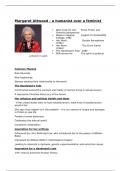
Margaret Attwood – a humanist over a feminist
Best know for her: Prose Fiction and
Feminist perspective
Master’s degree: English Lit at Radcliffe
College, 1962
Her Work: Double Persephone
(1961)
Her Work: The Circle Game
(1964)
The Handmaid’s Tale: 1985
PEN winner for The spirit of political
activism in work
Common Themes
Role Reversal
New beginnings
Women seeking their relationship to the world
The Handmaid’s Tale
Constructed around the concept and reality of women living in sexual slavery
A repressive Christian theocracy of the future.
Her religious and political beliefs and ideas
‘ if the united states were to have totalitarianism, what kind of totalitarianism
would it be’
She says that religion isn’t the problem – it is our notions of utopia and dystopia,
in fiction in real life.
Ponders human behaviour
Celebrates the natural world
Condemns materialism
Inspiration for her writings
Influenced by critic Northrop Frye, who introduced her to the poetry of William
Blake
Impressed by William Blake’s mythological imagery
Leading to interests in dystopia, genetic experimentation and extinction issues
Inspiration for a Handmaid’s tale
17th century American Puritan Theory
,Utopias and Dystopias
The political climate of the early 1980s
Dystopia Utopia
- Everything that society - Considered an ideally
isn’t perfect place socially,
- Makes the bad look politically and morally
worse - The idea derived from a
- Shows we need balance 1516 book by Sir
in society Thomas More
- Escapism - Imaginary
- Idealism and perfection
Dystopian Literature
Dystopia in Handmaid’s
,Chapter 1
General Points
- Tone of nostalgia and loss
- We hope that the present of the book is the future and that it is
better
- Sense of menace and threat
- 3 time frames (past, more distant past and now)
- Claustrophobic
- False sense of security
- Religious connotations – ‘guardians’ and ‘angels’
Themes
- Dystopia
- Autonomy
- Female experience
- Sexual experience
- Inequality of power
Setting
- Disorientations
- Unclear of time, or type of place
- Fluctuating perspective
- Don’t know what to expectations
Summary
Flashback of The Red Centre
, ‘a balcony ran around the room, for the spectators’
Double-meaning, foreshadowing – basketball watchers vs watchers of
birth
Double Flashback
‘like an afterimage’ ‘the music lingered’ ‘undercurrent of drums’
Flashback of her reminiscing in the centre whilst reflecting on the centre
in the present
Gender Roles established
‘electric cattle prods slung on thongs from their leather belts. No guns
though… Guns were for guards, specially picked by the angels’
Men had ultimate power – reflection of men with guns in the US and the
impact
‘we still had our bodies. That was our fantasy’
Questioning their human rights
Chapter 2
The novel shifts into the present and the commencement of a shopping
trip that will last for several chapters.
Offred has been stationed as a Handmaid in the Commander's home for
five weeks. Offred describes her white bedroom, which contains a window
and minimal furniture—a bed, a chair, and a picture of flowers. All items
that might be used as weapons or to assist in suicide have been elimin-
ated. Offred acknowledges the appeal of suicide but asserts her will to
live. She dresses in clothes that cover all parts of her body and that are al-
most entirely red; the white wings of a headdress obscure her face, limit-
ing her ability to see and be seen. Carrying a shopping basket, she enters
the kitchen, where Rita, a Martha dressed in green, is making bread.
Without smiling or other friendly gestures, Rita gives Offred tokens with
pictured foods to use for shopping. Offred describes eavesdropping on
Rita and Cora—the maid and another Martha—and hearing them gossip.
She briefly entertains a daydream in which she, Rita, and Cora chat about
their lives over coffee. She takes the tokens, listens to Rita's instructions
about which foods to buy, and leaves.
Best know for her: Prose Fiction and
Feminist perspective
Master’s degree: English Lit at Radcliffe
College, 1962
Her Work: Double Persephone
(1961)
Her Work: The Circle Game
(1964)
The Handmaid’s Tale: 1985
PEN winner for The spirit of political
activism in work
Common Themes
Role Reversal
New beginnings
Women seeking their relationship to the world
The Handmaid’s Tale
Constructed around the concept and reality of women living in sexual slavery
A repressive Christian theocracy of the future.
Her religious and political beliefs and ideas
‘ if the united states were to have totalitarianism, what kind of totalitarianism
would it be’
She says that religion isn’t the problem – it is our notions of utopia and dystopia,
in fiction in real life.
Ponders human behaviour
Celebrates the natural world
Condemns materialism
Inspiration for her writings
Influenced by critic Northrop Frye, who introduced her to the poetry of William
Blake
Impressed by William Blake’s mythological imagery
Leading to interests in dystopia, genetic experimentation and extinction issues
Inspiration for a Handmaid’s tale
17th century American Puritan Theory
,Utopias and Dystopias
The political climate of the early 1980s
Dystopia Utopia
- Everything that society - Considered an ideally
isn’t perfect place socially,
- Makes the bad look politically and morally
worse - The idea derived from a
- Shows we need balance 1516 book by Sir
in society Thomas More
- Escapism - Imaginary
- Idealism and perfection
Dystopian Literature
Dystopia in Handmaid’s
,Chapter 1
General Points
- Tone of nostalgia and loss
- We hope that the present of the book is the future and that it is
better
- Sense of menace and threat
- 3 time frames (past, more distant past and now)
- Claustrophobic
- False sense of security
- Religious connotations – ‘guardians’ and ‘angels’
Themes
- Dystopia
- Autonomy
- Female experience
- Sexual experience
- Inequality of power
Setting
- Disorientations
- Unclear of time, or type of place
- Fluctuating perspective
- Don’t know what to expectations
Summary
Flashback of The Red Centre
, ‘a balcony ran around the room, for the spectators’
Double-meaning, foreshadowing – basketball watchers vs watchers of
birth
Double Flashback
‘like an afterimage’ ‘the music lingered’ ‘undercurrent of drums’
Flashback of her reminiscing in the centre whilst reflecting on the centre
in the present
Gender Roles established
‘electric cattle prods slung on thongs from their leather belts. No guns
though… Guns were for guards, specially picked by the angels’
Men had ultimate power – reflection of men with guns in the US and the
impact
‘we still had our bodies. That was our fantasy’
Questioning their human rights
Chapter 2
The novel shifts into the present and the commencement of a shopping
trip that will last for several chapters.
Offred has been stationed as a Handmaid in the Commander's home for
five weeks. Offred describes her white bedroom, which contains a window
and minimal furniture—a bed, a chair, and a picture of flowers. All items
that might be used as weapons or to assist in suicide have been elimin-
ated. Offred acknowledges the appeal of suicide but asserts her will to
live. She dresses in clothes that cover all parts of her body and that are al-
most entirely red; the white wings of a headdress obscure her face, limit-
ing her ability to see and be seen. Carrying a shopping basket, she enters
the kitchen, where Rita, a Martha dressed in green, is making bread.
Without smiling or other friendly gestures, Rita gives Offred tokens with
pictured foods to use for shopping. Offred describes eavesdropping on
Rita and Cora—the maid and another Martha—and hearing them gossip.
She briefly entertains a daydream in which she, Rita, and Cora chat about
their lives over coffee. She takes the tokens, listens to Rita's instructions
about which foods to buy, and leaves.


