Evaluating the Person of Jesus Christ
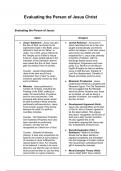
Evaluating the Person of Jesus:
Agree Disagree
● Jesus’ Statement - Jesus was also ● Jewish Reformer - Accounts of
the Son of God, as shown by his Jesus described him as a man who
statements made in the Bible. Jesus taught charismatically and tried to
referred to God as his ‘father’ or reform his religion. In his time, Jesus
‘abba’. As a child, Jesus referred to was known as a Rabbi and well
the Temple as his Father’s House respected for it. Jesus was primarily
(Luke 2). Jesus stated plainly to the a teacher of wisdom, with his
members of the Sanhedrin that he teachings based around love,
was indeed the Son of God. Jesus repentance, forgiveness and inner
gets his wisdom from his divinity. purity. E.g. Sermon on the Mount
(lustful thoughts as bad as adultery,
Counter : Jewish Interpretation, came to fulfil the law), Parable of
Jews at the time would have Lost Son (forgiveness), Parable of
interpreted ‘Son of God’ to mean Sheep and Goats (care for poor)
someone specially chosen by God
such as Moses. ● Messianic Prophecies - Jesus
understood himself as a prophet and
● Miracles - Jesus performed a Messianic figure. The Old Testament
number of miracles, including the did not suggest that the Messiah
Feeding of the 5000, walking on would be divine. Muslims see Jesus
water, the resurrection of Lazarus, as a prophet, as well as being a
and his own resurrection. Only teacher of wisdom, but notably not
someone with divine power would the Son of God.
be able to perform these miracles,
particularly self-resurrection. Jesus ● Development Argument (Hick) -
must’ve been aware of his divinity Jesus only self-identifies as the Son
because he used it to perform of God in John’s Gospel, agreed to
countless miracles. be the latest added. Hick argues
that Jesus’ recognition as the Son of
Counter : Old Testament Prophets, God was a later human invention.
Old Testament Prophets have also He also applied this to the
been reported as performing Incarnation arguing that Jesus was
miracles, yet they are not the ‘embodiment of God’s love’.
recognised as a literal son of God.
● Demythologisation (Hick +
Counter : Disbelief of Miracles Bultmann) - Myths in the Bible
(Hume), A wise man proportions his should not be taken literally or
belief to the evidence and evidence rejected completely, but translated
of miracles is never sufficient for into the language of modern culture.
rational belief in God. For miracles The resurrection symbolised God’s
to be believed, it needs to be more gift of renewal for example
absurd to say that the laws of nature
were preserved than to say that they ● Moral Exemplar Theory (Hick) -
were broken in a given instance. Jesus’ death didn’t have a literal
Evaluating the Person of Jesus:
Agree Disagree
● Jesus’ Statement - Jesus was also ● Jewish Reformer - Accounts of
the Son of God, as shown by his Jesus described him as a man who
statements made in the Bible. Jesus taught charismatically and tried to
referred to God as his ‘father’ or reform his religion. In his time, Jesus
‘abba’. As a child, Jesus referred to was known as a Rabbi and well
the Temple as his Father’s House respected for it. Jesus was primarily
(Luke 2). Jesus stated plainly to the a teacher of wisdom, with his
members of the Sanhedrin that he teachings based around love,
was indeed the Son of God. Jesus repentance, forgiveness and inner
gets his wisdom from his divinity. purity. E.g. Sermon on the Mount
(lustful thoughts as bad as adultery,
Counter : Jewish Interpretation, came to fulfil the law), Parable of
Jews at the time would have Lost Son (forgiveness), Parable of
interpreted ‘Son of God’ to mean Sheep and Goats (care for poor)
someone specially chosen by God
such as Moses. ● Messianic Prophecies - Jesus
understood himself as a prophet and
● Miracles - Jesus performed a Messianic figure. The Old Testament
number of miracles, including the did not suggest that the Messiah
Feeding of the 5000, walking on would be divine. Muslims see Jesus
water, the resurrection of Lazarus, as a prophet, as well as being a
and his own resurrection. Only teacher of wisdom, but notably not
someone with divine power would the Son of God.
be able to perform these miracles,
particularly self-resurrection. Jesus ● Development Argument (Hick) -
must’ve been aware of his divinity Jesus only self-identifies as the Son
because he used it to perform of God in John’s Gospel, agreed to
countless miracles. be the latest added. Hick argues
that Jesus’ recognition as the Son of
Counter : Old Testament Prophets, God was a later human invention.
Old Testament Prophets have also He also applied this to the
been reported as performing Incarnation arguing that Jesus was
miracles, yet they are not the ‘embodiment of God’s love’.
recognised as a literal son of God.
● Demythologisation (Hick +
Counter : Disbelief of Miracles Bultmann) - Myths in the Bible
(Hume), A wise man proportions his should not be taken literally or
belief to the evidence and evidence rejected completely, but translated
of miracles is never sufficient for into the language of modern culture.
rational belief in God. For miracles The resurrection symbolised God’s
to be believed, it needs to be more gift of renewal for example
absurd to say that the laws of nature
were preserved than to say that they ● Moral Exemplar Theory (Hick) -
were broken in a given instance. Jesus’ death didn’t have a literal