
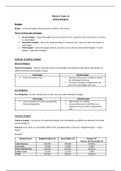
Theme 2 Topic 11
Setting Budgets
Budgets
Budget – a financial target a business aims to achieve in the future
There are three types of budget:
1. Income Budget – shows the target income of a business over a period of time, also known as revenue
or sales budget
2. Expenditure Budget – shows the target spending of a business over a period of time, also known as
cost budget
3. Profit Budget – shows the target profit of a business over a period of time (Profit Budget = Income
Budget – Expenditure Budget)
Methods of Setting a Budget
Historical Budgets
Historical Budgeting – involves using the previous years budget and updating it with minor adjustments for
inflation and other forecastable changes
Advantages Disadvantages
Quick and simple to do Assumes that business conditions remain
the unchanged each year
Can lead to wastage if departments are
given the same budget each year
Zero Budgeting
Zero Budgeting – involves starting from scratch each year when setting the budget
Advantages Disadvantages
If done properly, it is more accurate than Takes longer to complete
historical budgeting Increased demand on staff time is an
expensive resource with an opportunity
cost
Variance Analysis
Variance Analysis – the process of monitoring budgets and investigating any differences between forecasted
and actual figures
Variance occurs when an actual figure differs from a budgeted figure (Variance = Budgeted Figure – Actual
Figure)
Example:
Revenue/Cost Budgeted Figure (£) Actual Figure (£) Variance (£)
Adverse (A)/Favourable (F)
Sales Revenue 840,000 790,000 50,000 A
Fuel Costs 75,000 70,000 5,000 F
Raw Material Costs 245,000 265,000 20,000 A
Labour Costs 115,000 112,000 3,000 F
Profit 405,000 343,000 62,000 A
Setting Budgets
Budgets
Budget – a financial target a business aims to achieve in the future
There are three types of budget:
1. Income Budget – shows the target income of a business over a period of time, also known as revenue
or sales budget
2. Expenditure Budget – shows the target spending of a business over a period of time, also known as
cost budget
3. Profit Budget – shows the target profit of a business over a period of time (Profit Budget = Income
Budget – Expenditure Budget)
Methods of Setting a Budget
Historical Budgets
Historical Budgeting – involves using the previous years budget and updating it with minor adjustments for
inflation and other forecastable changes
Advantages Disadvantages
Quick and simple to do Assumes that business conditions remain
the unchanged each year
Can lead to wastage if departments are
given the same budget each year
Zero Budgeting
Zero Budgeting – involves starting from scratch each year when setting the budget
Advantages Disadvantages
If done properly, it is more accurate than Takes longer to complete
historical budgeting Increased demand on staff time is an
expensive resource with an opportunity
cost
Variance Analysis
Variance Analysis – the process of monitoring budgets and investigating any differences between forecasted
and actual figures
Variance occurs when an actual figure differs from a budgeted figure (Variance = Budgeted Figure – Actual
Figure)
Example:
Revenue/Cost Budgeted Figure (£) Actual Figure (£) Variance (£)
Adverse (A)/Favourable (F)
Sales Revenue 840,000 790,000 50,000 A
Fuel Costs 75,000 70,000 5,000 F
Raw Material Costs 245,000 265,000 20,000 A
Labour Costs 115,000 112,000 3,000 F
Profit 405,000 343,000 62,000 A


