

Theme 1 Topic 6
Organisational Structure
Organisational Design
Organisational Design – creating the formal hierarchy that establishes who is answerable to who throughout
the organisation
Organisational Structures
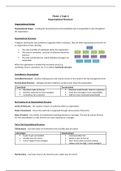
A diagram showing the way authority is organised within a business. They are often represented in the form of
an organisational chart showing:
The roles and titles of individuals within the organisation
The chain of command – the lines of authority within the
business
The units and divisions for which individual managers are
responsible
When the organisation is divided into functional areas (e.g.
marketing, finance, operations, etc.) it is called a functional structure.
Centralised or Decentralised
Centralised Structure – decision making power and control remains in the hands of the top management level.
Decentralised Structure – delegates decision making to workers lower down the organisation
Centralised Decentralised
Decisions made at the top Decisions made locally, closer to customers
Restricts authority for local managers Gives local managers more responsibility
Consistency for customers Staff are more motivated (potentially)
Key Features of an Organisational Structure
Levels of Hierarchy – the number of layers of authority within an organisation
Chain of Command – shows how authority is organised through various levels of hierarchy
Span of Control – the number of subordinates reporting directly to a manager. This may be narrow (if there
are few subordinates) or wide (if there are many reporting to a manager.
Tall or Flat Organisational Structure
Tall Structure – has more layers in its hierarchy and a smaller span of control
Advantages Disadvantages
Easier to get a promotion Communication lost
Smaller span of control Harder to get to the top
Lots of support from manager Don’t know what everyone is doing
Labour costs are high – more managers
Flat Structure – has fewer layers in its hierarchy and a wider span of control
Organisational Structure
Organisational Design
Organisational Design – creating the formal hierarchy that establishes who is answerable to who throughout
the organisation
Organisational Structures
A diagram showing the way authority is organised within a business. They are often represented in the form of
an organisational chart showing:
The roles and titles of individuals within the organisation
The chain of command – the lines of authority within the
business
The units and divisions for which individual managers are
responsible
When the organisation is divided into functional areas (e.g.
marketing, finance, operations, etc.) it is called a functional structure.
Centralised or Decentralised
Centralised Structure – decision making power and control remains in the hands of the top management level.
Decentralised Structure – delegates decision making to workers lower down the organisation
Centralised Decentralised
Decisions made at the top Decisions made locally, closer to customers
Restricts authority for local managers Gives local managers more responsibility
Consistency for customers Staff are more motivated (potentially)
Key Features of an Organisational Structure
Levels of Hierarchy – the number of layers of authority within an organisation
Chain of Command – shows how authority is organised through various levels of hierarchy
Span of Control – the number of subordinates reporting directly to a manager. This may be narrow (if there
are few subordinates) or wide (if there are many reporting to a manager.
Tall or Flat Organisational Structure
Tall Structure – has more layers in its hierarchy and a smaller span of control
Advantages Disadvantages
Easier to get a promotion Communication lost
Smaller span of control Harder to get to the top
Lots of support from manager Don’t know what everyone is doing
Labour costs are high – more managers
Flat Structure – has fewer layers in its hierarchy and a wider span of control


