Section B
Memory:
Memory is the ability to store information so that it can be used later.
Memory is a process through which our brain encodes, stores, retrieves
information.
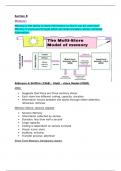
Atkinson & Shiffrin (1968) - Multi – store Model (MSM)
MSM:
Suggests that there are three memory stores
Each store has different coding, capacity, duration
Information moves between the stores through either attention,
rehearsal, retrieval
Memory Stores: sensory register
Sensory Memory
Information collected by senses
Duration: less than half a second
Large capacity
Coding is dependent on senses involved
Visual: iconic store
Auditory: echoing
Transfer process: attention
Short Term Memory (temporary store):
, Limited capacity (5-9 items of info)
Acoustic coding
Duration: about 18secs
Maintenance Rehearsal: repeating info to self repeatedly transfers info
to LTM
Long Term Memory (potentially permanent store):
Unlimited capacity
Semantic coding
Duration of a lifetime
To recall information from LTM, it must first be transferred back into
STM in a process called retrieval.
Evaluations:
Strength: research support for sensory register. Sperling (1960) – sensory
memory store
Limitation of the MSM is that there is research that indicates there are more
than one STM store. Case study- Shallice & Warrington (1970) found that
there are more than one STM stores. KF had amnesia following a motorcycle
incident. They found that KF’s STM for digits was very poor when they were
read aloud to him, but recall was much better when he read the digits
himself, implying there must be more than one STM store. Further studies
show that there could be a STM store for non-verbal sounds (noises). Thus,
MSM is too simplistic in claiming that there is just one STM store processing
different types of information.
Limitation, MSM is too simplistic in the processes of memory. Craik & Watkins
(1973) found that the type of rehearsal is more important than the amount.
E.g. elaborative rehearsal occurs when linking info to existing knowledge
which is needed in LTM. Means that info can be transferred to LTM without
prolonged rehearsal, thus MSM does not fully explain how long-term storage
is achieved.
Types of LTM:
Episodic: Memory for events of your life (experiences), time stamped, must
be consciously recalled e.g. birthdays
Semantic: Memory for meaning (knowledge), not time stamped, more
complex than just ‘facts’ e.g. knowing the capital of France
Memory:
Memory is the ability to store information so that it can be used later.
Memory is a process through which our brain encodes, stores, retrieves
information.
Atkinson & Shiffrin (1968) - Multi – store Model (MSM)
MSM:
Suggests that there are three memory stores
Each store has different coding, capacity, duration
Information moves between the stores through either attention,
rehearsal, retrieval
Memory Stores: sensory register
Sensory Memory
Information collected by senses
Duration: less than half a second
Large capacity
Coding is dependent on senses involved
Visual: iconic store
Auditory: echoing
Transfer process: attention
Short Term Memory (temporary store):
, Limited capacity (5-9 items of info)
Acoustic coding
Duration: about 18secs
Maintenance Rehearsal: repeating info to self repeatedly transfers info
to LTM
Long Term Memory (potentially permanent store):
Unlimited capacity
Semantic coding
Duration of a lifetime
To recall information from LTM, it must first be transferred back into
STM in a process called retrieval.
Evaluations:
Strength: research support for sensory register. Sperling (1960) – sensory
memory store
Limitation of the MSM is that there is research that indicates there are more
than one STM store. Case study- Shallice & Warrington (1970) found that
there are more than one STM stores. KF had amnesia following a motorcycle
incident. They found that KF’s STM for digits was very poor when they were
read aloud to him, but recall was much better when he read the digits
himself, implying there must be more than one STM store. Further studies
show that there could be a STM store for non-verbal sounds (noises). Thus,
MSM is too simplistic in claiming that there is just one STM store processing
different types of information.
Limitation, MSM is too simplistic in the processes of memory. Craik & Watkins
(1973) found that the type of rehearsal is more important than the amount.
E.g. elaborative rehearsal occurs when linking info to existing knowledge
which is needed in LTM. Means that info can be transferred to LTM without
prolonged rehearsal, thus MSM does not fully explain how long-term storage
is achieved.
Types of LTM:
Episodic: Memory for events of your life (experiences), time stamped, must
be consciously recalled e.g. birthdays
Semantic: Memory for meaning (knowledge), not time stamped, more
complex than just ‘facts’ e.g. knowing the capital of France