Psychology Revision
Paper 1
Section A
Social Influence:
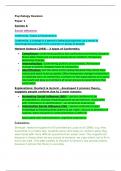
Conformity: Types & Explanations:
Conformity: a change in a person’s behaviour/opinions as a result of
real/imagined pressure from a person or group of people.
Herbert Kelman (1958) – 3 types of Conformity:
Compliance: Conforming publicly but continuing to privately disagree.
Stops when there are no group pressures to conform. Temporary
behaviour change.
Internalisation: Conforming publicly and privately. Permanent
change in beliefs. Deepest form of conformity.
Identification: Act the same as the group because they share their
values and want to be accepted. Often temporary change in behaviour.
A moderate form of conformity. Conform to the expectations of a social
role (parts ppl play as members of social groups & expectations that
come with)
Explanations: Deutsch & Gerard – developed 2 process theory,
suggests people conform due to 2 main reasons:
Normative Social Influence (NSI) – person conforms to be
accepted/fit in. Socially rewarding/avoid social rejection. Associated
with compliance & identification – an emotional experience.
Informative Social Influence (ISI) – person conforms to gain
knowledge & following what seems to be ‘right’. Occurs in presence of
experts, when situation is ambivalent/task is difficult.
Associated with internalisation- cognitive experience
Evaluations:
Strength: research support for ISI provided by Lucas et al (2006), e.g. they
found that in a maths test, students were more likely to conform when they
were faced with more difficult questions than easier ones. This supports ISI
because it shows when we are unsure of answers, we copy others not to fit in
but to be right. This adds validity to Deutsch & Gerard’s two process theory
because it proves the theory is accurate.
, Limitation of NSI: there are individual differences towards NSI. Research has
shown that individuals do not react to NSI in the same way. E.g. McGhee &
Teevan (1967) found that students who were in high need of affiliation were
more likely to conform. This finding is a weakness because it suggests that
not everyone is easily influenced by NSI, those who care less about being
liked are less affected by NSI. Thus, NSI as an explanation of conformity is
not universal as it cannot be applied to everyone.
Strength of NSI: there is research to support NSI as an explanation of
conformity. Asch found that many of his pps went along with a clearly wrong
answer just because other people did. Pps felt self-conscious giving the
correct answer as they were afraid of disapproval. This shows that some
conformity is the result of a need not to appear foolish/others had a desire
not to be rejected. This is a strength because it shows NSI is a valid
explanation of at least some conformity behaviour.
Solomon Asch (1951) – Conformity- ‘Lines’
Lab experiment, 50 male students, ‘vision test’
Naive participant (gave answer last) with 7 confederates (confederates
agreed in advance what their response would be)
At the start, all pps gave correct answers. Few rounds later,
confederates started to provide unanimously incorrect answers.
18 trials – gave wrong answers in 12 trials (critical trials)
Controlled Variables:
Group size: bigger the majority group, the more people conformed
but only to a certain point.
Unanimity: found that presence of just 1 confederate that goes
against majority choice can reduce conformity as much as 80%.
Absence of group unanimity lowers overall conformity as pps feel less
need for social approval.
Task difficultly: when difficulty increase, conformity increases.
Findings:
Percentage that conformed: 32% (⅓) – about 75% of pps conformed at
least once.
Percentage that didn’t conform: 25%
Paper 1
Section A
Social Influence:
Conformity: Types & Explanations:
Conformity: a change in a person’s behaviour/opinions as a result of
real/imagined pressure from a person or group of people.
Herbert Kelman (1958) – 3 types of Conformity:
Compliance: Conforming publicly but continuing to privately disagree.
Stops when there are no group pressures to conform. Temporary
behaviour change.
Internalisation: Conforming publicly and privately. Permanent
change in beliefs. Deepest form of conformity.
Identification: Act the same as the group because they share their
values and want to be accepted. Often temporary change in behaviour.
A moderate form of conformity. Conform to the expectations of a social
role (parts ppl play as members of social groups & expectations that
come with)
Explanations: Deutsch & Gerard – developed 2 process theory,
suggests people conform due to 2 main reasons:
Normative Social Influence (NSI) – person conforms to be
accepted/fit in. Socially rewarding/avoid social rejection. Associated
with compliance & identification – an emotional experience.
Informative Social Influence (ISI) – person conforms to gain
knowledge & following what seems to be ‘right’. Occurs in presence of
experts, when situation is ambivalent/task is difficult.
Associated with internalisation- cognitive experience
Evaluations:
Strength: research support for ISI provided by Lucas et al (2006), e.g. they
found that in a maths test, students were more likely to conform when they
were faced with more difficult questions than easier ones. This supports ISI
because it shows when we are unsure of answers, we copy others not to fit in
but to be right. This adds validity to Deutsch & Gerard’s two process theory
because it proves the theory is accurate.
, Limitation of NSI: there are individual differences towards NSI. Research has
shown that individuals do not react to NSI in the same way. E.g. McGhee &
Teevan (1967) found that students who were in high need of affiliation were
more likely to conform. This finding is a weakness because it suggests that
not everyone is easily influenced by NSI, those who care less about being
liked are less affected by NSI. Thus, NSI as an explanation of conformity is
not universal as it cannot be applied to everyone.
Strength of NSI: there is research to support NSI as an explanation of
conformity. Asch found that many of his pps went along with a clearly wrong
answer just because other people did. Pps felt self-conscious giving the
correct answer as they were afraid of disapproval. This shows that some
conformity is the result of a need not to appear foolish/others had a desire
not to be rejected. This is a strength because it shows NSI is a valid
explanation of at least some conformity behaviour.
Solomon Asch (1951) – Conformity- ‘Lines’
Lab experiment, 50 male students, ‘vision test’
Naive participant (gave answer last) with 7 confederates (confederates
agreed in advance what their response would be)
At the start, all pps gave correct answers. Few rounds later,
confederates started to provide unanimously incorrect answers.
18 trials – gave wrong answers in 12 trials (critical trials)
Controlled Variables:
Group size: bigger the majority group, the more people conformed
but only to a certain point.
Unanimity: found that presence of just 1 confederate that goes
against majority choice can reduce conformity as much as 80%.
Absence of group unanimity lowers overall conformity as pps feel less
need for social approval.
Task difficultly: when difficulty increase, conformity increases.
Findings:
Percentage that conformed: 32% (⅓) – about 75% of pps conformed at
least once.
Percentage that didn’t conform: 25%