

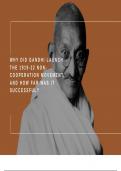
WHY DID GANDHI LAUNCH
THE 1919-22 NON-
C O O P E R AT I O N M O V E M E N T,
AND H OW FA R WA S IT
SUCCESSFUL?
, R E A S O N S F O R L A U N C H I N G T H E NO N - C O O P E RAT I V E M OV E M E N T
1. Protest against repressive laws:
The Rowlatt Act, passed in March 1919, allowed for the arrest and detention of individuals without trial, leading to widespread
discontent among Indians.
Press Act (1910): The Press Act of 1910 was another repressive law that gave the British authorities the power to censor and con
the press. It was aimed at suppressing nationalist sentiments and limiting the publication of materials that criticized British rule. Th
act also gave the British rights to imprison and execute anyone who writes radical articles in the newspapers.
2. Jallianwala Bagh Massacre: The Jallianwala Bagh massacre occurred on April 13, 1919, in Amritsar, when British troops, under the
command of General Dyer, fired on a peaceful gathering of thousands of Indians, resulting in hundreds of casualties. The brutal massacre in
Amritsar was a turning point that deeply shocked and angered the Indian population. Gandhi, already advocating non-violent resistance
this event as a stark example of British brutality and exploitation, providing further incentive to launch a non-cooperation movemen
3. Demand for Swaraj (Self-Rule): Gandhi aimed at achieving Swaraj or self-rule for India. The Non-Cooperation Movement was a ste
towards this goal, reflecting the growing desire among Indians for independence from British colonial rule.
4. Mass Participation: Gandhi envisioned the movement as a mass movement involving people from various backgrounds, including
peasants, workers, students, and professionals. The idea was to create a united front against British rule through non-violent means
THE 1919-22 NON-
C O O P E R AT I O N M O V E M E N T,
AND H OW FA R WA S IT
SUCCESSFUL?
, R E A S O N S F O R L A U N C H I N G T H E NO N - C O O P E RAT I V E M OV E M E N T
1. Protest against repressive laws:
The Rowlatt Act, passed in March 1919, allowed for the arrest and detention of individuals without trial, leading to widespread
discontent among Indians.
Press Act (1910): The Press Act of 1910 was another repressive law that gave the British authorities the power to censor and con
the press. It was aimed at suppressing nationalist sentiments and limiting the publication of materials that criticized British rule. Th
act also gave the British rights to imprison and execute anyone who writes radical articles in the newspapers.
2. Jallianwala Bagh Massacre: The Jallianwala Bagh massacre occurred on April 13, 1919, in Amritsar, when British troops, under the
command of General Dyer, fired on a peaceful gathering of thousands of Indians, resulting in hundreds of casualties. The brutal massacre in
Amritsar was a turning point that deeply shocked and angered the Indian population. Gandhi, already advocating non-violent resistance
this event as a stark example of British brutality and exploitation, providing further incentive to launch a non-cooperation movemen
3. Demand for Swaraj (Self-Rule): Gandhi aimed at achieving Swaraj or self-rule for India. The Non-Cooperation Movement was a ste
towards this goal, reflecting the growing desire among Indians for independence from British colonial rule.
4. Mass Participation: Gandhi envisioned the movement as a mass movement involving people from various backgrounds, including
peasants, workers, students, and professionals. The idea was to create a united front against British rule through non-violent means


