Mary I Religion and Economy
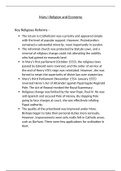
Key Religious Reforms –
The return to Catholicism was a priority and appeared simple
with the level of popular support. However, Protestantism
remained a substantial minority, most importantly in London.
The reformed church was protected by Statute Laws, and a
reversal of religious change could risk alienating the nobility
who had gained ex-monastic land.
In Mary’s first parliament (October 1553), the religious laws
passed by Edward were reversed, and the order of service at
the end of Henry VIII’s reign was reinstated. However, she was
forced to retain the superiority of divine law over statute law.
Mary’s third Parliament (November 1554- January 1555)
reversed Henry’s Act of Attainder against Papal legate Reginald
Pole. The Act of Repeal revoked the Royal Supremacy.
Religious change was limited by the new Pope, Paul IV. He was
anti-Spanish and accused Pole of Heresy. By stopping Pole
going to face charges at court, she was effectively refuting
Papal authority.
The quality of the priesthood was improved under Mary.
Bishops began to take their personal duties more seriously.
However, improvements were only really felt in Catholic areas,
such as Durham. There were few applications for ordination in
Kent.
Key Religious Reforms –
The return to Catholicism was a priority and appeared simple
with the level of popular support. However, Protestantism
remained a substantial minority, most importantly in London.
The reformed church was protected by Statute Laws, and a
reversal of religious change could risk alienating the nobility
who had gained ex-monastic land.
In Mary’s first parliament (October 1553), the religious laws
passed by Edward were reversed, and the order of service at
the end of Henry VIII’s reign was reinstated. However, she was
forced to retain the superiority of divine law over statute law.
Mary’s third Parliament (November 1554- January 1555)
reversed Henry’s Act of Attainder against Papal legate Reginald
Pole. The Act of Repeal revoked the Royal Supremacy.
Religious change was limited by the new Pope, Paul IV. He was
anti-Spanish and accused Pole of Heresy. By stopping Pole
going to face charges at court, she was effectively refuting
Papal authority.
The quality of the priesthood was improved under Mary.
Bishops began to take their personal duties more seriously.
However, improvements were only really felt in Catholic areas,
such as Durham. There were few applications for ordination in
Kent.