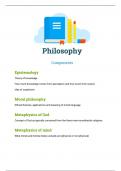
Philosophy
Components
Epistemology
Theory of knowledge
How much knowledge comes from perception and how much from reason
Idea of scepticism
Moral philosophy
Ethical theories, applications and meaning of moral language
Metaphysics of God
Concept of God as typically conceived from the three main monotheistic religions
Metaphysics of mind
What minds and mental states actually are (physical or non-physical)
, 2
Epistemology
Knowledge is justified true belief
Gettier cases :
- An individual has a justified true belief but that is not knowledge.
- define ‘knowledge’ in a way that rules out Gettier cases whilst still capturing all
instances of what we consider to be knowledge.
3 kinds of knowledge:
- Ability : how
- Acquaintance: of
- Propositional : that
Tripartite definition
Justified true belief = propositional knowledge
Theaetetus : Plato says knowledge is “true belief accompanied by a rational account”
Provide necessary and sufficient conditions
Eg. justification, truth and belief
Guessing is not properly justified and would not count as knowledge
But they may not be sufficient conditions as it would mean that everything that is a
justified true belief will be knowledge, however this is challenged by Gettier cases.
, 3
Gettier case 1
a belief that fails to count as knowledge because the justified belief is only true as a
result of luck.
Tripartite definition of knowledge is not sufficient b/C you can have a justified true belief
that is not knowledge
Gettier case 2
relies on the logical principle of disjunction introduction (or, more simply, addition)
if you have a true statement and add “or some other statement” then the full
statement (i.e. “true statement or some other statement”) is also true.
because the or means only one part has to be true
Despite being a justified true belief, it does not count as knowledge b/C it was just luck
that led it to being correct.
Tripartite def of knowledge not sufficient
1/+ conditions may not be necessary :
Components
Epistemology
Theory of knowledge
How much knowledge comes from perception and how much from reason
Idea of scepticism
Moral philosophy
Ethical theories, applications and meaning of moral language
Metaphysics of God
Concept of God as typically conceived from the three main monotheistic religions
Metaphysics of mind
What minds and mental states actually are (physical or non-physical)
, 2
Epistemology
Knowledge is justified true belief
Gettier cases :
- An individual has a justified true belief but that is not knowledge.
- define ‘knowledge’ in a way that rules out Gettier cases whilst still capturing all
instances of what we consider to be knowledge.
3 kinds of knowledge:
- Ability : how
- Acquaintance: of
- Propositional : that
Tripartite definition
Justified true belief = propositional knowledge
Theaetetus : Plato says knowledge is “true belief accompanied by a rational account”
Provide necessary and sufficient conditions
Eg. justification, truth and belief
Guessing is not properly justified and would not count as knowledge
But they may not be sufficient conditions as it would mean that everything that is a
justified true belief will be knowledge, however this is challenged by Gettier cases.
, 3
Gettier case 1
a belief that fails to count as knowledge because the justified belief is only true as a
result of luck.
Tripartite definition of knowledge is not sufficient b/C you can have a justified true belief
that is not knowledge
Gettier case 2
relies on the logical principle of disjunction introduction (or, more simply, addition)
if you have a true statement and add “or some other statement” then the full
statement (i.e. “true statement or some other statement”) is also true.
because the or means only one part has to be true
Despite being a justified true belief, it does not count as knowledge b/C it was just luck
that led it to being correct.
Tripartite def of knowledge not sufficient
1/+ conditions may not be necessary :