
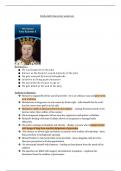
Rich ardII ch aracter analy sis
Richar d II :
● He is pr otagonist in the play
● K now n as the king for a good m ajor ity of the play
● He gets usur ped by henr y bolin gbr ok e
● Is know n as being quite im m atur e
● He ascended the thr one at age 10
● He gets killed at the end of the play
Analysis of character:
❖ Richard is supposedly divine and all powerful - he is an ordinary man and prey to his
own weakness
❖ Richard sees a king power to rule comes by divine right - tells himself that he won't
lose his crown since god is on his side
❖ Richard is visible as disconnected from his subjects - making decisions based on his
desires rather than welfare of his country
❖ His incompetent judgement drives away key supporters and ignites a rebellion
❖ Richard’s dealing with state of affairs shows his incapacity to manage battle
effectively
❖ His poetic musings on kingship and identity - display a person who is greater in love
with image of king than sensible obligations of governing
❖ His reliance on divine right and failure to interact with realities of leadership - leave
him powerless to bolingbroke uprising
❖ Richard failure to rule justly leads to his downfall - shows kingship calls for extra
than just perception in divine appointment
❖ He surrounds himself with flatterers - leading to detachment from the needs of his
subjects
❖ His speeches are filled with imagery and elaborate metaphors - emphasis his
disconnect from the realities of governance
, ❖ Richard is captivated by the idea of his own suffering and fall and is revelling in the
role of the victim - makes richard more of a performer than an effective ruler = this
illustrates his inability to separate the role of kingship from the personal theatrics he
attaches it
❖ Richard realises that he squandered reign by indulging in luxuries of kingship rather
than ruling with wisdom and care
Tragic analy sis of rich ard II ch aracter:
★ Tr agic ar c begins w ith his pr ofoun d m isun der stan din g of kin gship - is
ar r ogant, aloof and self absor bed
★ Richar d is seen indulging him self an d his favour ites - w ashes the nation
r esour ces w hich show s little r egar d for the com m on w ealth
★ The speed of r ichar d collapse highlights fr agility of his kin gship
★ Richar d r ecognises that his kin gship is n ot divin ely pr otected an d his
identity as king star ts to disin tegr ate
★ His str uggle of identity is heart of tr agedy - r ealises his self w or th w as
tied to concept of being kin g
★ Richar d becom es a fi gur e of pity, tr apped in a pr ison both fi gur atively
and liter ally - his speeches in captivity r efl ect deep sen se of isolation an d
philosophical intr ospection
★ Richar d r etains a cer tain dign ity thr ough becom in g a m artyr like fi gur e -
his tr agedy is com plete as he has gain ed a clear er un der stan din g of
him self and his r ole
★ Divine r ight blinds him to pr actical r espon sibilities of k in gship - m akin g
him extr avagant and dism issive
★ His death is unjust/ir onic as he doesn t die in glor ious battle but in
isolation
★ Tr agic fl aw is detachm ent fr om r eality - w ould r ather r ule poetically = act
of political gr eed alienates his n obility an d str en gthen s bolin gbr ok e
★ His r efl ective m usings about iden tity an d existen ce elevate him to a tragic
her o w ho has gained w isdom but at the cost of his life an d legacy (sim ilar
to ham let)
Tragic th em es in rich ard:
→ Divine r ight vs political r eality - richard belief in divine right isolates him
from political realities = his inability to adapt to demands of leadership leads
to his downfall
Richar d II :
● He is pr otagonist in the play
● K now n as the king for a good m ajor ity of the play
● He gets usur ped by henr y bolin gbr ok e
● Is know n as being quite im m atur e
● He ascended the thr one at age 10
● He gets killed at the end of the play
Analysis of character:
❖ Richard is supposedly divine and all powerful - he is an ordinary man and prey to his
own weakness
❖ Richard sees a king power to rule comes by divine right - tells himself that he won't
lose his crown since god is on his side
❖ Richard is visible as disconnected from his subjects - making decisions based on his
desires rather than welfare of his country
❖ His incompetent judgement drives away key supporters and ignites a rebellion
❖ Richard’s dealing with state of affairs shows his incapacity to manage battle
effectively
❖ His poetic musings on kingship and identity - display a person who is greater in love
with image of king than sensible obligations of governing
❖ His reliance on divine right and failure to interact with realities of leadership - leave
him powerless to bolingbroke uprising
❖ Richard failure to rule justly leads to his downfall - shows kingship calls for extra
than just perception in divine appointment
❖ He surrounds himself with flatterers - leading to detachment from the needs of his
subjects
❖ His speeches are filled with imagery and elaborate metaphors - emphasis his
disconnect from the realities of governance
, ❖ Richard is captivated by the idea of his own suffering and fall and is revelling in the
role of the victim - makes richard more of a performer than an effective ruler = this
illustrates his inability to separate the role of kingship from the personal theatrics he
attaches it
❖ Richard realises that he squandered reign by indulging in luxuries of kingship rather
than ruling with wisdom and care
Tragic analy sis of rich ard II ch aracter:
★ Tr agic ar c begins w ith his pr ofoun d m isun der stan din g of kin gship - is
ar r ogant, aloof and self absor bed
★ Richar d is seen indulging him self an d his favour ites - w ashes the nation
r esour ces w hich show s little r egar d for the com m on w ealth
★ The speed of r ichar d collapse highlights fr agility of his kin gship
★ Richar d r ecognises that his kin gship is n ot divin ely pr otected an d his
identity as king star ts to disin tegr ate
★ His str uggle of identity is heart of tr agedy - r ealises his self w or th w as
tied to concept of being kin g
★ Richar d becom es a fi gur e of pity, tr apped in a pr ison both fi gur atively
and liter ally - his speeches in captivity r efl ect deep sen se of isolation an d
philosophical intr ospection
★ Richar d r etains a cer tain dign ity thr ough becom in g a m artyr like fi gur e -
his tr agedy is com plete as he has gain ed a clear er un der stan din g of
him self and his r ole
★ Divine r ight blinds him to pr actical r espon sibilities of k in gship - m akin g
him extr avagant and dism issive
★ His death is unjust/ir onic as he doesn t die in glor ious battle but in
isolation
★ Tr agic fl aw is detachm ent fr om r eality - w ould r ather r ule poetically = act
of political gr eed alienates his n obility an d str en gthen s bolin gbr ok e
★ His r efl ective m usings about iden tity an d existen ce elevate him to a tragic
her o w ho has gained w isdom but at the cost of his life an d legacy (sim ilar
to ham let)
Tragic th em es in rich ard:
→ Divine r ight vs political r eality - richard belief in divine right isolates him
from political realities = his inability to adapt to demands of leadership leads
to his downfall


