The Divisions of the Nervous System
The nervous system is a specialised network of nerve cells that carry messages to and from the
brain and spinal cord to different parts of the body and so helps all parts of the body to
communicate with each other (it is our primary internal communication system). It is based on
electrical and chemical neural signals whereas the endocrine system (our secondary internal
communication system) is based on hormones.
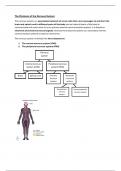
The nervous system is divided into two subsystems:
1. The central nervous system (CNS)
2. The peripheral nervous system (PNS)
Nervous
system
Central nervous Peripheral nervous
system (CNS) system (PNS)
Brain Spinal cord Somatic Autonomi
nervous c nervous
system system
Sympathetic Parasympathetic
nervous nervous system
system
, The Central Nervous System
- The CNS is made up of the brain and spinal cord
- The CNS has two main functions: the control of behaviour and the regulation of the
body’s physiological processes
- In order to do this, the brain must be able to receive information from the sensory
receptors (eyes, ears, skin etc.) and be able to send messages to the muscles and glands
of the body
- This involves the spinal cord, a collection of nerve cells that are attached to the brain
and run the length of the spinal column
The Brain
The brain is the center of all conscious awareness
The cerebral cortex (the brain’s outer layer) is 3mm thick and covers the brain. It is divided into 4
lobes – frontal, parietal, temporal and occipital, each responsible for processing different types
of information. Collectively, your cerebral cortex is responsible for the higher-level processes of
the brain, including language, memory, reasoning, thought, learning, decision-making, emotion,
intelligence and personality.
Our brains have higher mental functions (many other mammals do not)
There are 2 hemispheres in the brain (left and right) - the cerebrum is split into 2 cerebral
hemispheres, joined by the corpus callosum
The cerebral cortex is the outer layer of the cerebrum
The brain receives information from sensory receptors
Frontal lobe
- Reasoning
- Motor skills
- Expressive language
The nervous system is a specialised network of nerve cells that carry messages to and from the
brain and spinal cord to different parts of the body and so helps all parts of the body to
communicate with each other (it is our primary internal communication system). It is based on
electrical and chemical neural signals whereas the endocrine system (our secondary internal
communication system) is based on hormones.
The nervous system is divided into two subsystems:
1. The central nervous system (CNS)
2. The peripheral nervous system (PNS)
Nervous
system
Central nervous Peripheral nervous
system (CNS) system (PNS)
Brain Spinal cord Somatic Autonomi
nervous c nervous
system system
Sympathetic Parasympathetic
nervous nervous system
system
, The Central Nervous System
- The CNS is made up of the brain and spinal cord
- The CNS has two main functions: the control of behaviour and the regulation of the
body’s physiological processes
- In order to do this, the brain must be able to receive information from the sensory
receptors (eyes, ears, skin etc.) and be able to send messages to the muscles and glands
of the body
- This involves the spinal cord, a collection of nerve cells that are attached to the brain
and run the length of the spinal column
The Brain
The brain is the center of all conscious awareness
The cerebral cortex (the brain’s outer layer) is 3mm thick and covers the brain. It is divided into 4
lobes – frontal, parietal, temporal and occipital, each responsible for processing different types
of information. Collectively, your cerebral cortex is responsible for the higher-level processes of
the brain, including language, memory, reasoning, thought, learning, decision-making, emotion,
intelligence and personality.
Our brains have higher mental functions (many other mammals do not)
There are 2 hemispheres in the brain (left and right) - the cerebrum is split into 2 cerebral
hemispheres, joined by the corpus callosum
The cerebral cortex is the outer layer of the cerebrum
The brain receives information from sensory receptors
Frontal lobe
- Reasoning
- Motor skills
- Expressive language