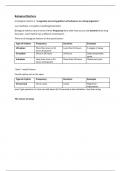
Biological Rhythms
A biological rhythm is “a regularly occurring pattern of behaviour in a living organism”
e.g. heartbeat, circulation, breathing/respiration
Biological rhythms vary in terms of their frequency (how often they occur) and duration (how long
they last) - each rhythm has a different combination.
There are 3 biological rhythms on the specification:
Type of rhythm Frequency Duration Example
Ultradian More than once in 24 Less than 24 hours 5 stages of sleep
hours (frequent)
Circadian Once in 24 hours 24 hours Daily sleep/wake
cycle
Infradian Less than once in 24 More than 24 hours Menstrual cycle
hours (infrequent)
“dian” = day/24 hours
Fourth rhythm not on the spec:
Type of rhythm Frequency Duration Example
Circannual Once a year A year Migration /
hibernation
(won’t get question on it but can talk about it) Circannual is also infradian – less than a day
The nature of sleep
, (Gets lighter as night progresses)
Stages 1 & 2 = Light sleep
-> Body processes (heart rate, respiration, metabolic rate) are all high
-> Arousal threshold is low – relatively easy to wake
-> Brain activity = synchronised/stable = low amplitude/high frequency alpha and theta waves
(shallow and fast)
Stages 3 & 4 = Deep sleep
-> Body processes (heart rate, respiration, metabolic rate) are all low
-> Arousal threshold is high – relatively hard to wake
-> Brain activity = synchronised/stable = high amplitude/low frequency delta waves (deep and
slow) - slow wave sleep
REM
-> Paradoxical – 2 opposite states at the same time
-> Rapid eye movement – dreams/nightmares - approx. 15 mins each period
-> Fast, desynchronised brain activity (sounds like light sleep)
-> Body processes (heart rate, respiration, metabolic rate) are all high (light sleep)
-> Arousal threshold is high – relatively hard to wake (deep sleep)
-> Muscle paralysis (deep sleep)
The effect of endogenous pacemakers and exogenous zeitgebers on the sleep/wake cycle
A key issue is how biological rhythms are controlled. They are clearly intended to help us adapt to our environment,
most obviously with rhythms such as the sleep-wake cycle and hibernation. However, evidence also shows that they can
operate in the absence of environmental cues.
A biological rhythm is “a regularly occurring pattern of behaviour in a living organism”
e.g. heartbeat, circulation, breathing/respiration
Biological rhythms vary in terms of their frequency (how often they occur) and duration (how long
they last) - each rhythm has a different combination.
There are 3 biological rhythms on the specification:
Type of rhythm Frequency Duration Example
Ultradian More than once in 24 Less than 24 hours 5 stages of sleep
hours (frequent)
Circadian Once in 24 hours 24 hours Daily sleep/wake
cycle
Infradian Less than once in 24 More than 24 hours Menstrual cycle
hours (infrequent)
“dian” = day/24 hours
Fourth rhythm not on the spec:
Type of rhythm Frequency Duration Example
Circannual Once a year A year Migration /
hibernation
(won’t get question on it but can talk about it) Circannual is also infradian – less than a day
The nature of sleep
, (Gets lighter as night progresses)
Stages 1 & 2 = Light sleep
-> Body processes (heart rate, respiration, metabolic rate) are all high
-> Arousal threshold is low – relatively easy to wake
-> Brain activity = synchronised/stable = low amplitude/high frequency alpha and theta waves
(shallow and fast)
Stages 3 & 4 = Deep sleep
-> Body processes (heart rate, respiration, metabolic rate) are all low
-> Arousal threshold is high – relatively hard to wake
-> Brain activity = synchronised/stable = high amplitude/low frequency delta waves (deep and
slow) - slow wave sleep
REM
-> Paradoxical – 2 opposite states at the same time
-> Rapid eye movement – dreams/nightmares - approx. 15 mins each period
-> Fast, desynchronised brain activity (sounds like light sleep)
-> Body processes (heart rate, respiration, metabolic rate) are all high (light sleep)
-> Arousal threshold is high – relatively hard to wake (deep sleep)
-> Muscle paralysis (deep sleep)
The effect of endogenous pacemakers and exogenous zeitgebers on the sleep/wake cycle
A key issue is how biological rhythms are controlled. They are clearly intended to help us adapt to our environment,
most obviously with rhythms such as the sleep-wake cycle and hibernation. However, evidence also shows that they can
operate in the absence of environmental cues.