
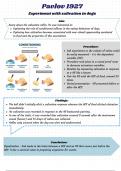
Pavlov 1927
Experiment with salivation in dogs
Aim:
Learn about the salivation reflex. He was interested in:
Explaining the role of conditioned reflexes in the eating behaviour of dogs.
Exploring how salivation becomes associated with new stimuli apparentley unrelated
to food and the properties of this association.
Procedure:
Lab experiment so the volume of saliva could
be easliy measured - it is the dependent
variable (DV).
Procedure took place in a sound proof room
to decrease extranious variables.
Baseline by measuring salivation in response
to a NS like a buzzer.
Pair the NS with the UCS of food, around 20
times.
Varied presentation - NS presented before or
after the UCS.
Findings:
The bell didn’t initially elicit a salivation response whereas the UCS of food elicited slaivation
immediately.
No salivation was recorded in response to the NS backwards pariring.
In one of the trials, it was recorded that salivation occured 9 seconds after the metronome
sound (buzzer) and 45 drops of saliva was collected.
Reflex only occured when the dog was alert and undistracted.
Conclusion:
Signalisation - link made in the brain between a UCS and an NS that occurs just before the
UCS. It has a survival value in preparing organisms for events.
Experiment with salivation in dogs
Aim:
Learn about the salivation reflex. He was interested in:
Explaining the role of conditioned reflexes in the eating behaviour of dogs.
Exploring how salivation becomes associated with new stimuli apparentley unrelated
to food and the properties of this association.
Procedure:
Lab experiment so the volume of saliva could
be easliy measured - it is the dependent
variable (DV).
Procedure took place in a sound proof room
to decrease extranious variables.
Baseline by measuring salivation in response
to a NS like a buzzer.
Pair the NS with the UCS of food, around 20
times.
Varied presentation - NS presented before or
after the UCS.
Findings:
The bell didn’t initially elicit a salivation response whereas the UCS of food elicited slaivation
immediately.
No salivation was recorded in response to the NS backwards pariring.
In one of the trials, it was recorded that salivation occured 9 seconds after the metronome
sound (buzzer) and 45 drops of saliva was collected.
Reflex only occured when the dog was alert and undistracted.
Conclusion:
Signalisation - link made in the brain between a UCS and an NS that occurs just before the
UCS. It has a survival value in preparing organisms for events.


