
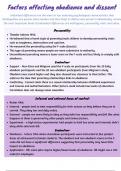
Factors affecting obedience and dissent
Individual differences are the more or less enduring psychological characteristics that
distinguishes one person from another and thus helps to define each person’s individuality. Among
the most important kinds of individual differences are intelligence, personality traits and value.
Personality:
Theodor Adorno 1950.
He believed that a harsh style of parenting leads children to develop personality traits
such as toughness, destructions and cynicism.
He measured the personality using the F-scale (fascist).
This type of parenting means people are more submissive to authority.
Unconditional parenting means a lower score on the F-scale and less likely to comply with
obedience.
Evaluation:
Support - Alan Elms and Milgram used the F-scale on participants from the 20 fully
obedient participants and the 20 non-obedient participants from Milgram’s study.
Obedient ones scored higher and they also showed less closeness to their father. This
enforces the idea that parenting relationships links to obedience.
Conflicting - Cannot claim there is a casual relationship between childhood experiences
and trauma and authoritarianism. Other factors could include low levels of education.
Correlation does not always mean causation.
Internal and external locus of control:
Rotter 1966.
Internal - people tend to take responsibility for their actions as they believe they are in
control. They obey less and defy orders.
External - people are more likely to obey as they take less responsibility and fell like what
happens to them is governed by other people and chance factors.
Experiment - a high status experimenter told people to hold live wires and internals didn’t
obey while externals did.
Evaluation:
Weakness - Schurz 1955 where Australian participants were instructed to five painful
doses of ultrasound to female students. The obedient and non obedient scores on the F-
scale did not have a significant difference suggesting that personality may have little
impact on obedience.
Application - HR, some jobs require higher/lower levels of obedience. HR might use a LOC
scale for employees.
Individual differences are the more or less enduring psychological characteristics that
distinguishes one person from another and thus helps to define each person’s individuality. Among
the most important kinds of individual differences are intelligence, personality traits and value.
Personality:
Theodor Adorno 1950.
He believed that a harsh style of parenting leads children to develop personality traits
such as toughness, destructions and cynicism.
He measured the personality using the F-scale (fascist).
This type of parenting means people are more submissive to authority.
Unconditional parenting means a lower score on the F-scale and less likely to comply with
obedience.
Evaluation:
Support - Alan Elms and Milgram used the F-scale on participants from the 20 fully
obedient participants and the 20 non-obedient participants from Milgram’s study.
Obedient ones scored higher and they also showed less closeness to their father. This
enforces the idea that parenting relationships links to obedience.
Conflicting - Cannot claim there is a casual relationship between childhood experiences
and trauma and authoritarianism. Other factors could include low levels of education.
Correlation does not always mean causation.
Internal and external locus of control:
Rotter 1966.
Internal - people tend to take responsibility for their actions as they believe they are in
control. They obey less and defy orders.
External - people are more likely to obey as they take less responsibility and fell like what
happens to them is governed by other people and chance factors.
Experiment - a high status experimenter told people to hold live wires and internals didn’t
obey while externals did.
Evaluation:
Weakness - Schurz 1955 where Australian participants were instructed to five painful
doses of ultrasound to female students. The obedient and non obedient scores on the F-
scale did not have a significant difference suggesting that personality may have little
impact on obedience.
Application - HR, some jobs require higher/lower levels of obedience. HR might use a LOC
scale for employees.


