

B4 -Ecosystem
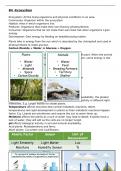
Ecosystem: All the living organisms and physical conditions in an area.
Community: Organism within the ecosystem
Habitat: Area in which organisms live.
Producer: Organisms that make their own food by photosynthesis
Consumer: Organisms that do not make their own food, Eat other organisms t gain
energy.
Decomposer: Gain energy by feeding on dead/decaying matter.
Plants take in energy from the sun which is absorbed by the chlorophyll and used in
photosynthesis to make glucose.
Carbon Dioxide + Water Glucose + Oxygen
The glucose is changed into carbohydrates and proteins in th pant. When the animal
eats the plant, biomass is transferred to the animals. However, some energy is lost
due to respiration.
Biomass is the amount of living material present.
Biotic Factors: Living factors
-Number of organisms
-What organisms are present and competition between them
-Diseases
Abiotic-factors: Non-living factors.
-Temperature
-pH
Light is required for photosynthesis. The greater the light availability, the greater
the success of the plant. Plants have evolved to grow successfully in different light
intensities. E.g. Larger leaves for shade plants.
Temperature affects enzymes that control metabolic reactions. Warm
temperatures aid rapid development in plants as their metabolic reactions happen
faster. E.g. Lizards are ectotherms and require the sun to warm them up.
Moisture affects the plants as a lack of water may lead to death. If plants have a
lack of water, they will wilt as the cells are no longer turgid.
pH affects biological activity in soil and mineral availability.
Acid plants: Rhododendrons and ferns.
Alkali plants: Cucumber and Cauliflowers.
Not all Pyramids of Numbers are in a
pyramid number.
As a single oak tree could feed multiple
insects.
, In order to survive, plants and animals need several materials from their
surroundings. If these materials are limited, they must compete for these resources.
As a result, the weaker competitor may die or leave the area.
Population: The number of organisms of each species living in an area.
Competition has a direct effect on population size.
Interdependence: How different organisms depend on each other in a community.
They have ecological relationships with each other. There are 3 main types:
1. Predation
Relationship between predators and prey.
2. Mutualism
Both organisms’ benefit.
3. Parasitism
Only the parasite benefits and the host suffers.
Pyramid of Numbers: In a pyramid of numbers the length of the bar represents the
number of organisms in a trophic in a level.
However Pyramid of Biomass is a pyramid shape
Scientists calculate the dry mass of an orgaisim as the water content can vary
between all organisms. This means the ogranisms is killed and dried.
Ecosystem: All the living organisms and physical conditions in an area.
Community: Organism within the ecosystem
Habitat: Area in which organisms live.
Producer: Organisms that make their own food by photosynthesis
Consumer: Organisms that do not make their own food, Eat other organisms t gain
energy.
Decomposer: Gain energy by feeding on dead/decaying matter.
Plants take in energy from the sun which is absorbed by the chlorophyll and used in
photosynthesis to make glucose.
Carbon Dioxide + Water Glucose + Oxygen
The glucose is changed into carbohydrates and proteins in th pant. When the animal
eats the plant, biomass is transferred to the animals. However, some energy is lost
due to respiration.
Biomass is the amount of living material present.
Biotic Factors: Living factors
-Number of organisms
-What organisms are present and competition between them
-Diseases
Abiotic-factors: Non-living factors.
-Temperature
-pH
Light is required for photosynthesis. The greater the light availability, the greater
the success of the plant. Plants have evolved to grow successfully in different light
intensities. E.g. Larger leaves for shade plants.
Temperature affects enzymes that control metabolic reactions. Warm
temperatures aid rapid development in plants as their metabolic reactions happen
faster. E.g. Lizards are ectotherms and require the sun to warm them up.
Moisture affects the plants as a lack of water may lead to death. If plants have a
lack of water, they will wilt as the cells are no longer turgid.
pH affects biological activity in soil and mineral availability.
Acid plants: Rhododendrons and ferns.
Alkali plants: Cucumber and Cauliflowers.
Not all Pyramids of Numbers are in a
pyramid number.
As a single oak tree could feed multiple
insects.
, In order to survive, plants and animals need several materials from their
surroundings. If these materials are limited, they must compete for these resources.
As a result, the weaker competitor may die or leave the area.
Population: The number of organisms of each species living in an area.
Competition has a direct effect on population size.
Interdependence: How different organisms depend on each other in a community.
They have ecological relationships with each other. There are 3 main types:
1. Predation
Relationship between predators and prey.
2. Mutualism
Both organisms’ benefit.
3. Parasitism
Only the parasite benefits and the host suffers.
Pyramid of Numbers: In a pyramid of numbers the length of the bar represents the
number of organisms in a trophic in a level.
However Pyramid of Biomass is a pyramid shape
Scientists calculate the dry mass of an orgaisim as the water content can vary
between all organisms. This means the ogranisms is killed and dried.


