

Internal medicine
1.asthma
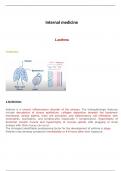
Anatomy:
1.Definition:
Asthma is a chronic inflammatory disorder of the airways. The histopathologic features
include denudation of airway epithelium, collagen deposition beneath the basement
membrane, airway edema, mast cell activation, and inflammatory cell infiltration with
neutrophils, eosinophils, and lymphocytes (especially T lymphocytes). Hypertrophy of
bronchial smooth muscle and hypertrophy of mucous glands with plugging of small
airways with thick mucus can occur.
The strongest identifiable predisposing factor for the development of asthma is atopy.
Patients may develop symptoms immediately or 4-6 hours after their exposure.
,2.Mechanism
,3.clinical findings:
Asthma is characterized by episodic wheezing, difficulty in breathing, chest tightness, and
cough.
Asthma symptoms are frequently worse at night;3 and 4 AM,Complications of asthma
include exhaustion, dehydration, airway infection, cor pulmonale, and tussive syncope.
Pneumothorax occurs but is rare. Acute hypercapnic and hypoxic respirator y failure
occurs in severe disease.
B. peak respiratory flow
ü PEF should be measured in the morning before the administration of a
bronchodilator and in the afternoon after taking a bronchodilator.
ü A 20% change in PEF values from morning to afternoon or from day to day
suggests inadequately controlled asthma.
ü PEF values less than 200L/min indicates severe airflow obstruction.
, C. bronchial provocation testing
ü With histamine or methacholine, or exercise challenge testing may be
useful when asthma suspected and spirometr y is nondiagnostic.
ü Bronchial provocation is not generally recommended if the FEV1 is less than 65%.
ü A positive test is defined as a decrease in FEV1 of at least 20% at exposure to a dose of
16mg/ml or less.
D. arterial blood gas
ü Respirator y alkalosis and an increase in the alveolar-arterial oxygen difference are
common.
ü During severe exacerbations, hypoxemia develops and the PaCO2 returns to normal.
ü The combination of an increased PaCO2 and respirator y acidosis is a harbinger of
respiratory failure and may indicate the need for mechanical ventilation.
4.Diagnosis and differential diagnosis
essential of diagnosis
1. Episodic or chronic symptoms of airflow obstruction: breathless, cough, wheezing, and
chest tightness.
2. Symptoms frequently worse at night or in the early morning. 2
3. Prolonged expiration and diffuse wheezes on physical examination.
1.asthma
Anatomy:
1.Definition:
Asthma is a chronic inflammatory disorder of the airways. The histopathologic features
include denudation of airway epithelium, collagen deposition beneath the basement
membrane, airway edema, mast cell activation, and inflammatory cell infiltration with
neutrophils, eosinophils, and lymphocytes (especially T lymphocytes). Hypertrophy of
bronchial smooth muscle and hypertrophy of mucous glands with plugging of small
airways with thick mucus can occur.
The strongest identifiable predisposing factor for the development of asthma is atopy.
Patients may develop symptoms immediately or 4-6 hours after their exposure.
,2.Mechanism
,3.clinical findings:
Asthma is characterized by episodic wheezing, difficulty in breathing, chest tightness, and
cough.
Asthma symptoms are frequently worse at night;3 and 4 AM,Complications of asthma
include exhaustion, dehydration, airway infection, cor pulmonale, and tussive syncope.
Pneumothorax occurs but is rare. Acute hypercapnic and hypoxic respirator y failure
occurs in severe disease.
B. peak respiratory flow
ü PEF should be measured in the morning before the administration of a
bronchodilator and in the afternoon after taking a bronchodilator.
ü A 20% change in PEF values from morning to afternoon or from day to day
suggests inadequately controlled asthma.
ü PEF values less than 200L/min indicates severe airflow obstruction.
, C. bronchial provocation testing
ü With histamine or methacholine, or exercise challenge testing may be
useful when asthma suspected and spirometr y is nondiagnostic.
ü Bronchial provocation is not generally recommended if the FEV1 is less than 65%.
ü A positive test is defined as a decrease in FEV1 of at least 20% at exposure to a dose of
16mg/ml or less.
D. arterial blood gas
ü Respirator y alkalosis and an increase in the alveolar-arterial oxygen difference are
common.
ü During severe exacerbations, hypoxemia develops and the PaCO2 returns to normal.
ü The combination of an increased PaCO2 and respirator y acidosis is a harbinger of
respiratory failure and may indicate the need for mechanical ventilation.
4.Diagnosis and differential diagnosis
essential of diagnosis
1. Episodic or chronic symptoms of airflow obstruction: breathless, cough, wheezing, and
chest tightness.
2. Symptoms frequently worse at night or in the early morning. 2
3. Prolonged expiration and diffuse wheezes on physical examination.


