ATTACHM
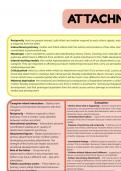
Reciprocity: how two people interact; both infant and mother respond to each other’s signals, and e
a response from the other.
Interactional synchrony: mother and infant reflect both the actions and emotions of the other and
coordinated (synchronised) way.
Monotropic: a term sometimes used to describe Bowlby’s theory. Mono, meaning ‘one’, indicates th
particular attachment is different from all others and of central importance to the child’s developme
Internal working models: the mental representations we all carry with us of our attachment to our p
caregiver. They are important in affecting our future relationships because they carry our perception
relationships look like.
Critical period: refers to a time within which an attachment must form if it is to form at all. Lorenz an
found that attachment in monkeys had critical periods. Bowlby extended the idea to humans. propo
human infants have a sensitive period after which it will be much more difficult to form an attachme
Maternal deprivation: the emotional and intellectual consequences of separation between a child
mother. Bowlby proposed that continuous care from a mother is essential for normal psychological
development, and that prolonged separation form this adult causes serious damage to emotional a
intellectual development
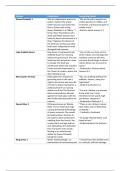
Caregiver-infant interactions – Babies have Evaluation:
- Hard to know what is happening – observe simple gestu
frequent and important interactions with their
expressions, and assume the infant’s intentions. This means
caregiver. cannot really know for certain that behaviours seen in moth
Reciprocity – Mothers respond to infant interaction have a special meaning.
alertness. From 3 months, close attention + Controlled observations – capture fine detail of interacti
between mother and infant. strength of this line of research because it means the resea
validity.
Interactional synchrony – Interactions become
- Purpose of synchrony and reciprocity – Feldman: just ob
coordinated. Isabella et al.: quality of purpose not entirely understood. However, there is some e
attachment related to synchrony. interactional synchrony and reciprocity help in the develop
Attachment figures – Babies typically form a mother-infant attachment, as well as being helpful in stres
empathy, language, and moral development.
primary attachment to their mothers before
developing secondary attachments. The - Inconsistent findings – different research questions, ove
strength of this bond can impact social and unclear. This is a problem because it means psychologists
emotional development in later life. answer a simple question the layperson often asks: what is
Role of the father – Grossman et al.: father?
- Children without fathers aren’t different – suggesting th
attachment to fathers is less important, but
role as a secondary attachment figure is not important.
fathers may have a different role – play and - Fathers not primary attachments – this may be due to tr
stimulation. roles or biological differences. On the other hand, it could b
Fathers as primary carers – Field: fathers as hormones (such as oestrogen) create higher levels of nurtu
therefore women are biologically predisposed to be the pr
primary carers adopt attachment behaviour
attachment figure.
Reciprocity: how two people interact; both infant and mother respond to each other’s signals, and e
a response from the other.
Interactional synchrony: mother and infant reflect both the actions and emotions of the other and
coordinated (synchronised) way.
Monotropic: a term sometimes used to describe Bowlby’s theory. Mono, meaning ‘one’, indicates th
particular attachment is different from all others and of central importance to the child’s developme
Internal working models: the mental representations we all carry with us of our attachment to our p
caregiver. They are important in affecting our future relationships because they carry our perception
relationships look like.
Critical period: refers to a time within which an attachment must form if it is to form at all. Lorenz an
found that attachment in monkeys had critical periods. Bowlby extended the idea to humans. propo
human infants have a sensitive period after which it will be much more difficult to form an attachme
Maternal deprivation: the emotional and intellectual consequences of separation between a child
mother. Bowlby proposed that continuous care from a mother is essential for normal psychological
development, and that prolonged separation form this adult causes serious damage to emotional a
intellectual development
Caregiver-infant interactions – Babies have Evaluation:
- Hard to know what is happening – observe simple gestu
frequent and important interactions with their
expressions, and assume the infant’s intentions. This means
caregiver. cannot really know for certain that behaviours seen in moth
Reciprocity – Mothers respond to infant interaction have a special meaning.
alertness. From 3 months, close attention + Controlled observations – capture fine detail of interacti
between mother and infant. strength of this line of research because it means the resea
validity.
Interactional synchrony – Interactions become
- Purpose of synchrony and reciprocity – Feldman: just ob
coordinated. Isabella et al.: quality of purpose not entirely understood. However, there is some e
attachment related to synchrony. interactional synchrony and reciprocity help in the develop
Attachment figures – Babies typically form a mother-infant attachment, as well as being helpful in stres
empathy, language, and moral development.
primary attachment to their mothers before
developing secondary attachments. The - Inconsistent findings – different research questions, ove
strength of this bond can impact social and unclear. This is a problem because it means psychologists
emotional development in later life. answer a simple question the layperson often asks: what is
Role of the father – Grossman et al.: father?
- Children without fathers aren’t different – suggesting th
attachment to fathers is less important, but
role as a secondary attachment figure is not important.
fathers may have a different role – play and - Fathers not primary attachments – this may be due to tr
stimulation. roles or biological differences. On the other hand, it could b
Fathers as primary carers – Field: fathers as hormones (such as oestrogen) create higher levels of nurtu
therefore women are biologically predisposed to be the pr
primary carers adopt attachment behaviour
attachment figure.