

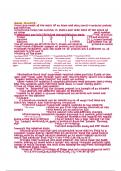
Atomic structure
Nucleus most of the mass of an atom and very small contains proton
and neutrons
Electrons orbit the nucleus in shells and take most of the space of
an atom
subatomic particle Relative charge Relative mass granmano ofproton
proton
Neutron I atomic proton
Electron 1 3 number no o
no of protons no of electrons 7 atoms are neutral protonsin
ions have different number ofnuclei
protons and electrons
isotopes elements with the same no of protons but a different no of
neutrons e.gl C and I
history of the atom
JohnDalton1803 J.JThompson1897
atomsarespheres
ndeachelementis and III
Discoveredtheelectron discoverednucleus
atomwasn'tsolid
adefromadifferent wasmadeupofother verysmallandtvely
m
lectrons
discovered aproblemwithRutherford's
intothepositivenucleus
couldcollapse
proposed
here particles developed charged alsoconcluded electronswere infixedenergyshells
plumbpuddingmodel atomwasmainlyempty
spacemadeupof a ve
cloud
Rutherford Gold leaf experiment positive alphaparticlesfireed at thin
gold leaf most went through gold leaf mainlyempty space and a small
number deflected back theyhit the small the nucleus
Bohr when EM radiation is absorbed electrons move between shells the
emit this radiation when electrons move down to lower energy shells
Time of Flight mass spectrometer
used to determine all the isotopespresent in a sample of an element
can identify the different isotopes of elements
needs to be under a vacuum otherwise air particles will ionise and
register on the detector
stages
Ionisation sample can be ionised in a no of ways 72 of these are
1
electron impact and electrospray ionisation
Electron Impact vaporised sample injected at low pressure
foratoms electron gun fires highenergy electrons at the
sample this knocks out an electron gun
forms positive ions withdifferentcharges
Electrospray ionisation sampledissolved in a volatile polar solven
injected through a fine hypodermicneedle
giving a finemini aerosol tip of needle has a high voltage at the
tipt sample molecule M gains a proton Ht from the solvent forming
MH Mig Ht MHtcg
solvent evaporates away and MHt moves
towards the negativeplate
2 Acceleration positive ions accelerated by an electric field to a
constant kineticenergy given that all particles have the same kinetic
energy velocity of each particledepends on its mass lighterparticles
reach the detector first KE 112mV2 KE J M kg V M Is
3 Flight tube positive ions with smaller miz value have the same
kinetic energy as those with a larger miz value heavier particles take
longer to move through the drift area usually 5m long ions distinguished
by different flight times
time of flight is length of flight tube m velocityofparticle mis
1st d Iv t see dem V mist M t Mz t z M Ar of ion
Nucleus most of the mass of an atom and very small contains proton
and neutrons
Electrons orbit the nucleus in shells and take most of the space of
an atom
subatomic particle Relative charge Relative mass granmano ofproton
proton
Neutron I atomic proton
Electron 1 3 number no o
no of protons no of electrons 7 atoms are neutral protonsin
ions have different number ofnuclei
protons and electrons
isotopes elements with the same no of protons but a different no of
neutrons e.gl C and I
history of the atom
JohnDalton1803 J.JThompson1897
atomsarespheres
ndeachelementis and III
Discoveredtheelectron discoverednucleus
atomwasn'tsolid
adefromadifferent wasmadeupofother verysmallandtvely
m
lectrons
discovered aproblemwithRutherford's
intothepositivenucleus
couldcollapse
proposed
here particles developed charged alsoconcluded electronswere infixedenergyshells
plumbpuddingmodel atomwasmainlyempty
spacemadeupof a ve
cloud
Rutherford Gold leaf experiment positive alphaparticlesfireed at thin
gold leaf most went through gold leaf mainlyempty space and a small
number deflected back theyhit the small the nucleus
Bohr when EM radiation is absorbed electrons move between shells the
emit this radiation when electrons move down to lower energy shells
Time of Flight mass spectrometer
used to determine all the isotopespresent in a sample of an element
can identify the different isotopes of elements
needs to be under a vacuum otherwise air particles will ionise and
register on the detector
stages
Ionisation sample can be ionised in a no of ways 72 of these are
1
electron impact and electrospray ionisation
Electron Impact vaporised sample injected at low pressure
foratoms electron gun fires highenergy electrons at the
sample this knocks out an electron gun
forms positive ions withdifferentcharges
Electrospray ionisation sampledissolved in a volatile polar solven
injected through a fine hypodermicneedle
giving a finemini aerosol tip of needle has a high voltage at the
tipt sample molecule M gains a proton Ht from the solvent forming
MH Mig Ht MHtcg
solvent evaporates away and MHt moves
towards the negativeplate
2 Acceleration positive ions accelerated by an electric field to a
constant kineticenergy given that all particles have the same kinetic
energy velocity of each particledepends on its mass lighterparticles
reach the detector first KE 112mV2 KE J M kg V M Is
3 Flight tube positive ions with smaller miz value have the same
kinetic energy as those with a larger miz value heavier particles take
longer to move through the drift area usually 5m long ions distinguished
by different flight times
time of flight is length of flight tube m velocityofparticle mis
1st d Iv t see dem V mist M t Mz t z M Ar of ion


