

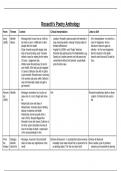
Rossetti’s Poetry Anthology
Poem Themes Context Critical Interpretations Links to ADH
Song Afterlife - Message-don't mourn me as I will not - Landow- Rossetti’s persona asks her beloved to - Kin’s interpretation- no need for a
(1848) Nature be there to see it- indifferent to other stop mourning death- embody Victorian ideal of man for happiness- Nora's
people after her death female selflessness” decision to leave to gain an
- Dirge- funeral song with elegiac tone - Angela Kin (2006)- word “haply” destroys identity + for her own happiness
- Idea of second sleep used- Victorian feminine idea portrayed by Pre-Ralphealites (e.g. - Rank’s reaction to his death-
believe it was for waiting for the return Dante) as it implies women can find peace and doesn't want Nora and Torvald to
of Jesus + judgement day contentment without her beloved- a potentially fuss.
- Written when Rossetti was 18 and in proto feminist view.
poor health. She had just got engaged
to James Collinsson but with no plans
to get married. Rossetti was in recovery
from anxiety and panic while Collinson
was not financially steady enough to
get married.
Remem Afterlife - Message- remember me, but do not N/A Rossetti romanticises death vs Ibsen
ber grieve me- it is ok to forget and move realism- Dr Rank did not want to
(1849) on die
- Melancholic tone with idea of
Melancholia- Victorian ideal of finding
beauty in sadness and death
- Patriarchan sonnet (usually from a
man’s POV)- Rossetti flipped this
- Rossetti in love with James Colinson at
the time- poem embodies the idea of
love to the idea of death + expression
of her strong feelings for him.
From Dialogue - Message- A person’s life and death -Simone de Beauvoir - in a patriarchal culture woman -Simone de Beauvoir
the Afterlife does not have any significance to the inevitably must make herself into or pretend to be -Nora- breaks cycle of pointless
Antique Desire for world an alluring object. The ‘the very face itself existence as housewife by leaving
, (1854) death becomes a mask’. -Mrs L- life without purpose is “doubly
Nature blank”
Personae -Women as insignificant- hold no
property + unable to significantly
impact lives.
Echo Afterlife - Message- come back to me so we - Biographer Francis Thomas debates whether this - Rosetti presents death
(1854) Religious can be in love or a wish to return to the is fictional, or drawn from Rossetti's previous sweetly whereas Ibsen-
past. relationship with James Collinson who had just Torvald + Rank- Torald’s
- Lyric poem from perspective Of failed becoming a Jesuit Priest, meaning he was reaction is very flippant and
speaker whose lover returns to her in a single and able to marry. dismissive when told Rank is
dream dead.
- Lyric = set to music- done by Mary
Ann Virginia Gabriel
- Themes of love death and rejection
- A revised version of them original
manuscript shows more vulnerable side
of Rossetti and ends on a more
melancholic tone
Shut Dialogue - Woman shut out from her garden- - Lars Wallner-an earlier edition of the poem had - Krogstand + Mrs Linde’s
Out Despair metaphor for loss of fertility? the subtitle “What happened to me”- response to relationship- broke apart as had
Nature - Melancholic and resigned tone the ending of Rossetti’s engagement to Collinson- different interests- Mrs Linde
Religious - Reflect mourning of the spirit to be either Frances and Maria, needed security- needed social
childlessness(Rossetti did not have any Christina’s mother and sister, who did not approve status
children when it was common to be a of the relationship, or God splitting the couple up - Rossetti + Collinson broke up due
housewife and raise children at the because of Collinson’s decision to go back to the to religious differences- Rosetti
time- domestic sphere) - potentially Catholic Church Anglo- Catholic and Collinson
proto feminist? or female loss of - Waldman- Religious ideals conflict with inner Catholic + also mother’s
innocence desires. disapproval
- Lynda Palazzo- Women's imprisonment
“metaphor for social abuse of women in society”.
Poem Themes Context Critical Interpretations Links to ADH
Song Afterlife - Message-don't mourn me as I will not - Landow- Rossetti’s persona asks her beloved to - Kin’s interpretation- no need for a
(1848) Nature be there to see it- indifferent to other stop mourning death- embody Victorian ideal of man for happiness- Nora's
people after her death female selflessness” decision to leave to gain an
- Dirge- funeral song with elegiac tone - Angela Kin (2006)- word “haply” destroys identity + for her own happiness
- Idea of second sleep used- Victorian feminine idea portrayed by Pre-Ralphealites (e.g. - Rank’s reaction to his death-
believe it was for waiting for the return Dante) as it implies women can find peace and doesn't want Nora and Torvald to
of Jesus + judgement day contentment without her beloved- a potentially fuss.
- Written when Rossetti was 18 and in proto feminist view.
poor health. She had just got engaged
to James Collinsson but with no plans
to get married. Rossetti was in recovery
from anxiety and panic while Collinson
was not financially steady enough to
get married.
Remem Afterlife - Message- remember me, but do not N/A Rossetti romanticises death vs Ibsen
ber grieve me- it is ok to forget and move realism- Dr Rank did not want to
(1849) on die
- Melancholic tone with idea of
Melancholia- Victorian ideal of finding
beauty in sadness and death
- Patriarchan sonnet (usually from a
man’s POV)- Rossetti flipped this
- Rossetti in love with James Colinson at
the time- poem embodies the idea of
love to the idea of death + expression
of her strong feelings for him.
From Dialogue - Message- A person’s life and death -Simone de Beauvoir - in a patriarchal culture woman -Simone de Beauvoir
the Afterlife does not have any significance to the inevitably must make herself into or pretend to be -Nora- breaks cycle of pointless
Antique Desire for world an alluring object. The ‘the very face itself existence as housewife by leaving
, (1854) death becomes a mask’. -Mrs L- life without purpose is “doubly
Nature blank”
Personae -Women as insignificant- hold no
property + unable to significantly
impact lives.
Echo Afterlife - Message- come back to me so we - Biographer Francis Thomas debates whether this - Rosetti presents death
(1854) Religious can be in love or a wish to return to the is fictional, or drawn from Rossetti's previous sweetly whereas Ibsen-
past. relationship with James Collinson who had just Torvald + Rank- Torald’s
- Lyric poem from perspective Of failed becoming a Jesuit Priest, meaning he was reaction is very flippant and
speaker whose lover returns to her in a single and able to marry. dismissive when told Rank is
dream dead.
- Lyric = set to music- done by Mary
Ann Virginia Gabriel
- Themes of love death and rejection
- A revised version of them original
manuscript shows more vulnerable side
of Rossetti and ends on a more
melancholic tone
Shut Dialogue - Woman shut out from her garden- - Lars Wallner-an earlier edition of the poem had - Krogstand + Mrs Linde’s
Out Despair metaphor for loss of fertility? the subtitle “What happened to me”- response to relationship- broke apart as had
Nature - Melancholic and resigned tone the ending of Rossetti’s engagement to Collinson- different interests- Mrs Linde
Religious - Reflect mourning of the spirit to be either Frances and Maria, needed security- needed social
childlessness(Rossetti did not have any Christina’s mother and sister, who did not approve status
children when it was common to be a of the relationship, or God splitting the couple up - Rossetti + Collinson broke up due
housewife and raise children at the because of Collinson’s decision to go back to the to religious differences- Rosetti
time- domestic sphere) - potentially Catholic Church Anglo- Catholic and Collinson
proto feminist? or female loss of - Waldman- Religious ideals conflict with inner Catholic + also mother’s
innocence desires. disapproval
- Lynda Palazzo- Women's imprisonment
“metaphor for social abuse of women in society”.


