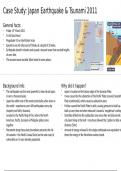
Case Study: Japan Earthquake & Tsunami 2011
General facts:
- Friday 11th March 2011
- 14:46 (local time)
- Magnitude 9.0 on the Richter Scale
- Epicentre was 43 miles east of Tohoku at a depth of 20 miles.
- Earthquake lasted 6 minutes and caused a tsunami wave that reached heights
of over 40m.
- The tsunami wave reached 10km inland in some places.
Background info: Why did it happen?
- The earthquake was the most powerful to have struck Japan - Japan is located on the Eastern edge of the Eurasian Plate.
in over a thousand years. - It was caused by the subduction of the Pacific Plate (oceanic) beneath
- Japan lies within one of the most tectonically active zones in Plate (continental), which caused a subduction zone.
the world > experiences over 400 earthquakes every day - Friction caused the Pacific Plate to stick, causing pressure to build up.
(majority not felt by humans). built up over time and when released it caused a ‘megathrust’ earthqu
- Located on the Pacific Ring of Fire, where the North - Scientists drilled into the subduction zone soon after and discovered a
American, Pacific, Eurasian & Philippine plates come clay layer lining in the fault > may have allowed the 2 plates to slide an
together. distance (50m).
- Movement along these plate boundaries presents the risk - Amount of energy released in the single earthquake was equivalent to
of tsunamis > the Pacific Coastal Zone (on the east coast) is times the energy of the Hiroshima nuclear bomb.
vulnerable as it is very densely populated.
,Case Study: Japan Earthquake & Tsunami 2011
Primary impacts:
- 15,894 deaths
- 6,152 people were injured
- 130,927 people were displaced
- 2,562 people remain missing
- A 9m high wave flooded the plants generators & electrical wiring > people lost energy immediately.
- Japan spent billions of dollars building anti-tsunami defences at heights of 12m > the tsunami washed over them, rendering them totally ineff
- 332,395 buildings, 2,126 roads, 56 bridges & 26 railways were destroyed or damaged.
- 300 hospitals were damaged & 11 were destroyed.
- Around 4.4 million households in North-East Japan were left without electricity & 1.5 million without water.
- Ports & airports in Sendai were damaged & closed.
- The massive surge destroyed three-storey buildings where people had gathered for safety.
- Japan’s transport network suffered huge disruptions > sections of the Tohoku Expressway were damaged.
- The earthquake moved parts of North-East Japan 2.4m closer to North America.
- Geologists estimate that the Pacific Plate has slipped westwards by 20-40m.
- Liquefaction occurred in many parts of Tokyo built on reclaimed land > 1,046 buildings damaged.
Secondary impacts::
- Scientists estimate that over 800 earthquakes of magnitude 4.5 or more were recorded following the main earthquake.
- Tsunami (that hit 12 minutes after) up to 40m high devastated entire towns and resulted in the loss of thousands of lives > caused a lot of dam
up to 6 miles inland.
- The economic cost was $235 billion (most expensive natural disaster in history).
- Some coastal areas experience land subsidence as the earthquake dropped the beachfronts in some places by more than 50cm.
- Only 58% of people in coastal areas followed the tsunami warnings and headed for higher ground > waves hit 49% who didn’t.
- The damaged caused by the earthquakes resulted in the meltdown of 7 reactors > radiation levels at one point were over 8x the normal levels
- A 250 mile stretch of coastline dropped by 0.6m, allowing the tsunami to travel further inland.
- 6 months on in the town of Kesennuma, the fishing industry is operating at 20% of its normal capacity.
, Case Study: Japan Earthquake & Tsunami 2011
Immediate responses:
- Rescue services & army moved very quickly into the affected area > were able to clear roads & create access paths very quickly but the amoun
the tsunami made efforts to count the number of deaths difficult.
- Doctors & nurses were flown from other parts of Japan to help with relief efforts & many patients were flown far out on the area to receive tr
- Over 300,000 were left homeless and so the army helped build temporary shelters.
- The Japanese Red Cross received over $1 billion in donations & gave out 30,00 emergency relief kits & 14,000 sleeping kits.
- Residents within a 12-mile radius of the Fukushima power plant were evacuated.
- Modern innovations, such as Twitter were bringing updates on the situation far earlier than the media.
Long-term responses:
- The government set up a Reconstruction Design Council who had a budget of over 23 billion Yen to rebuild houses.
- The original 12m tsunami barriers were replaced with ones that were 18m high (some scientists have noted that this would still not protect pr
earthquake was to take place.
- Billions of pounds have been spent making buildings more resistant to earthquakes > involves using types of glass that doesn’t shatter, weight
counter the sway or huge shock absorbers in the foundations.
- Over £70 million was spent on lasers that are used to monitor even the slightest movement.
General facts:
- Friday 11th March 2011
- 14:46 (local time)
- Magnitude 9.0 on the Richter Scale
- Epicentre was 43 miles east of Tohoku at a depth of 20 miles.
- Earthquake lasted 6 minutes and caused a tsunami wave that reached heights
of over 40m.
- The tsunami wave reached 10km inland in some places.
Background info: Why did it happen?
- The earthquake was the most powerful to have struck Japan - Japan is located on the Eastern edge of the Eurasian Plate.
in over a thousand years. - It was caused by the subduction of the Pacific Plate (oceanic) beneath
- Japan lies within one of the most tectonically active zones in Plate (continental), which caused a subduction zone.
the world > experiences over 400 earthquakes every day - Friction caused the Pacific Plate to stick, causing pressure to build up.
(majority not felt by humans). built up over time and when released it caused a ‘megathrust’ earthqu
- Located on the Pacific Ring of Fire, where the North - Scientists drilled into the subduction zone soon after and discovered a
American, Pacific, Eurasian & Philippine plates come clay layer lining in the fault > may have allowed the 2 plates to slide an
together. distance (50m).
- Movement along these plate boundaries presents the risk - Amount of energy released in the single earthquake was equivalent to
of tsunamis > the Pacific Coastal Zone (on the east coast) is times the energy of the Hiroshima nuclear bomb.
vulnerable as it is very densely populated.
,Case Study: Japan Earthquake & Tsunami 2011
Primary impacts:
- 15,894 deaths
- 6,152 people were injured
- 130,927 people were displaced
- 2,562 people remain missing
- A 9m high wave flooded the plants generators & electrical wiring > people lost energy immediately.
- Japan spent billions of dollars building anti-tsunami defences at heights of 12m > the tsunami washed over them, rendering them totally ineff
- 332,395 buildings, 2,126 roads, 56 bridges & 26 railways were destroyed or damaged.
- 300 hospitals were damaged & 11 were destroyed.
- Around 4.4 million households in North-East Japan were left without electricity & 1.5 million without water.
- Ports & airports in Sendai were damaged & closed.
- The massive surge destroyed three-storey buildings where people had gathered for safety.
- Japan’s transport network suffered huge disruptions > sections of the Tohoku Expressway were damaged.
- The earthquake moved parts of North-East Japan 2.4m closer to North America.
- Geologists estimate that the Pacific Plate has slipped westwards by 20-40m.
- Liquefaction occurred in many parts of Tokyo built on reclaimed land > 1,046 buildings damaged.
Secondary impacts::
- Scientists estimate that over 800 earthquakes of magnitude 4.5 or more were recorded following the main earthquake.
- Tsunami (that hit 12 minutes after) up to 40m high devastated entire towns and resulted in the loss of thousands of lives > caused a lot of dam
up to 6 miles inland.
- The economic cost was $235 billion (most expensive natural disaster in history).
- Some coastal areas experience land subsidence as the earthquake dropped the beachfronts in some places by more than 50cm.
- Only 58% of people in coastal areas followed the tsunami warnings and headed for higher ground > waves hit 49% who didn’t.
- The damaged caused by the earthquakes resulted in the meltdown of 7 reactors > radiation levels at one point were over 8x the normal levels
- A 250 mile stretch of coastline dropped by 0.6m, allowing the tsunami to travel further inland.
- 6 months on in the town of Kesennuma, the fishing industry is operating at 20% of its normal capacity.
, Case Study: Japan Earthquake & Tsunami 2011
Immediate responses:
- Rescue services & army moved very quickly into the affected area > were able to clear roads & create access paths very quickly but the amoun
the tsunami made efforts to count the number of deaths difficult.
- Doctors & nurses were flown from other parts of Japan to help with relief efforts & many patients were flown far out on the area to receive tr
- Over 300,000 were left homeless and so the army helped build temporary shelters.
- The Japanese Red Cross received over $1 billion in donations & gave out 30,00 emergency relief kits & 14,000 sleeping kits.
- Residents within a 12-mile radius of the Fukushima power plant were evacuated.
- Modern innovations, such as Twitter were bringing updates on the situation far earlier than the media.
Long-term responses:
- The government set up a Reconstruction Design Council who had a budget of over 23 billion Yen to rebuild houses.
- The original 12m tsunami barriers were replaced with ones that were 18m high (some scientists have noted that this would still not protect pr
earthquake was to take place.
- Billions of pounds have been spent making buildings more resistant to earthquakes > involves using types of glass that doesn’t shatter, weight
counter the sway or huge shock absorbers in the foundations.
- Over £70 million was spent on lasers that are used to monitor even the slightest movement.