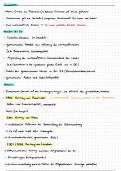
ORDER OF MONARCHS
Henry VII → 1485 –1509
Henry VIII → 1509 – 1547
Edward VI → 1547 – 1553
Mary I → 1553 – 1558
Elizebeth II → 1558 – 1603
Henry VII
Background
1. What was the impact of the Wars of the Roses?
- Some nobles used the unstable period of weak rule to seize more power over
their local areas. When Richard the 3rd seized the throne from his two
nephews he created - disunity /unease in the country —> more support for the
opposition. Shown by the rebellion of Buckingham
- Throughout the wars there was little physical destruction to the country,and
did encourage violence /uncertainty in an already weakened society.
● Lead to monarchy being unstable.
● War of the roses = yolkiest and Lancastrian families(, two parts of the royal
family)
● monarchs have power cus people believe they have authority rests in trust.
● In the war of the roses the crown changed hands so often suggesting to
people the monarch was just a man, not divine unquestionable ruler--
reduced the authority of the monarch.
● Henry spends a lot of time trying to restore the authority/ the power-succeeds.
● The king doesn't have an army, there's no police, no civil servants- the power
of the king rests on his ability to get other people to do what he wants.
● War of roses meant the nobles were willing to challenge him
Henry consolidation of power
CLAIM TO THE THRONE
- Weak
- Through mum (margaret beufort) direct descendent ED 3 by marriage of third son
(john of gaunt) to katherine swynford.-- but their son john beufort (h7s great
grandfather) born prior to marriage weakened future claim by line.
- H7 royal blood from dad (edmund tudor) — whose mother catherine married H5
before marrying h7s dads dad (welsh, owen).---> edmund is half brother of king H6
who made him earl of richmond. —-> h7 is ½ nephew to the king and part of
extended family.
- Really the claim rested on victory in battle– defeated/killed rich3- a sign that god
approved h7s assumption of power.
, - H7s luck- The members of the greater nobility had destroyed most of each other by
killing various Aires and their land had been returned to the crown.
- Those on Richard’s side were able to be punished or disinherited as traitors.
- People beneath the great warring houses were fed up with the impact a generation of
political changes on constant changing royalty had caused so were ready to support
one monarch to help the country recover to its previous prosperity.
- An adult
- Proven to be a great leader and soldier, these qualities lessened opposition to him.
- An only child so no need to worry about family rivalry
- After living in France for much of his life and his obscure Welsh origins meant he had
few personal enemies.
-
AIMS
- H7s aim = remain king/ establish dynasty - handong on unchallenged succession to
descendants.
- Policies home/abroad reflected this. – goal to secure/strengthen
- Needed too: establish effective government, maintain law and order, control nobles,
secure crown finances.
CHARACTER
- Character of a king key; as ruler was responsible for policy / closely involved in the
business of government. —---monarch is personal and all depend on interest/
willingness to work.
- Historians seem to disagree about h7s— pragmatist, harsh, cruel, rational, tight,.
ESTABLISHING AND CONSOLIDATING THE TUDOR DYNASTY
- H7 dated the beginning of reign from the day before battle of bosworth- 22nd Aug
1485, rich 3s supporters declared traitors, estates became property of the crown by
act of attainder.
- Deliberately arranged coronation before the first parliament– could never be said
parliament made him king.
- Married elizabeth of york, daughter of ed6 –untied houses of lancaster/ york
dissuaded yorkist challengers. (married after coronation prevent accusations)
- Birth of son/ heir Arther early in reign (sept 1486) established dynasty- propaganda
named after king arthur, round table even born in ‘camelot’
- Enlisted support of church gained control of nobility
- Secured support of the pope and kings of france/spain recognised legitimacy.
Government
CENTRAL GOVERNMENT
- Centre = king and men he chose to sit on council
- Function of king's council= to advise on matters of state to administer law/order
/control government.
, -H7 relied on a small core group of councillor met with reguaryl- included chief officers
of state- gave stability to new regime
- To improve efficiency of central gov, h7 decided use smaller committees formed
within council
- One responsible for implementation of acts of livery and maintenance.
- Court of general surveyors , audited revenue from crown lands
- Council learned in law, responsible for wardships, marriage , relief of all kings,
tenants and feudal dues. Disliked due to bonds/ recognises— end of reign
most detested/ key of all governments.
REGIONAL GOVERNMENT
- Governor of the kingdom took key men appointed by the king through regional
councils– trusted to follow orders without question.
- Thomas howard, earl of surrey— council of the north
- Jasper tudor, duke of bedford— council of wales/ marches
- Sir Edward Poyning — council of ireland.
LOCAL GOVERNMENT
- Key unit of local government was the county.
- Sheriffs and JPs were the 2 most important royal officials in each county.
- Jps for life, sheriff annually
- Sherife = crowns representative in every county, responsible for– management of
parliamentary elections/ peacekeeping/ detention of criminals
- Jps governed and dispensed justice in courts, quarter sessions. Could- arrest/ try/
imprison/ issue a range of punishments including death.
- Serious offences- treason/ rebellion, tried at courts of assize ( presided by crowns
judges)
- Highest court was court of king's bench pride decisions made at quarter sessions/
assize courts
PARLIAMENT
- Summoned on 7 occasions, 5 in the first decade of rule when insecure.
- Bills passed most frequently was acts of attainder- to subdue political opponents
- Legislation used to carry out policies against riots/ retaining.
- 10% of all statutes dealt with responsibilities of JPs and control of provinces.
- Other acts for social discipline- 1495 laid down rules on wages and hours of work.
- H7s limited use of parliament especially after 1495 (2x) emphasised the fact all
power derived from the crown.
Royal finance ,Domestic policies
ROYAL FINANCE
- H7s financial aims were simple- achieve solvency by increasing royal income/
decreasing expenditure/ restoring crown's financial strength.
, - Henry felt insecure unless rich, explains why financial administration was ruthlessly
efficient- used wealth too:
- Reward loyal service (john morton)
- Bribe potential opponents
- Fund armies
- Consolidate the dynasty: full treasury would provide his hei with resources to
retain the throne.
ORDINARY REVENUE
- Regular income which the crown relayed on to finance costs of monarchy
- Main sources:
- Crown lands- inherited lands that included Earldoms of Richmond, March,
Warwick, Duchy of Lancasrer, Principality of Wales— annual income ^
£29,000 (1485) to £42,000 (1509)
- Customs duties- ⅓ of crowns ordinary revenue. Average annual receipts ^
£33,000 to £40,000
- Feudal dues- in 1487 annual proceeds (wardships, marriage) £350, by 1507 ^
£6000.
- Legal System/ profits of justice- ensured most criminal acts (treason)
punished by fines, not imprisonment/ execution.
EXTRAORDINARY REVENUE
- Extraordinary revenue money that came to the crown irregularly- 6 principle sources:
- Bonds and recognises; practise of subjects paying crown as guarantee of
their future good behaviour- ^ £3000 (1493) to £35000 (1505)
- Clerical taxes; grants made by Convocation, £25,000 towards the cost of the
french campaign 1491-92
- Feudal obligations- right to levy obligations as distraint of knighthood or to
demand payment for special occasions, marriage of eldest daughter
- French pension- king of france promised (treaty of etaples, 1492) pay
£159,000 for annual instalments of £5000
- Loans and benevolences: requests made to H7s landholding subject for
financial support that were impossible to decline, traditionally agreements.
- Parliamentary grants; raised by me and of taxes on movable property
fifteenths and tenths. Pay for the battle of stoke , marked defeat of yorkists
and french campaign.
DOMESTIC POLICIES
- H7s financial administration underpinned and supported other domestic policies,
geared towards controlling nobility/ co-operating w church/ maining law.order.
- NOBILITY- controlled by issuing attainders, curbing retaining and rewarding good
service
- CHURCH; offered the church his patronage/ protection / it publicly held his god-given
right to rule. Pope supported
- Law.order- agents of central government JPs. sheriffs, supported by trusted noble
governors working through regional councils, brought kingdom control.
Henry VII → 1485 –1509
Henry VIII → 1509 – 1547
Edward VI → 1547 – 1553
Mary I → 1553 – 1558
Elizebeth II → 1558 – 1603
Henry VII
Background
1. What was the impact of the Wars of the Roses?
- Some nobles used the unstable period of weak rule to seize more power over
their local areas. When Richard the 3rd seized the throne from his two
nephews he created - disunity /unease in the country —> more support for the
opposition. Shown by the rebellion of Buckingham
- Throughout the wars there was little physical destruction to the country,and
did encourage violence /uncertainty in an already weakened society.
● Lead to monarchy being unstable.
● War of the roses = yolkiest and Lancastrian families(, two parts of the royal
family)
● monarchs have power cus people believe they have authority rests in trust.
● In the war of the roses the crown changed hands so often suggesting to
people the monarch was just a man, not divine unquestionable ruler--
reduced the authority of the monarch.
● Henry spends a lot of time trying to restore the authority/ the power-succeeds.
● The king doesn't have an army, there's no police, no civil servants- the power
of the king rests on his ability to get other people to do what he wants.
● War of roses meant the nobles were willing to challenge him
Henry consolidation of power
CLAIM TO THE THRONE
- Weak
- Through mum (margaret beufort) direct descendent ED 3 by marriage of third son
(john of gaunt) to katherine swynford.-- but their son john beufort (h7s great
grandfather) born prior to marriage weakened future claim by line.
- H7 royal blood from dad (edmund tudor) — whose mother catherine married H5
before marrying h7s dads dad (welsh, owen).---> edmund is half brother of king H6
who made him earl of richmond. —-> h7 is ½ nephew to the king and part of
extended family.
- Really the claim rested on victory in battle– defeated/killed rich3- a sign that god
approved h7s assumption of power.
, - H7s luck- The members of the greater nobility had destroyed most of each other by
killing various Aires and their land had been returned to the crown.
- Those on Richard’s side were able to be punished or disinherited as traitors.
- People beneath the great warring houses were fed up with the impact a generation of
political changes on constant changing royalty had caused so were ready to support
one monarch to help the country recover to its previous prosperity.
- An adult
- Proven to be a great leader and soldier, these qualities lessened opposition to him.
- An only child so no need to worry about family rivalry
- After living in France for much of his life and his obscure Welsh origins meant he had
few personal enemies.
-
AIMS
- H7s aim = remain king/ establish dynasty - handong on unchallenged succession to
descendants.
- Policies home/abroad reflected this. – goal to secure/strengthen
- Needed too: establish effective government, maintain law and order, control nobles,
secure crown finances.
CHARACTER
- Character of a king key; as ruler was responsible for policy / closely involved in the
business of government. —---monarch is personal and all depend on interest/
willingness to work.
- Historians seem to disagree about h7s— pragmatist, harsh, cruel, rational, tight,.
ESTABLISHING AND CONSOLIDATING THE TUDOR DYNASTY
- H7 dated the beginning of reign from the day before battle of bosworth- 22nd Aug
1485, rich 3s supporters declared traitors, estates became property of the crown by
act of attainder.
- Deliberately arranged coronation before the first parliament– could never be said
parliament made him king.
- Married elizabeth of york, daughter of ed6 –untied houses of lancaster/ york
dissuaded yorkist challengers. (married after coronation prevent accusations)
- Birth of son/ heir Arther early in reign (sept 1486) established dynasty- propaganda
named after king arthur, round table even born in ‘camelot’
- Enlisted support of church gained control of nobility
- Secured support of the pope and kings of france/spain recognised legitimacy.
Government
CENTRAL GOVERNMENT
- Centre = king and men he chose to sit on council
- Function of king's council= to advise on matters of state to administer law/order
/control government.
, -H7 relied on a small core group of councillor met with reguaryl- included chief officers
of state- gave stability to new regime
- To improve efficiency of central gov, h7 decided use smaller committees formed
within council
- One responsible for implementation of acts of livery and maintenance.
- Court of general surveyors , audited revenue from crown lands
- Council learned in law, responsible for wardships, marriage , relief of all kings,
tenants and feudal dues. Disliked due to bonds/ recognises— end of reign
most detested/ key of all governments.
REGIONAL GOVERNMENT
- Governor of the kingdom took key men appointed by the king through regional
councils– trusted to follow orders without question.
- Thomas howard, earl of surrey— council of the north
- Jasper tudor, duke of bedford— council of wales/ marches
- Sir Edward Poyning — council of ireland.
LOCAL GOVERNMENT
- Key unit of local government was the county.
- Sheriffs and JPs were the 2 most important royal officials in each county.
- Jps for life, sheriff annually
- Sherife = crowns representative in every county, responsible for– management of
parliamentary elections/ peacekeeping/ detention of criminals
- Jps governed and dispensed justice in courts, quarter sessions. Could- arrest/ try/
imprison/ issue a range of punishments including death.
- Serious offences- treason/ rebellion, tried at courts of assize ( presided by crowns
judges)
- Highest court was court of king's bench pride decisions made at quarter sessions/
assize courts
PARLIAMENT
- Summoned on 7 occasions, 5 in the first decade of rule when insecure.
- Bills passed most frequently was acts of attainder- to subdue political opponents
- Legislation used to carry out policies against riots/ retaining.
- 10% of all statutes dealt with responsibilities of JPs and control of provinces.
- Other acts for social discipline- 1495 laid down rules on wages and hours of work.
- H7s limited use of parliament especially after 1495 (2x) emphasised the fact all
power derived from the crown.
Royal finance ,Domestic policies
ROYAL FINANCE
- H7s financial aims were simple- achieve solvency by increasing royal income/
decreasing expenditure/ restoring crown's financial strength.
, - Henry felt insecure unless rich, explains why financial administration was ruthlessly
efficient- used wealth too:
- Reward loyal service (john morton)
- Bribe potential opponents
- Fund armies
- Consolidate the dynasty: full treasury would provide his hei with resources to
retain the throne.
ORDINARY REVENUE
- Regular income which the crown relayed on to finance costs of monarchy
- Main sources:
- Crown lands- inherited lands that included Earldoms of Richmond, March,
Warwick, Duchy of Lancasrer, Principality of Wales— annual income ^
£29,000 (1485) to £42,000 (1509)
- Customs duties- ⅓ of crowns ordinary revenue. Average annual receipts ^
£33,000 to £40,000
- Feudal dues- in 1487 annual proceeds (wardships, marriage) £350, by 1507 ^
£6000.
- Legal System/ profits of justice- ensured most criminal acts (treason)
punished by fines, not imprisonment/ execution.
EXTRAORDINARY REVENUE
- Extraordinary revenue money that came to the crown irregularly- 6 principle sources:
- Bonds and recognises; practise of subjects paying crown as guarantee of
their future good behaviour- ^ £3000 (1493) to £35000 (1505)
- Clerical taxes; grants made by Convocation, £25,000 towards the cost of the
french campaign 1491-92
- Feudal obligations- right to levy obligations as distraint of knighthood or to
demand payment for special occasions, marriage of eldest daughter
- French pension- king of france promised (treaty of etaples, 1492) pay
£159,000 for annual instalments of £5000
- Loans and benevolences: requests made to H7s landholding subject for
financial support that were impossible to decline, traditionally agreements.
- Parliamentary grants; raised by me and of taxes on movable property
fifteenths and tenths. Pay for the battle of stoke , marked defeat of yorkists
and french campaign.
DOMESTIC POLICIES
- H7s financial administration underpinned and supported other domestic policies,
geared towards controlling nobility/ co-operating w church/ maining law.order.
- NOBILITY- controlled by issuing attainders, curbing retaining and rewarding good
service
- CHURCH; offered the church his patronage/ protection / it publicly held his god-given
right to rule. Pope supported
- Law.order- agents of central government JPs. sheriffs, supported by trusted noble
governors working through regional councils, brought kingdom control.