

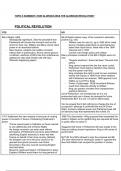
TOPIC 5 SUMMARY- HOW GLORIOUS WAS THE GLORIOUS REVOLUTION?
POLITICAL REVOLUTION
YES NO
Bill of Rights 1689 Bill of Rights retains many of the monarch’s absolutist
- Ideologically significant. Sets the precedent that powers e.g. veto
Parliament will choose the monarch and set the - William uses his veto 2x, eg in 1692 bill to make
terms for their rule- William and Mary cannot claim tenure of judges dependent on good behaviour
power in an absolutist fashion. rather than royal favour, initial veto of the 1694
- New clauses- subjects can petition monarch Triennial Act in 1693
without fear of prosecution, throne cannot pass to - Control over foreign policy and military
a Catholic, elections of MPs free from interference Many principles contained in the Bill of Rights were not
(attempt to stop what Charles did with Quo new
Warranto happening again) - “Regular elections”- there had been Triennial Acts
before.
- King cannot suspend the law (he never could)
- Parliament must approve taxation (they always
had the power over this)
- King maintains the right to pick his own ministers
(sticks with Danby in 1690 even when relations
with Parliament are strained, 1689 appoints Lord
Halifax as Lord Privy Seal)
- Power of patronage- 16/26 incumbent Bishops
owed their influence directly to William
- King can pardon ministers from impeachment
(pardons Somers)
Act of Parliament- not revolutionary as it is not
entrenched and can in theory be reversed bu future
Parliaments BUT it is not- it is still in effect today.
Can be argued that it did nothing but change the line of
succession- although it confirmed the end of Divine
Right, monarch retained power and Parliament was still
an advisory body that represented the richest 2%.
1701 Settlement Act saw masses of amounts of curbing 1696 The Association- Whig proposal that reasserted the
power of monarch in favour of bolstering Parliament’s belief in William as the rightful King and required all those
power in public office to swear it.
- Throne cannot pass to Catholics or those married
to one (effectively end of Divine Right) Suggests that those in Parliament still saw loyalty to the
- No foreign monarch can enter wars without King as holding utmost importance- King is still centre of
permission of Parliament (concerns about William government
sacrificing English economy to enter war with
France on behalf of his home country Holland) BUT 89 Tory MPs refused to sign the proposal and 86
- No foreigner can sit in the privy council or be JPs were removed for refusing to swear it- opposed the
granted land grants (concern over Dutch idea that William had usurped the position of James.
favourites in the privy council receiving English
land and titles)
- Monarch needs permission of Parliament to leave
England (William would leave for long periods of
, time to go to war, leaving Mary as Regent)
- Parliament chooses Sophia of Hanover as the
successor- confirms the end of Divine Right. (Fear
over the next monarch being James Stuart as
neither Mary nor Anne had children.)
- Parliament can impeach King’s ministers without
his intervention to pardon them= they demote
Montague, Russel resigns due to pressure, and
impeachment proceedings opened against
Somers force him to resign. An affront to the
King’s right to political patronage and to choose
his own ministers, diminishes his ability to “rule”
over the country with a cabinet of allies.
- All matters to be discussed with the full privy
council (concern over William using a smaller
cabinet of allies to make key decisions rather than
the privy council)
Mutiny Act 1689 made Parliament a pre eminent part of
government- gave William the power to punish mutineers
in court martials but had to be renewed every year-
necessitated the calling of Parliament. Removed
monarch’s ability to dominate Parliament by not calling
them and ruling alone- forced co operation and shared
power.
William had to use it as there were factions of the army
who were still loyal to James, and since William was at
war with France he needed a wholly loyal army.
Triennial Act 1694. Not revolutionary
- Closes loophole in the Bill of Rights requirement - There had been 2 Triennial Acts passed before-
for frequent elections in 1641 and 1664, neither of which had been
- Hard for King to build up a loyal faction in enforced well (Protectorate and 2nd Stuart
Parliament due to frequent elections (6 between personal rule.)
1689 and 1701)- rage of the party. Only 14% of - Political position still seen as stepping stones to
MPs engaged in cross party voting after 1695= places in the King’s higher office- competition of
politics becomes more about party loyalty than favour of the King continued to shape politics.
loyalty to the King, he is no longer the centre of
government.
- Triennial act represents decreasing dominance of
royal power as he is forced to pass legislation
against his will in order to secure funds for war.
Parliamentary control over finance makes them a
permanent partner in government
- 1697 Country opposition pass a law that says
Parliament will only fund the army of 10,000,
reduced to 7,000 in 1698
- 1698 Civil List Act effectively also removed his
control over foreign policy- Parliament has control
over military expenditure. Also had to be renewed
POLITICAL REVOLUTION
YES NO
Bill of Rights 1689 Bill of Rights retains many of the monarch’s absolutist
- Ideologically significant. Sets the precedent that powers e.g. veto
Parliament will choose the monarch and set the - William uses his veto 2x, eg in 1692 bill to make
terms for their rule- William and Mary cannot claim tenure of judges dependent on good behaviour
power in an absolutist fashion. rather than royal favour, initial veto of the 1694
- New clauses- subjects can petition monarch Triennial Act in 1693
without fear of prosecution, throne cannot pass to - Control over foreign policy and military
a Catholic, elections of MPs free from interference Many principles contained in the Bill of Rights were not
(attempt to stop what Charles did with Quo new
Warranto happening again) - “Regular elections”- there had been Triennial Acts
before.
- King cannot suspend the law (he never could)
- Parliament must approve taxation (they always
had the power over this)
- King maintains the right to pick his own ministers
(sticks with Danby in 1690 even when relations
with Parliament are strained, 1689 appoints Lord
Halifax as Lord Privy Seal)
- Power of patronage- 16/26 incumbent Bishops
owed their influence directly to William
- King can pardon ministers from impeachment
(pardons Somers)
Act of Parliament- not revolutionary as it is not
entrenched and can in theory be reversed bu future
Parliaments BUT it is not- it is still in effect today.
Can be argued that it did nothing but change the line of
succession- although it confirmed the end of Divine
Right, monarch retained power and Parliament was still
an advisory body that represented the richest 2%.
1701 Settlement Act saw masses of amounts of curbing 1696 The Association- Whig proposal that reasserted the
power of monarch in favour of bolstering Parliament’s belief in William as the rightful King and required all those
power in public office to swear it.
- Throne cannot pass to Catholics or those married
to one (effectively end of Divine Right) Suggests that those in Parliament still saw loyalty to the
- No foreign monarch can enter wars without King as holding utmost importance- King is still centre of
permission of Parliament (concerns about William government
sacrificing English economy to enter war with
France on behalf of his home country Holland) BUT 89 Tory MPs refused to sign the proposal and 86
- No foreigner can sit in the privy council or be JPs were removed for refusing to swear it- opposed the
granted land grants (concern over Dutch idea that William had usurped the position of James.
favourites in the privy council receiving English
land and titles)
- Monarch needs permission of Parliament to leave
England (William would leave for long periods of
, time to go to war, leaving Mary as Regent)
- Parliament chooses Sophia of Hanover as the
successor- confirms the end of Divine Right. (Fear
over the next monarch being James Stuart as
neither Mary nor Anne had children.)
- Parliament can impeach King’s ministers without
his intervention to pardon them= they demote
Montague, Russel resigns due to pressure, and
impeachment proceedings opened against
Somers force him to resign. An affront to the
King’s right to political patronage and to choose
his own ministers, diminishes his ability to “rule”
over the country with a cabinet of allies.
- All matters to be discussed with the full privy
council (concern over William using a smaller
cabinet of allies to make key decisions rather than
the privy council)
Mutiny Act 1689 made Parliament a pre eminent part of
government- gave William the power to punish mutineers
in court martials but had to be renewed every year-
necessitated the calling of Parliament. Removed
monarch’s ability to dominate Parliament by not calling
them and ruling alone- forced co operation and shared
power.
William had to use it as there were factions of the army
who were still loyal to James, and since William was at
war with France he needed a wholly loyal army.
Triennial Act 1694. Not revolutionary
- Closes loophole in the Bill of Rights requirement - There had been 2 Triennial Acts passed before-
for frequent elections in 1641 and 1664, neither of which had been
- Hard for King to build up a loyal faction in enforced well (Protectorate and 2nd Stuart
Parliament due to frequent elections (6 between personal rule.)
1689 and 1701)- rage of the party. Only 14% of - Political position still seen as stepping stones to
MPs engaged in cross party voting after 1695= places in the King’s higher office- competition of
politics becomes more about party loyalty than favour of the King continued to shape politics.
loyalty to the King, he is no longer the centre of
government.
- Triennial act represents decreasing dominance of
royal power as he is forced to pass legislation
against his will in order to secure funds for war.
Parliamentary control over finance makes them a
permanent partner in government
- 1697 Country opposition pass a law that says
Parliament will only fund the army of 10,000,
reduced to 7,000 in 1698
- 1698 Civil List Act effectively also removed his
control over foreign policy- Parliament has control
over military expenditure. Also had to be renewed


