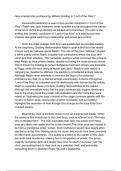
The military in *Othello* serves as the foundation upon which Shakespeare
constructs the play’s central tensions, character identities, and tragic trajectory.
From the opening scenes, the martial world of Venice defines Othello’s social
standing, shapes the play’s language and imagery, and ultimately becomes the
lens through which personal relationships are distorted with catastrophic
consequences. The military setting provides not just background but becomes an
active force that both elevates and destroys the protagonist, exposing the fragile
nature of reputation and the dangerous intersection between professional duty
and private life.
Othello’s identity as a military leader grants him status in Venetian society that
would otherwise be denied to him as a Moor. The Duke’s immediate deference
to Othello’s expertise – “Valiant Othello, we must straight employ you against
the general enemy Ottoman” – demonstrates how military necessity temporarily
overrides racial prejudice. However, this respect proves conditional and
precarious. The same society that depends on his battlefield prowess remains
uneasy about his marriage to Desdemona, revealing the limits of his social
acceptance. Iago expertly exploits this tension, recognizing that while Othello
commands armies, he remains vulnerable to insinuations about his personal life.
The military honor that elevates Othello simultaneously isolates him, making
him susceptible to Iago’s manipulations precisely because his worldview has
been shaped by the straightforward codes of warfare rather than the
complexities of civilian society.
Shakespeare employs military imagery throughout the play to reflect both
Othello’s psychology and Iago’s manipulative strategies. Othello’s speech
naturally reverts to the language of campaigns and combat, even when
discussing matters of love. His agonized lament – “Farewell the tranquil mind!
Farewell content! Farewell the plumèd troops and the big wars that make
ambition virtue!” – reveals his inability to conceive of identity outside of his
military role. This martial mindset becomes increasingly destructive as Iago
reframes domestic concerns as military crises. When Iago warns that “good
name in man and woman is the immediate jewel of their souls,” he deliberately
appeals to Othello’s soldierly understanding of honor. The handkerchief, a
trivial domestic item, becomes “ocular proof” in Othello’s mind, transformed
through Iago’s rhetoric from a love token into battlefield evidence of treason.
constructs the play’s central tensions, character identities, and tragic trajectory.
From the opening scenes, the martial world of Venice defines Othello’s social
standing, shapes the play’s language and imagery, and ultimately becomes the
lens through which personal relationships are distorted with catastrophic
consequences. The military setting provides not just background but becomes an
active force that both elevates and destroys the protagonist, exposing the fragile
nature of reputation and the dangerous intersection between professional duty
and private life.
Othello’s identity as a military leader grants him status in Venetian society that
would otherwise be denied to him as a Moor. The Duke’s immediate deference
to Othello’s expertise – “Valiant Othello, we must straight employ you against
the general enemy Ottoman” – demonstrates how military necessity temporarily
overrides racial prejudice. However, this respect proves conditional and
precarious. The same society that depends on his battlefield prowess remains
uneasy about his marriage to Desdemona, revealing the limits of his social
acceptance. Iago expertly exploits this tension, recognizing that while Othello
commands armies, he remains vulnerable to insinuations about his personal life.
The military honor that elevates Othello simultaneously isolates him, making
him susceptible to Iago’s manipulations precisely because his worldview has
been shaped by the straightforward codes of warfare rather than the
complexities of civilian society.
Shakespeare employs military imagery throughout the play to reflect both
Othello’s psychology and Iago’s manipulative strategies. Othello’s speech
naturally reverts to the language of campaigns and combat, even when
discussing matters of love. His agonized lament – “Farewell the tranquil mind!
Farewell content! Farewell the plumèd troops and the big wars that make
ambition virtue!” – reveals his inability to conceive of identity outside of his
military role. This martial mindset becomes increasingly destructive as Iago
reframes domestic concerns as military crises. When Iago warns that “good
name in man and woman is the immediate jewel of their souls,” he deliberately
appeals to Othello’s soldierly understanding of honor. The handkerchief, a
trivial domestic item, becomes “ocular proof” in Othello’s mind, transformed
through Iago’s rhetoric from a love token into battlefield evidence of treason.