
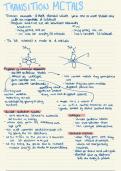
TRANSITION METALS
Transition & block element which
elements -
form one or more stable ions
with an incomplete -subshell
·
Scadium and Zinc are not transition elements
scadium Zinc
only forms one ion
only forms one ion
-
-
-
ion has an
empty 3d orbitals
-
has a complete 3d subshell
-
The 3d subshell is made of d orbitals
3dxy 3d
Properties or
Yaens -
-variable oxidation states
>
-
behave as catalysts like normal metals
they form positive
-
-
S
form complexions ions
-
-
however
-form coloured they can form multiple
compoundsding
-
what different positive ions
since
they have ligands are present
various oxidation
they will have
different colours
states
they can act
as catalysts by gaining or
losing a
complexion is a molecule
electrons or ion with a central transition ion and
bonded dative covalent bonds
ligands by
Variable oxidation states
-
arise because the 3d and 4s subshells catalysts
are similar in variable oxidation states
energy
-
when ions 4s electrons between them
form
-
are
-
can move
lost first -
can
catalyse redoxreactions
-
the most common oxidation state is a
by electrons Vacant d orbitals
losing the 45
-
at the start of the period it is easierfor
-
when they form ions
They
all 3d electrons to be cost have vacant orbital
at the end of the period due to increased which are
energetically
-
its harder to remove electrons
nuclear
charge accessible
allows for dative bond with
ligands
-
-
donated pair of electrons
fills the emptya orbital
, complex ions
Geometry
complex - molecule formed by
or ion linear
central transition metal ion two
ligands
-
a
1800
surrounded
by one or more
-
HsN : -CuiNHs
ligands
if charged it is a complexion tetrahedral
-
transition element accepts electrons four coordinate bonds
-
-
into its d orbital
?
complex formation d7109 .
5
ligands form dative bonds
&
-
by donating a
pair of electrons
into o orbitals
go empty
-
CI
Square planar
Complexes with water and ammonia -
four coordinate bonds
and both
-
water amonia are -
Cis platin
neutral ligands
p. .
monodentate
ligands have one
-
-
come pair =
one bond
small so6 fit around
-
can
-
co-ordination number =
number of
dative bonds Octahedral
-
here it is 6
-
Six coordinate bonds
-
these complexes therefore have an -
900
octahedral shape
980 bond
angle
-
LIGAND EXCHANGE
complexes with hydroxide andehoridsions >
- when one
ligand is replaced with
negatively charged ligands
-
another
-
monodante -
Forms a MORE stable complex
-
hydroxides can fit 6 as only aresmall -
the ligands can be partially or
clorides fit 4 as
they are large fullyexchanged
-
can
Ligand Copper exchange
-
molecule or ion with one or more love -
when in solution it is
pairs of electrons copper hexaaqua
Blue solution
Monodentate [Cu(H20) s ]* >
-
bond
one love pair one
LAddition of OH-
-
-
Bidentate
-
two lone pairs - two bonds [u(H20)(OH) ] ,
- pare blue
precipitate
Polydentate Laddition of conc .
NH
multiple lone pairs multiple bonds
ba
=
e
-
[cu (NHs(H2O)c] deep -
on
Transition & block element which
elements -
form one or more stable ions
with an incomplete -subshell
·
Scadium and Zinc are not transition elements
scadium Zinc
only forms one ion
only forms one ion
-
-
-
ion has an
empty 3d orbitals
-
has a complete 3d subshell
-
The 3d subshell is made of d orbitals
3dxy 3d
Properties or
Yaens -
-variable oxidation states
>
-
behave as catalysts like normal metals
they form positive
-
-
S
form complexions ions
-
-
however
-form coloured they can form multiple
compoundsding
-
what different positive ions
since
they have ligands are present
various oxidation
they will have
different colours
states
they can act
as catalysts by gaining or
losing a
complexion is a molecule
electrons or ion with a central transition ion and
bonded dative covalent bonds
ligands by
Variable oxidation states
-
arise because the 3d and 4s subshells catalysts
are similar in variable oxidation states
energy
-
when ions 4s electrons between them
form
-
are
-
can move
lost first -
can
catalyse redoxreactions
-
the most common oxidation state is a
by electrons Vacant d orbitals
losing the 45
-
at the start of the period it is easierfor
-
when they form ions
They
all 3d electrons to be cost have vacant orbital
at the end of the period due to increased which are
energetically
-
its harder to remove electrons
nuclear
charge accessible
allows for dative bond with
ligands
-
-
donated pair of electrons
fills the emptya orbital
, complex ions
Geometry
complex - molecule formed by
or ion linear
central transition metal ion two
ligands
-
a
1800
surrounded
by one or more
-
HsN : -CuiNHs
ligands
if charged it is a complexion tetrahedral
-
transition element accepts electrons four coordinate bonds
-
-
into its d orbital
?
complex formation d7109 .
5
ligands form dative bonds
&
-
by donating a
pair of electrons
into o orbitals
go empty
-
CI
Square planar
Complexes with water and ammonia -
four coordinate bonds
and both
-
water amonia are -
Cis platin
neutral ligands
p. .
monodentate
ligands have one
-
-
come pair =
one bond
small so6 fit around
-
can
-
co-ordination number =
number of
dative bonds Octahedral
-
here it is 6
-
Six coordinate bonds
-
these complexes therefore have an -
900
octahedral shape
980 bond
angle
-
LIGAND EXCHANGE
complexes with hydroxide andehoridsions >
- when one
ligand is replaced with
negatively charged ligands
-
another
-
monodante -
Forms a MORE stable complex
-
hydroxides can fit 6 as only aresmall -
the ligands can be partially or
clorides fit 4 as
they are large fullyexchanged
-
can
Ligand Copper exchange
-
molecule or ion with one or more love -
when in solution it is
pairs of electrons copper hexaaqua
Blue solution
Monodentate [Cu(H20) s ]* >
-
bond
one love pair one
LAddition of OH-
-
-
Bidentate
-
two lone pairs - two bonds [u(H20)(OH) ] ,
- pare blue
precipitate
Polydentate Laddition of conc .
NH
multiple lone pairs multiple bonds
ba
=
e
-
[cu (NHs(H2O)c] deep -
on


