‘Explain and analyse three theories of representation’ (9 Marks) – Mercy
Section A
8/9
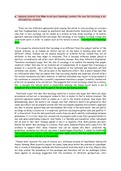
One theory of representation is the Delegate Theory. This is the idea that the
most important job of an MP is to listen to the views of their constituents. An
MP should be a mouthpiece for their community within Parliament. An
example of the delegate theory in action is when Conservative MP Zac
Goldsmith promised that he would resign if the conservative government went
ahead with building a third runway at Heathrow airport. The government
followed through with their plan and he subsequently resigned. Despite both
Goldsmith and the government being in the same party, he took it upon
himself to represent the views of his constituency rather than the views of the
government. However, to analyse the significance of the delegate model, it is
important to note that during Zac Goldsmiths by-election he actually lost his
seat. Furthermore, there are some significant issues with the delegate model,
one being the access to true community views. MPs can only accurately
represent their constituents if they are able to get everyone's true view point,
by using surgeries, phone calls and radio shows the MP will only get the views
of a certain demographic. For example, a single mother of three children will
not have the time to go to a surgery where as a retired business owner will.
This means that the delegate theory may not work as MPs are unable to truly
represent their constituents.
Another model is the Mandate Theory. This is the idea that MPs should follow
their party line at all times because their constituency voted for a political party
rather than them as a person. An example of this is when Frank Field, a Labour
MP for Birkenhead resigned after 40 years of representation. He had views in
favour of Brexit and did not agree with the Labour stance of remain. He ran
against Labour and, despite the public support he was expected to have after
40 years, he lost his seat by a huge number of votes. This is evidence of how
the electorate seem to vote for a political party rather than a person. It could
Section A
8/9
One theory of representation is the Delegate Theory. This is the idea that the
most important job of an MP is to listen to the views of their constituents. An
MP should be a mouthpiece for their community within Parliament. An
example of the delegate theory in action is when Conservative MP Zac
Goldsmith promised that he would resign if the conservative government went
ahead with building a third runway at Heathrow airport. The government
followed through with their plan and he subsequently resigned. Despite both
Goldsmith and the government being in the same party, he took it upon
himself to represent the views of his constituency rather than the views of the
government. However, to analyse the significance of the delegate model, it is
important to note that during Zac Goldsmiths by-election he actually lost his
seat. Furthermore, there are some significant issues with the delegate model,
one being the access to true community views. MPs can only accurately
represent their constituents if they are able to get everyone's true view point,
by using surgeries, phone calls and radio shows the MP will only get the views
of a certain demographic. For example, a single mother of three children will
not have the time to go to a surgery where as a retired business owner will.
This means that the delegate theory may not work as MPs are unable to truly
represent their constituents.
Another model is the Mandate Theory. This is the idea that MPs should follow
their party line at all times because their constituency voted for a political party
rather than them as a person. An example of this is when Frank Field, a Labour
MP for Birkenhead resigned after 40 years of representation. He had views in
favour of Brexit and did not agree with the Labour stance of remain. He ran
against Labour and, despite the public support he was expected to have after
40 years, he lost his seat by a huge number of votes. This is evidence of how
the electorate seem to vote for a political party rather than a person. It could