

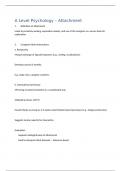
A Level Psychology – Attachment
1. 📌 Definition of Attachment
Leads to proximity-seeking, separation anxiety, and use of the caregiver as a secure base for
exploration.
2. 👶 Caregiver-Infant Interactions
a. Reciprocity
Mutual exchange of signals/responses (e.g., smiling, vocalisations).
Develops around 3 months.
E.g., baby cries, caregiver comforts.
b. Interactional Synchrony
Mirroring of actions/emotions in a coordinated way.
Meltzoff & Moore (1977):
Found infants as young as 2-3 weeks could imitate facial expressions (e.g., tongue protrusion).
Suggests innate capacity for interaction.
Evaluation:
✅ Supports biological basis of attachment
❌ Hard to interpret infant behavior – inference-based
, ❌ Does not explain long-term impact
3. 🧒 Stages of Attachment (Schaffer & Emerson, 1964)
Study: 60 babies in Glasgow, observed monthly for 1 year + follow-up at 18 months.
Stages:
Asocial Stage (0–6 weeks)
Similar response to objects and humans
Preference for human faces
Indiscriminate Attachment (6 weeks – 6 months)
Preference for people
Accept comfort from anyone
Specific Attachment (7 months)
Separation anxiety from primary caregiver
Stranger anxiety appears
Multiple Attachments (9+ months)
1. 📌 Definition of Attachment
Leads to proximity-seeking, separation anxiety, and use of the caregiver as a secure base for
exploration.
2. 👶 Caregiver-Infant Interactions
a. Reciprocity
Mutual exchange of signals/responses (e.g., smiling, vocalisations).
Develops around 3 months.
E.g., baby cries, caregiver comforts.
b. Interactional Synchrony
Mirroring of actions/emotions in a coordinated way.
Meltzoff & Moore (1977):
Found infants as young as 2-3 weeks could imitate facial expressions (e.g., tongue protrusion).
Suggests innate capacity for interaction.
Evaluation:
✅ Supports biological basis of attachment
❌ Hard to interpret infant behavior – inference-based
, ❌ Does not explain long-term impact
3. 🧒 Stages of Attachment (Schaffer & Emerson, 1964)
Study: 60 babies in Glasgow, observed monthly for 1 year + follow-up at 18 months.
Stages:
Asocial Stage (0–6 weeks)
Similar response to objects and humans
Preference for human faces
Indiscriminate Attachment (6 weeks – 6 months)
Preference for people
Accept comfort from anyone
Specific Attachment (7 months)
Separation anxiety from primary caregiver
Stranger anxiety appears
Multiple Attachments (9+ months)


