

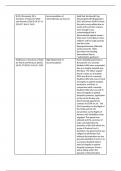
R (SG (Previously JS)) v Accommodation of Held that the Benefit Cap
Secretary of State for Work International Law Sources (Housing Benefit) Regulations
and Pensions [2015] UK SC 16 2012 did breach ECHR A14 but
[2015] 1 W.L.R. 1449 the policy was justified due to
social and economic reasons,
even though it was
acknowledged that it
discriminated against women
(they were more likely to have
children and be single parents
and thus were
disproportionately affected).
Lord Carnwarth [105]
described non-binding
international law as
“authoritative guidance”.
Mathieson v Secretary of State High Watermark of Facts: disability payments to
for Work and Pensions [2015] Accommodation the parents of a severely
UK SC 47 [2015] 1 W.L.R. 3250 disabled child were suspended
due to a lengthy hospital stay
(84 days). The father argued
that X's status on 6 October
2010 was that of a severely
disabled child who was in need
of lengthy in-patient hospital
treatment, and that, in
comparison with a severely
disabled child who was not in
need of lengthy in-patient
hospital treatment, application
to him of the 84-day rule
discriminated against him
contrary to ECHR art.14. The
UN Convention on the Right of
the Child and the UN
Convention on the Rights of
Persons with Disabilities were
engaged. The appeal was
allowed and the secretary of
state conceded that the
provision of DLA fell within the
scope of Protocol1 art.1;
therefore, the government was
obliged to administer DLA
without discrimination on any
grounds identified in art.14. As
a severely disabled child in
need of lengthy in-patient
hospital treatment, X had a
status falling within the
grounds of discrimination
, prohibited by art.14 The Court
ordered that X was entitled to
continued payment of DLA.
The SC noted this breach of
non-binding international laws
and considered whether it
impacted the claim. Lord
Wilson noted the breach and
referred to non-binding
international law as
“authoritative” – so the breach
of non-binding international
law here did impact the claim
in an informal way in that the
general principles of
international law were obeyed
and the domestic law
interpreted in harmony with
said international law. This
case represents a high
watermark of accommodation
on the part of judges in
relation to considering
international law and
implementing them informally
and/or implementing their
principles.
R (SC, CB & Eight Children) v Halt of Progressive Attitude A two-child limit was imposed
Secretary of State for Work & on “child tax credit” under the
Pensions [2021] UK SC 26 Tax Credits Act 2002 Pt 1
[2021] 3 W.L.R. 428 [73] Lord s.9(3A) and s.9(3B) for the
Reed payment of the individual
element of child tax credit. The
appellants appealed against a
decision that the two-child
limit applicable under the Tax
Credits Act 2002 Pt 1
s.9(3A) and s.9(3B) for the
payment of the individual
element of child tax credit was
incompatible with their rights
under the ECHR. Their appeals
were dismissed and held:
there was no breach of A8 as it
did not directly oblige the state
to provide a programme of
financial support for private or
family life; nor was there any
evidence that the legislation
had the indirect effect of
discouraging families from
Secretary of State for Work International Law Sources (Housing Benefit) Regulations
and Pensions [2015] UK SC 16 2012 did breach ECHR A14 but
[2015] 1 W.L.R. 1449 the policy was justified due to
social and economic reasons,
even though it was
acknowledged that it
discriminated against women
(they were more likely to have
children and be single parents
and thus were
disproportionately affected).
Lord Carnwarth [105]
described non-binding
international law as
“authoritative guidance”.
Mathieson v Secretary of State High Watermark of Facts: disability payments to
for Work and Pensions [2015] Accommodation the parents of a severely
UK SC 47 [2015] 1 W.L.R. 3250 disabled child were suspended
due to a lengthy hospital stay
(84 days). The father argued
that X's status on 6 October
2010 was that of a severely
disabled child who was in need
of lengthy in-patient hospital
treatment, and that, in
comparison with a severely
disabled child who was not in
need of lengthy in-patient
hospital treatment, application
to him of the 84-day rule
discriminated against him
contrary to ECHR art.14. The
UN Convention on the Right of
the Child and the UN
Convention on the Rights of
Persons with Disabilities were
engaged. The appeal was
allowed and the secretary of
state conceded that the
provision of DLA fell within the
scope of Protocol1 art.1;
therefore, the government was
obliged to administer DLA
without discrimination on any
grounds identified in art.14. As
a severely disabled child in
need of lengthy in-patient
hospital treatment, X had a
status falling within the
grounds of discrimination
, prohibited by art.14 The Court
ordered that X was entitled to
continued payment of DLA.
The SC noted this breach of
non-binding international laws
and considered whether it
impacted the claim. Lord
Wilson noted the breach and
referred to non-binding
international law as
“authoritative” – so the breach
of non-binding international
law here did impact the claim
in an informal way in that the
general principles of
international law were obeyed
and the domestic law
interpreted in harmony with
said international law. This
case represents a high
watermark of accommodation
on the part of judges in
relation to considering
international law and
implementing them informally
and/or implementing their
principles.
R (SC, CB & Eight Children) v Halt of Progressive Attitude A two-child limit was imposed
Secretary of State for Work & on “child tax credit” under the
Pensions [2021] UK SC 26 Tax Credits Act 2002 Pt 1
[2021] 3 W.L.R. 428 [73] Lord s.9(3A) and s.9(3B) for the
Reed payment of the individual
element of child tax credit. The
appellants appealed against a
decision that the two-child
limit applicable under the Tax
Credits Act 2002 Pt 1
s.9(3A) and s.9(3B) for the
payment of the individual
element of child tax credit was
incompatible with their rights
under the ECHR. Their appeals
were dismissed and held:
there was no breach of A8 as it
did not directly oblige the state
to provide a programme of
financial support for private or
family life; nor was there any
evidence that the legislation
had the indirect effect of
discouraging families from


