
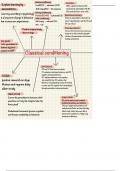
Before conditioning Extinction
Explain learning by Food(UCS) → salivation (UCR) After a period of time the CS
associations. Bell ringing(NS) → No response can loose its association with the
UCS and will return to be a NS
During conditioning
Learning according to psychology Spontaneous recovery
Paired UCS+NS →salivated(UCS)
is a long term change in behaviour After conditioning Once an association is formed it is
due to ones own experiences Bell ringing → salivated (CR) never truly forgotten and the CS and
CR can return
(NS →CS)
Stimuli generalisation
Pavlovs original study
Once a CR is formed it can come as a
done on dogs response to other stimuli and people
who learn by association will continue
making associations
Ivan pavlov
Later generalised to
humans by john b
Classical conditioning
watson an ABP
DIFFERENCE
OP and CC both done on animals
CC explains involuntary behaviour and OP
explains voluntary behaviour
CODA SLT explains behaviour and cognition
pavlovs research on dogs less scientific than CC explains that
behaviour is developed by seeing role models
Watson and rayners baby in action and CC explains that it is developed
albert study through association and generalisation
OBJECTION
Cannot be generalised to humans which CONCLUSION
CC can be used to treat irrational
questions not only the study but also the
problems like phobias and addiction
theory itself
Theory is supported by evidence and
study done by Pavlov and also the baby
Reductionist because it ignores cognition albert study where they were able to
demonstrate a phobia in a Baby using
and focuses completely on behaviour
classical conditioning
Explain learning by Food(UCS) → salivation (UCR) After a period of time the CS
associations. Bell ringing(NS) → No response can loose its association with the
UCS and will return to be a NS
During conditioning
Learning according to psychology Spontaneous recovery
Paired UCS+NS →salivated(UCS)
is a long term change in behaviour After conditioning Once an association is formed it is
due to ones own experiences Bell ringing → salivated (CR) never truly forgotten and the CS and
CR can return
(NS →CS)
Stimuli generalisation
Pavlovs original study
Once a CR is formed it can come as a
done on dogs response to other stimuli and people
who learn by association will continue
making associations
Ivan pavlov
Later generalised to
humans by john b
Classical conditioning
watson an ABP
DIFFERENCE
OP and CC both done on animals
CC explains involuntary behaviour and OP
explains voluntary behaviour
CODA SLT explains behaviour and cognition
pavlovs research on dogs less scientific than CC explains that
behaviour is developed by seeing role models
Watson and rayners baby in action and CC explains that it is developed
albert study through association and generalisation
OBJECTION
Cannot be generalised to humans which CONCLUSION
CC can be used to treat irrational
questions not only the study but also the
problems like phobias and addiction
theory itself
Theory is supported by evidence and
study done by Pavlov and also the baby
Reductionist because it ignores cognition albert study where they were able to
demonstrate a phobia in a Baby using
and focuses completely on behaviour
classical conditioning


