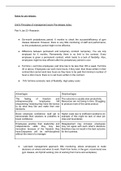
Elements of the Tort of Negligence
Background
- Elements
o 1. Did D owe C a Duty of Care?
o 2. Did D breach that duty by negligent conduct?
o 3. Did the D’s breach cause the C’s loss / damage? And was the breach not too remote?
- Preliminary Points
o Defendant may be able to raise a defence that can defeat the claim entirely or reduce the
damages paid.
o All elements are required to give rise to a claim.
o There can be multiple claimants or defendants.
Where 2 parties act together with a common plan they will be jointly and severally liable
which allows the claimant to sue both individually or each separately.
Several concurrent liability is when negligent action of 2 or more parties acting alone
cause the same damage
1. Did the Defendant have a Legal Duty of Care towards the Claimant? (Establishing the Duty)
- ‘Law only concerns itself with carelessness when there is a duty to take care and where failure in
that duty has caused damage.’
o Lord Macmillan - Donoghue v Stevenson [1932]
- Often Establishing the Duty of Care is Straightforward
o Law often makes it clear where a duty exists. (E.g. Dr to Patient – Pippin v Shepard [1882])
- Occasionally the court will need to establish if a duty of care exists on the facts.
o Courts have placed limitations on situations where a duty of care may exist.
Evident in Problematic duty areas such as where the injury suffered is purely psychiatric
or economic, where the defendant is a public body, acts of third parties who the
defendant is responsible for or when it is caused by an omission.
In these areas court have attempted to limit liability by holding that there is no duty or a
very narrow scope to establish a duty for public policy reasons.
2. Did the Defendant breach that duty by negligent conduct? (Is D at Fault)
- Standard of Reasonable Care
o If a defendant owes a duty of care their conduct must meet the standard of Reasonable
Care.
, - Breaching a Duty
o To Breach a duty therefore, their conduct must fall below the standard of Reasonable Care.
o Must establish that D was at fault (Premised on Fault) – It is not enough to show that D
harmed C, they must have harmed C as a result of failing to show reasonable care.
- Motive Irrelevant
o As negligence is a failure to show reasonable care it is describing conduct and not
referencing any state of mind.
3. Did the D’s breach cause the C’s loss / damage? And was the breach not too remote?
- Damages suffered by the Claimant must have been caused by the defendants breach of their
duty.
o There must be a causal link between the defendants fault (their breach of their duty) and
the damages caused.
- D must have Factually caused C’s loss (Factual Causation)
- The loss caused must not be too remote from the breach (legal causation)
How does a Defendant Breach their Duty – (Defendants Breach of Duty)
Element within the Tort of Negligence
- The tort of negligence: “Your fault” – focus: D’s conduct
Competing values in the Tort Law:
- Freedom of Action v. Freedom from Harm
o We want freedom to act as we please but doing (acts) or not doing (omission) things gives
rise to risks of harm.
, o Positive Acts v Omissions
“acts … are often worse than omissions … because they create the harms … and risks of
harm which omissions fail to remedy”
Tony Honore
E.g. Dr fails to give surgery to a patient = Omission but if they examine a patient and, in
the process, cut a vein that would be a positive act (act).
o Life is full of risky activity.
We want the benefits but not the detriments!
o Tort tries to balance these interests.
- Key Questions
o To what extent am I free to do what I want?
o To what extent am I protected from harm-causing acts or omissions?
o Where and how does tort law draw the line / balance these values?
Breach of Duty In the Tort of Negligence
- Defendant cannot by their Acts or Omissions unreasonably impose risks on others that result
in harm.
o Must be harm
o Mut be unreasonable conduct.
- If conduct is unreasonable, then you are in breach of a duty.
o If you do something or fail to do something, which the law classifies as being
unreasonable, then you are in breach of duty.
Background to Breach of Duty
, - C Bears proof to prove breach of duty.
o The claimant must prove the defendant has been negligent.
o If the defendant is asserting a positive defence, then generally, they must prove that.
- Breach of Duty
o Is conduct that falls below standard of care that is expected from a reasonable person.
- Conduct
o Question of Fact - What factually did Defendant do or not do.
- Fall below the standard of care of a Reasonable Person
o Standard which the law judges the behaviour of the defendant.
o Question of Law – Negligent conduct that was unreasonable.
Establishing Conduct was Unreasonable-
- 1: Was the risk that materialised (harm) because of D’s conduct foreseeable at the time of
the conduct?
o Objective test:
Was it a risk that could have been foreseen at the time of the conduct by anybody even
if D is consciously unaware of it.
(Low Threshold - Most risk is Foreseeable)
o Could anyone in D’s situation have foreseen the risk of harm at the time of alleged
wrongful act.
If anyone in D’s situation could have foreseen the risk of harm at the time of the alleged
wrongful act, then the harm was foreseeable.
(E.g. Anyone could foresee that Driving and Using a Phone might result in the driver
hitting somone.)
Note hindsight bias -
Makes risks much more foreseeable after they have occurred.
Roe v Minister of Health (1954)
Facts – Anaesthetic had been kept in a solution to keep it safe from bacteria. –
Solution had seeped through miniscule cracks of glass. - Nobody knew that that
could happen at the time of this incident. – Anaesthetic then used and they suffered
injuries.
Held - court said when deciding whether harm was foreseeable, they must look at it
at the time of the alleged wrongful act. - According to all the evidence presented in
the case, was, nobody could foresee it. – Therefore conduct was not unreasonable.
- 2: Should D have foreseen it?
o (Was the Risk reasonably foreseeable to the reasonable person with the defendant’s
knowledge and in the defendants position?)
Background
- Elements
o 1. Did D owe C a Duty of Care?
o 2. Did D breach that duty by negligent conduct?
o 3. Did the D’s breach cause the C’s loss / damage? And was the breach not too remote?
- Preliminary Points
o Defendant may be able to raise a defence that can defeat the claim entirely or reduce the
damages paid.
o All elements are required to give rise to a claim.
o There can be multiple claimants or defendants.
Where 2 parties act together with a common plan they will be jointly and severally liable
which allows the claimant to sue both individually or each separately.
Several concurrent liability is when negligent action of 2 or more parties acting alone
cause the same damage
1. Did the Defendant have a Legal Duty of Care towards the Claimant? (Establishing the Duty)
- ‘Law only concerns itself with carelessness when there is a duty to take care and where failure in
that duty has caused damage.’
o Lord Macmillan - Donoghue v Stevenson [1932]
- Often Establishing the Duty of Care is Straightforward
o Law often makes it clear where a duty exists. (E.g. Dr to Patient – Pippin v Shepard [1882])
- Occasionally the court will need to establish if a duty of care exists on the facts.
o Courts have placed limitations on situations where a duty of care may exist.
Evident in Problematic duty areas such as where the injury suffered is purely psychiatric
or economic, where the defendant is a public body, acts of third parties who the
defendant is responsible for or when it is caused by an omission.
In these areas court have attempted to limit liability by holding that there is no duty or a
very narrow scope to establish a duty for public policy reasons.
2. Did the Defendant breach that duty by negligent conduct? (Is D at Fault)
- Standard of Reasonable Care
o If a defendant owes a duty of care their conduct must meet the standard of Reasonable
Care.
, - Breaching a Duty
o To Breach a duty therefore, their conduct must fall below the standard of Reasonable Care.
o Must establish that D was at fault (Premised on Fault) – It is not enough to show that D
harmed C, they must have harmed C as a result of failing to show reasonable care.
- Motive Irrelevant
o As negligence is a failure to show reasonable care it is describing conduct and not
referencing any state of mind.
3. Did the D’s breach cause the C’s loss / damage? And was the breach not too remote?
- Damages suffered by the Claimant must have been caused by the defendants breach of their
duty.
o There must be a causal link between the defendants fault (their breach of their duty) and
the damages caused.
- D must have Factually caused C’s loss (Factual Causation)
- The loss caused must not be too remote from the breach (legal causation)
How does a Defendant Breach their Duty – (Defendants Breach of Duty)
Element within the Tort of Negligence
- The tort of negligence: “Your fault” – focus: D’s conduct
Competing values in the Tort Law:
- Freedom of Action v. Freedom from Harm
o We want freedom to act as we please but doing (acts) or not doing (omission) things gives
rise to risks of harm.
, o Positive Acts v Omissions
“acts … are often worse than omissions … because they create the harms … and risks of
harm which omissions fail to remedy”
Tony Honore
E.g. Dr fails to give surgery to a patient = Omission but if they examine a patient and, in
the process, cut a vein that would be a positive act (act).
o Life is full of risky activity.
We want the benefits but not the detriments!
o Tort tries to balance these interests.
- Key Questions
o To what extent am I free to do what I want?
o To what extent am I protected from harm-causing acts or omissions?
o Where and how does tort law draw the line / balance these values?
Breach of Duty In the Tort of Negligence
- Defendant cannot by their Acts or Omissions unreasonably impose risks on others that result
in harm.
o Must be harm
o Mut be unreasonable conduct.
- If conduct is unreasonable, then you are in breach of a duty.
o If you do something or fail to do something, which the law classifies as being
unreasonable, then you are in breach of duty.
Background to Breach of Duty
, - C Bears proof to prove breach of duty.
o The claimant must prove the defendant has been negligent.
o If the defendant is asserting a positive defence, then generally, they must prove that.
- Breach of Duty
o Is conduct that falls below standard of care that is expected from a reasonable person.
- Conduct
o Question of Fact - What factually did Defendant do or not do.
- Fall below the standard of care of a Reasonable Person
o Standard which the law judges the behaviour of the defendant.
o Question of Law – Negligent conduct that was unreasonable.
Establishing Conduct was Unreasonable-
- 1: Was the risk that materialised (harm) because of D’s conduct foreseeable at the time of
the conduct?
o Objective test:
Was it a risk that could have been foreseen at the time of the conduct by anybody even
if D is consciously unaware of it.
(Low Threshold - Most risk is Foreseeable)
o Could anyone in D’s situation have foreseen the risk of harm at the time of alleged
wrongful act.
If anyone in D’s situation could have foreseen the risk of harm at the time of the alleged
wrongful act, then the harm was foreseeable.
(E.g. Anyone could foresee that Driving and Using a Phone might result in the driver
hitting somone.)
Note hindsight bias -
Makes risks much more foreseeable after they have occurred.
Roe v Minister of Health (1954)
Facts – Anaesthetic had been kept in a solution to keep it safe from bacteria. –
Solution had seeped through miniscule cracks of glass. - Nobody knew that that
could happen at the time of this incident. – Anaesthetic then used and they suffered
injuries.
Held - court said when deciding whether harm was foreseeable, they must look at it
at the time of the alleged wrongful act. - According to all the evidence presented in
the case, was, nobody could foresee it. – Therefore conduct was not unreasonable.
- 2: Should D have foreseen it?
o (Was the Risk reasonably foreseeable to the reasonable person with the defendant’s
knowledge and in the defendants position?)