

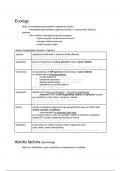
Ecology
- study of interrelationship between organisms (biotic);
- interrelationship between organisms (biotic) + environment (abiotic)
- purpose
- info to better understand natural processes
- improve quality of natural environment
- manage natural resources
- protect human health
Levels of organisation (lowest > highest)
species organisms interbreed + produce fertile offspring
How body features adapt to habitat?
population group of organisms of same species living in same habitat
How abiotic factors affect population size?
temp, light, rain/humidity, wind, oxygen level, salinity, substratum nature
community all populations of diff species (biotic) living in same habitat
w/ certain deg of interdependence:
- mutual tolerance commensalism
- beneficial interaction mutualism, competition
- feeding relationships predation, parasitism
- withstand any harmful effects
How diff species(biotic) interact?
ecosystem natural unit of living components + non-living components
- interact to form a self-supporting, stable yet dynamic system
eg. woodland, rocky shore, mangrove, stream
How materials cycled (btwn biotic + abiotic)?
carbon cycle, nitrogen cycle
biome similar ecosystems spanning large geographical area (on earth) with
similar climatic conditions
- characterised by dominant plant type
eg. savanna (africa, india, N australia, middle S america), grassland,
tropical RF, tundra, temperate deciduous forest
How changes in earth climate affect orgs in biome?
biosphere entire space on earth’s surface where organisms exist
(land, water, lower atmosphere)
How human activities affect ecological processes (global warming)?
Abiotic factors (non-living)
- affect no, distribution, types, behaviour of organisms in a habitat
, 1) Temperature
- how to measure
- air above + below canopy
- air above water surface + water temp
- affect distribution
- enzymes work best within narrow temp range
- catalyse metabolic reactions
- extreme temp: lower diversity of organisms
- affect behaviour
- poikilotherm: X maintain constant body temp
- need special adaptation > avoid overheating/cooling
- snake: hibernate @winter
- deciduous trees: shed leaves @winter
- homoiotherm: can maintain constant temp independent of habitat
temp
- by adaptation > less heat loss
- polar bear: thick layer of subcutaneous fat
- active in diff seasons in wide range of habitats
2) Light
- how to measure (with Lux meter; unit: Lux)
- affect behaviour
- plants
- (Light intensity) > affect rate of photosynthesis
- (Photoperiod) > affect flowering
- Epiphyllum 昙花, dragon fruit, cacti flower overnight +
wilt by morning
- rely on nocturnal animals (bats, moths) for
pollination + fertilisation
- animals
- diurnal animals: active @day + rest @night
- nocturnal animals: active @night (dark environment)
- develop good night vision, other special sensory
methods
- bats: detect echoes of sound
3) Rainfall + Humidity
- affect amt of water available
- affect behaviour
- limited water supply
- develop special mechanisms > retain water, reduce water loss
- cactus: spiny leaves
- camel: thick fur
- small desert animals: hide underground
- study of interrelationship between organisms (biotic);
- interrelationship between organisms (biotic) + environment (abiotic)
- purpose
- info to better understand natural processes
- improve quality of natural environment
- manage natural resources
- protect human health
Levels of organisation (lowest > highest)
species organisms interbreed + produce fertile offspring
How body features adapt to habitat?
population group of organisms of same species living in same habitat
How abiotic factors affect population size?
temp, light, rain/humidity, wind, oxygen level, salinity, substratum nature
community all populations of diff species (biotic) living in same habitat
w/ certain deg of interdependence:
- mutual tolerance commensalism
- beneficial interaction mutualism, competition
- feeding relationships predation, parasitism
- withstand any harmful effects
How diff species(biotic) interact?
ecosystem natural unit of living components + non-living components
- interact to form a self-supporting, stable yet dynamic system
eg. woodland, rocky shore, mangrove, stream
How materials cycled (btwn biotic + abiotic)?
carbon cycle, nitrogen cycle
biome similar ecosystems spanning large geographical area (on earth) with
similar climatic conditions
- characterised by dominant plant type
eg. savanna (africa, india, N australia, middle S america), grassland,
tropical RF, tundra, temperate deciduous forest
How changes in earth climate affect orgs in biome?
biosphere entire space on earth’s surface where organisms exist
(land, water, lower atmosphere)
How human activities affect ecological processes (global warming)?
Abiotic factors (non-living)
- affect no, distribution, types, behaviour of organisms in a habitat
, 1) Temperature
- how to measure
- air above + below canopy
- air above water surface + water temp
- affect distribution
- enzymes work best within narrow temp range
- catalyse metabolic reactions
- extreme temp: lower diversity of organisms
- affect behaviour
- poikilotherm: X maintain constant body temp
- need special adaptation > avoid overheating/cooling
- snake: hibernate @winter
- deciduous trees: shed leaves @winter
- homoiotherm: can maintain constant temp independent of habitat
temp
- by adaptation > less heat loss
- polar bear: thick layer of subcutaneous fat
- active in diff seasons in wide range of habitats
2) Light
- how to measure (with Lux meter; unit: Lux)
- affect behaviour
- plants
- (Light intensity) > affect rate of photosynthesis
- (Photoperiod) > affect flowering
- Epiphyllum 昙花, dragon fruit, cacti flower overnight +
wilt by morning
- rely on nocturnal animals (bats, moths) for
pollination + fertilisation
- animals
- diurnal animals: active @day + rest @night
- nocturnal animals: active @night (dark environment)
- develop good night vision, other special sensory
methods
- bats: detect echoes of sound
3) Rainfall + Humidity
- affect amt of water available
- affect behaviour
- limited water supply
- develop special mechanisms > retain water, reduce water loss
- cactus: spiny leaves
- camel: thick fur
- small desert animals: hide underground


