

Cell membrane
- differentially permeable
- made up of phospholipids + proteins
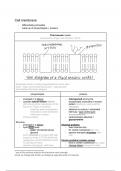
Fluid mosaic model
proposed by Singer and Nicolson (1972)
phosphate heads X widely separated/touch each other
draw + label: transmembrane protein + glycoprotein
add suitable title below diagram
phospholipids proteins
- arranged in a bilayer - interspersed among the
- constant lateral motion <fluid> phospholipid molecules in mosaic
drift among same layer/plane (X flip pattern randomly, asymmetrical
flop from 1 layer to another) <mosaic>
relatively weak hydrophobic - attached to surface / embedded
interactions hold membrane half-way / span entire layer
molecules in place transmembrane
X fixed position - carbohydrates attached >
glycoproteins
Structure
- arranged in a bilayer Channel proteins
- hydrophilic head - fixed channel size
- polar1 phosphate group - for certain substances eg. ions
- glycerol - passive transport: X energy slow
point outwards in contact with (aq) rate
solutions inside CYTOPLASM and
outside the cell EXTRACELLULAR Carrier proteins/ protein pumps
FLUID (tissue fluid) - bind to certain substances eg. sugar
electron micrograph: dark lines - change shape transport to other
1
one of the nucleus attracts the electrons more strongly
small -ve charge and small +ve charge at opposite ends of molecule
, - hydrophobic tail side
- non-polar2 fatty acids - active transport: energy fast rate
point inwards, protected from - against concentration gradient
contacting (aq) environment continue after equilibrium
electron micrograph: lighter region
Receptors ID card scanner
- bind to chemical msgers outside
cells
eg. hormones, neurotransmitters,
insulin (blood glucose regulation)
- relay msg to inside of cells
- may turn on activities in cells
Antigens ID card
- glycoproteins for cell recognition
- self vs foreign antigens
- not attack vs attack
Enzymes
- speed up chemical reactions
eg. breakdown of food substances
Development of discovery of structure of cell membrane
1895 Overton: lipid-soluble substances could penetrate cells easily
1917 Langmuir: major component of CM exhibited both water-loving and water-hating
properties
1925 Gorter + Grendal:
extracted lipids from the CM of red blood cells
spread the lipids in a single layer on a water surface
> area of layer was DOUBLE the surface area of CM
proposed the bilayer model 2 layers of lipids
1935 Davison + Danielli:
scientists observed 2 dark lines in electron micrograph of CM
> thought dark lines = protein layers
proposed the ‘sandwich’ model
phospholipids bilayer sandwiched between 2 layers of proteins3
1972 Singer + Nicolson:
scientists split CM of frozen cell, observed particles on inner surfaces
> suggesting proteins are interspersed among phospholipids
proposed the Fluid Mosaic Model
phospholipid bilayer with protein molecules interspersed in mosaic pattern
NOS
- scientific knowledge is tentative, subject to change
- doing science requires creativity and imagination
2
nuclei attract the electrons equally; molecule has no charged regions
3
those proteins extracted from membrane were mainly hydrophobic; X on surface of membrane in
contact with water
- differentially permeable
- made up of phospholipids + proteins
Fluid mosaic model
proposed by Singer and Nicolson (1972)
phosphate heads X widely separated/touch each other
draw + label: transmembrane protein + glycoprotein
add suitable title below diagram
phospholipids proteins
- arranged in a bilayer - interspersed among the
- constant lateral motion <fluid> phospholipid molecules in mosaic
drift among same layer/plane (X flip pattern randomly, asymmetrical
flop from 1 layer to another) <mosaic>
relatively weak hydrophobic - attached to surface / embedded
interactions hold membrane half-way / span entire layer
molecules in place transmembrane
X fixed position - carbohydrates attached >
glycoproteins
Structure
- arranged in a bilayer Channel proteins
- hydrophilic head - fixed channel size
- polar1 phosphate group - for certain substances eg. ions
- glycerol - passive transport: X energy slow
point outwards in contact with (aq) rate
solutions inside CYTOPLASM and
outside the cell EXTRACELLULAR Carrier proteins/ protein pumps
FLUID (tissue fluid) - bind to certain substances eg. sugar
electron micrograph: dark lines - change shape transport to other
1
one of the nucleus attracts the electrons more strongly
small -ve charge and small +ve charge at opposite ends of molecule
, - hydrophobic tail side
- non-polar2 fatty acids - active transport: energy fast rate
point inwards, protected from - against concentration gradient
contacting (aq) environment continue after equilibrium
electron micrograph: lighter region
Receptors ID card scanner
- bind to chemical msgers outside
cells
eg. hormones, neurotransmitters,
insulin (blood glucose regulation)
- relay msg to inside of cells
- may turn on activities in cells
Antigens ID card
- glycoproteins for cell recognition
- self vs foreign antigens
- not attack vs attack
Enzymes
- speed up chemical reactions
eg. breakdown of food substances
Development of discovery of structure of cell membrane
1895 Overton: lipid-soluble substances could penetrate cells easily
1917 Langmuir: major component of CM exhibited both water-loving and water-hating
properties
1925 Gorter + Grendal:
extracted lipids from the CM of red blood cells
spread the lipids in a single layer on a water surface
> area of layer was DOUBLE the surface area of CM
proposed the bilayer model 2 layers of lipids
1935 Davison + Danielli:
scientists observed 2 dark lines in electron micrograph of CM
> thought dark lines = protein layers
proposed the ‘sandwich’ model
phospholipids bilayer sandwiched between 2 layers of proteins3
1972 Singer + Nicolson:
scientists split CM of frozen cell, observed particles on inner surfaces
> suggesting proteins are interspersed among phospholipids
proposed the Fluid Mosaic Model
phospholipid bilayer with protein molecules interspersed in mosaic pattern
NOS
- scientific knowledge is tentative, subject to change
- doing science requires creativity and imagination
2
nuclei attract the electrons equally; molecule has no charged regions
3
those proteins extracted from membrane were mainly hydrophobic; X on surface of membrane in
contact with water


