

Unit 8 - Physiology of Human Body Systems
Learning Aim A: Understand the impacts of disorders of the musculoskeletal system and their
associated corrective treatments.
Assignment Title: Musculoskeletal Disorders
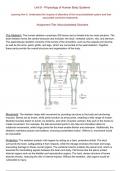
The Skeleton: The human skeleton comprises 206 bones and is divided into two main sections. The
axial skeleton forms the central structure and includes: the skull, vertebral column, ribs, and sternum.
The appendicular skeleton consists of the bones of the shoulders, such as the scapula and clavicle,
as well as the arms, pelvic girdle, and legs, which are connected to the axial skeleton. Together,
these parts provide the overall structure and organisation of the body.
Movement: The skeleton helps with movement by providing structure to the body and anchoring
muscles. Bones act as levers, while joints function as pivot points, enabling a wide range of motion.
Skeletal muscles attach to bones via tendons, and when muscles contract, they pull on the bones to
create movement. For example, the ball-and-socket joints in the hips and shoulders allow for
rotational movements, while hinge joints like the knee enable flexion and extension. Additionally, the
skeleton maintains posture and balance, ensuring coordinated motion. Without it, movement would
be impossible.
Protection: The skeleton protects vital organs by acting as a hard, protective shield. The skull
surrounds the brain, safeguarding it from impacts, while the ribcage encloses the heart and lungs,
preventing damage to these crucial organs. The vertebral column protects the spinal cord, which is
essential for transmitting signals between the brain and body. Flat bones like the pelvis protect
internal organs such as the bladder and reproductive organs. The hard, dense structure of bones
absorbs shocks, reducing the risk of internal injuries. Without the skeleton, vital organs would be
vulnerable to injury.
,Support: The skeleton provides support by forming a rigid framework that gives the body shape and
stability. The vertebral column supports the head and torso, allowing an individual to stand upright.
The pelvis provides a strong base to hold the upper body’s weight, while the leg bones, like the femur
and tibia, bear weight and keep the body upright. The ribcage supports the upper body and anchors
muscles involved in posture. Joints and ligaments help maintain balance, while cartilage prevents
bones from grinding during movement. All these structures ensure the body remains upright and
stable during standing and motion.
Producing Blood Cells: Bones are responsible for producing blood cells in the bone marrow, a soft
tissue found inside certain bones like the pelvis, femur, and sternum. Red bone marrow produces red
blood cells, which carry oxygen, white blood cells, which fight infections, and platelets, which help
with clotting. In younger people, most bones contain red marrow, but as a person gets older, some of
it turns into yellow marrow. Yellow marrow stores fat but can change back to red marrow if the body
needs more blood cells. The hard outer layer of bones, called compact bone, protects the bone
marrow and keeps it safe while it works.
Blood cell production in bone marrow occurs through a process called hematopoiesis. Inside the
bone marrow, there are special stem cells called hematopoietic stem cells. These cells can divide
and mature into three main types of blood cells: red blood cells, white blood cells, and platelets. The
process begins when the body signals a need for specific blood cells, like after an injury or during an
infection. The stem cells multiply and differentiate into precursor cells, which then develop into
mature blood cells. For example, red blood cells come from erythroblasts, white blood cells from
myeloblasts, and platelets from megakaryocytes. These cells are then released into the bloodstream
to perform their functions.
, Storing Minerals: The skeleton stores important minerals like calcium and phosphorus within the
hard tissue of bones. These minerals are deposited into the bone matrix, making the bones strong
and rigid. Bones act as a mineral reservoir, releasing these nutrients into the bloodstream when the
body needs them for various functions, such as muscle contraction, nerve signalling, and maintaining
overall balance in the body. This process is regulated by hormones to ensure proper levels of
minerals in the blood.
MINERAL FUNCTION
Calcium Strengthens bones and teeth; essential for muscle contraction, nerve
signalling, and blood clotting.
Phosphorus Works with calcium to build strong bones and teeth; supports energy
production and cell repair.
Magnesium Helps maintain bone density; supports muscle relaxation and nerve
function.
Sodium Regulates fluid balance and nerve impulses; supports muscle function.
Potassium Contributes to bone health; helps maintain proper muscle contractions and
nerve signals.
Fluoride Strengthens teeth and bones, helping to prevent decay and fractures.
Zinc Supports bone growth and repair; plays a role in cell division and immune
function.
Iron Found in small amounts in bones; helps transport oxygen in blood and
supports energy metabolism.
Copper Aids in collagen formation, which helps maintain bone strength.
Manganese Supports bone formation and cartilage production.
Silicon Plays a role in bone mineralisation and connective tissue health.
Boron Helps regulate calcium and magnesium metabolism for bone health.
Types of Bone Tissue: Bones are made of two main types of tissue: compact bone and spongy
bone. Compact bone is the dense, outer layer that provides strength, support, and protection. It
contains microscopic channels for blood vessels and nerves. Spongy bone, found inside bones, is
lighter and porous, helping to absorb shock and reduce weight. It also contains red bone marrow,
which produces blood cells. Surrounding the bone is the periosteum, a thin, protective layer that
nourishes the bone and supports growth and repair. Bone tissue is made up of tiny structural units
called osteons in compact bone, which contain blood vessels and nerves for nourishment. In spongy
bone, the network of trabeculae provides strength while keeping the bone lightweight. Bone cells like
osteoblasts, osteocytes, and osteoclasts work together to maintain and remodel bone tissue,
ensuring it stays strong and healthy throughout life. (1)
Learning Aim A: Understand the impacts of disorders of the musculoskeletal system and their
associated corrective treatments.
Assignment Title: Musculoskeletal Disorders
The Skeleton: The human skeleton comprises 206 bones and is divided into two main sections. The
axial skeleton forms the central structure and includes: the skull, vertebral column, ribs, and sternum.
The appendicular skeleton consists of the bones of the shoulders, such as the scapula and clavicle,
as well as the arms, pelvic girdle, and legs, which are connected to the axial skeleton. Together,
these parts provide the overall structure and organisation of the body.
Movement: The skeleton helps with movement by providing structure to the body and anchoring
muscles. Bones act as levers, while joints function as pivot points, enabling a wide range of motion.
Skeletal muscles attach to bones via tendons, and when muscles contract, they pull on the bones to
create movement. For example, the ball-and-socket joints in the hips and shoulders allow for
rotational movements, while hinge joints like the knee enable flexion and extension. Additionally, the
skeleton maintains posture and balance, ensuring coordinated motion. Without it, movement would
be impossible.
Protection: The skeleton protects vital organs by acting as a hard, protective shield. The skull
surrounds the brain, safeguarding it from impacts, while the ribcage encloses the heart and lungs,
preventing damage to these crucial organs. The vertebral column protects the spinal cord, which is
essential for transmitting signals between the brain and body. Flat bones like the pelvis protect
internal organs such as the bladder and reproductive organs. The hard, dense structure of bones
absorbs shocks, reducing the risk of internal injuries. Without the skeleton, vital organs would be
vulnerable to injury.
,Support: The skeleton provides support by forming a rigid framework that gives the body shape and
stability. The vertebral column supports the head and torso, allowing an individual to stand upright.
The pelvis provides a strong base to hold the upper body’s weight, while the leg bones, like the femur
and tibia, bear weight and keep the body upright. The ribcage supports the upper body and anchors
muscles involved in posture. Joints and ligaments help maintain balance, while cartilage prevents
bones from grinding during movement. All these structures ensure the body remains upright and
stable during standing and motion.
Producing Blood Cells: Bones are responsible for producing blood cells in the bone marrow, a soft
tissue found inside certain bones like the pelvis, femur, and sternum. Red bone marrow produces red
blood cells, which carry oxygen, white blood cells, which fight infections, and platelets, which help
with clotting. In younger people, most bones contain red marrow, but as a person gets older, some of
it turns into yellow marrow. Yellow marrow stores fat but can change back to red marrow if the body
needs more blood cells. The hard outer layer of bones, called compact bone, protects the bone
marrow and keeps it safe while it works.
Blood cell production in bone marrow occurs through a process called hematopoiesis. Inside the
bone marrow, there are special stem cells called hematopoietic stem cells. These cells can divide
and mature into three main types of blood cells: red blood cells, white blood cells, and platelets. The
process begins when the body signals a need for specific blood cells, like after an injury or during an
infection. The stem cells multiply and differentiate into precursor cells, which then develop into
mature blood cells. For example, red blood cells come from erythroblasts, white blood cells from
myeloblasts, and platelets from megakaryocytes. These cells are then released into the bloodstream
to perform their functions.
, Storing Minerals: The skeleton stores important minerals like calcium and phosphorus within the
hard tissue of bones. These minerals are deposited into the bone matrix, making the bones strong
and rigid. Bones act as a mineral reservoir, releasing these nutrients into the bloodstream when the
body needs them for various functions, such as muscle contraction, nerve signalling, and maintaining
overall balance in the body. This process is regulated by hormones to ensure proper levels of
minerals in the blood.
MINERAL FUNCTION
Calcium Strengthens bones and teeth; essential for muscle contraction, nerve
signalling, and blood clotting.
Phosphorus Works with calcium to build strong bones and teeth; supports energy
production and cell repair.
Magnesium Helps maintain bone density; supports muscle relaxation and nerve
function.
Sodium Regulates fluid balance and nerve impulses; supports muscle function.
Potassium Contributes to bone health; helps maintain proper muscle contractions and
nerve signals.
Fluoride Strengthens teeth and bones, helping to prevent decay and fractures.
Zinc Supports bone growth and repair; plays a role in cell division and immune
function.
Iron Found in small amounts in bones; helps transport oxygen in blood and
supports energy metabolism.
Copper Aids in collagen formation, which helps maintain bone strength.
Manganese Supports bone formation and cartilage production.
Silicon Plays a role in bone mineralisation and connective tissue health.
Boron Helps regulate calcium and magnesium metabolism for bone health.
Types of Bone Tissue: Bones are made of two main types of tissue: compact bone and spongy
bone. Compact bone is the dense, outer layer that provides strength, support, and protection. It
contains microscopic channels for blood vessels and nerves. Spongy bone, found inside bones, is
lighter and porous, helping to absorb shock and reduce weight. It also contains red bone marrow,
which produces blood cells. Surrounding the bone is the periosteum, a thin, protective layer that
nourishes the bone and supports growth and repair. Bone tissue is made up of tiny structural units
called osteons in compact bone, which contain blood vessels and nerves for nourishment. In spongy
bone, the network of trabeculae provides strength while keeping the bone lightweight. Bone cells like
osteoblasts, osteocytes, and osteoclasts work together to maintain and remodel bone tissue,
ensuring it stays strong and healthy throughout life. (1)


