Perfect competition, imperfectly competitive markets
and monopoly
Market structures
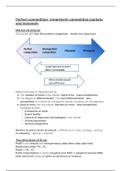
Concerned with how the market is organised - shown on a spectrum.
Market structure is characterised by:
● The number of firms in the market. More firms - more competitive.
● The degree of differentiation. The more differentiated - less
competitive. In a perfectly competitive market, products are homogenous.
● Ease of entry into the market. Barriers to entry - less competitive.
Examples include:
○ Economies of scale
○ Brand loyalty
○ Control of important technologies in the market
○ Strong reputation
○ Vertical integration
Barriers to entry can be structural - differences in costs, strategy + pricing
or statutory - patents + licences.
The objectives of firms
Profit is the reward that entrepreneurs yield when they take risks.
Break even when TR = TC.
Profit = TR - TC.
Profit maximisation is where marginal cost (MC) = marginal revenue (MR).
Each extra unit produced gives no extra loss or revenue.
,Profits increase when MR > MC.
Profits decrease when MC > MR.
Maximising profits:
● Higher wages + dividends
● Retained profits don’t entail interest charges
● Satisfies shareholders particularly in PLCs
Divorce of ownership from control
When the agent makes decisions inclined to their own interests, rather than
the principals. Conflicting stakeholder objectives can’t always be satisfied
e.g. high salaries and large dividends, since funds are limited. When a
manager sells their shares, shareholders gain more control - could give rise
to ‘shareholder activism’ - put pressure on management + getting higher
dividends.
Other possible objectives of a firm
Survival:
● This is a short term view e.g. new firms in competitive markets or in a
recession
Growth:
● Taking advantage of economies of scale
● Expanding their product range or by M&A
● R&D might make them competitive in the long run
Increasing market share:
● Often achieved by maximising sales e.g. Amazon in the e-reader market
Quality:
, ● Improving customer service or quality of the good they produce
● Could be through innovation + gaining a reputation
Maximising revenue:
● Revenue maximisation occurs when MR = 0. Each extra unit sold
generates no extra revenue
At Q P1, the firm is operating at MR=0.
Sales maximisation:
● Sell as much goods + services as possible without making a loss e.g.
Not-for-profit organisations
● On a diagram this is where average costs (AC) = average revenue (AR)
The diagram below summarises each objective.
and monopoly
Market structures
Concerned with how the market is organised - shown on a spectrum.
Market structure is characterised by:
● The number of firms in the market. More firms - more competitive.
● The degree of differentiation. The more differentiated - less
competitive. In a perfectly competitive market, products are homogenous.
● Ease of entry into the market. Barriers to entry - less competitive.
Examples include:
○ Economies of scale
○ Brand loyalty
○ Control of important technologies in the market
○ Strong reputation
○ Vertical integration
Barriers to entry can be structural - differences in costs, strategy + pricing
or statutory - patents + licences.
The objectives of firms
Profit is the reward that entrepreneurs yield when they take risks.
Break even when TR = TC.
Profit = TR - TC.
Profit maximisation is where marginal cost (MC) = marginal revenue (MR).
Each extra unit produced gives no extra loss or revenue.
,Profits increase when MR > MC.
Profits decrease when MC > MR.
Maximising profits:
● Higher wages + dividends
● Retained profits don’t entail interest charges
● Satisfies shareholders particularly in PLCs
Divorce of ownership from control
When the agent makes decisions inclined to their own interests, rather than
the principals. Conflicting stakeholder objectives can’t always be satisfied
e.g. high salaries and large dividends, since funds are limited. When a
manager sells their shares, shareholders gain more control - could give rise
to ‘shareholder activism’ - put pressure on management + getting higher
dividends.
Other possible objectives of a firm
Survival:
● This is a short term view e.g. new firms in competitive markets or in a
recession
Growth:
● Taking advantage of economies of scale
● Expanding their product range or by M&A
● R&D might make them competitive in the long run
Increasing market share:
● Often achieved by maximising sales e.g. Amazon in the e-reader market
Quality:
, ● Improving customer service or quality of the good they produce
● Could be through innovation + gaining a reputation
Maximising revenue:
● Revenue maximisation occurs when MR = 0. Each extra unit sold
generates no extra revenue
At Q P1, the firm is operating at MR=0.
Sales maximisation:
● Sell as much goods + services as possible without making a loss e.g.
Not-for-profit organisations
● On a diagram this is where average costs (AC) = average revenue (AR)
The diagram below summarises each objective.