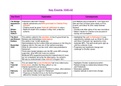
Key Events 1640-42
Key Event Explanation Consequences
The Bridge Proposed a deal with Charles: Lord Bedford (who proposed it), Lord Saye and
Appointme- • regular parliaments and MPs promoted to Charles Privy Sele and Earl of Essex given seats on Privy
nts Council. Council, and Oliver St John made Solicitor
• Charles would be given financial settlement in return. General.
Winter- • Bedford’s death from smallpox in May 1641 ended the • Charles took little notice of his new councillors.
Spring scheme. • Made it harder for Charles to be accused of
1640-41 having ‘evil counsellors’.
The Root This petition called for the abolition of church government by • Highlighted the split in Parliament; it was
and Branch Bishops and Archbishops (episcopacy). supported by radicals such as Oliver St John
Petition The petition had 15,000 signatures. and Oliver Cromwell, but rejected by more
Demonstrations by the London Mob put pressure on the King for moderate MPs. This split would grow right up
December religious reform- this was one of the earliest examples. until the outbreak of war.
1640 Oliver St John drew it up into a bill, which was presented to • Proposing very significant change and
Parliament. challenge to Charles’ power.
There were heated debates over the Bill; some MPs strongly
supported, other MPs felt it was too radical.
Moderate MPs supported pursuing the impeachment of Laud,
but not completely removing the episcopacy- too extreme.
Bill was so controversial it was shelved in August 1641.
The This act stated that a new Parliament had to be called every • Highlights Charles’ weakened position.
Triennial three years, whether the King called it or not. • Radical change to relationship between King
Act Charles signed this act because: and Parliament.
• Politically isolated, Laud and Strafford in prison, other advisors • Moderates satisfied.
February less talented, little support in Parliament. • Inspired radicals to want more change.
1641 • Presence of Scottish Army in the North of England made it
difficult for Charles not to sign the act.
, Key Event Explanation Consequences
The Trial of By 1640, Parliament saw Strafford as one of Charles’ ‘Evil counsellors’.
the Earl of Strafford was accused of high treason in November, was imprisoned
Strafford and the impeachment process began.
Strafford’s trial began on 22nd March 1641.
March-May Trial was significant for MPs such as Pym and Lord Saye and Sele;
1641 Strafford knew they had been in contact with the Scots and if he was not
found guilty he could turn the tables on them.
His trial was to take place in the House of Lords- worried MPs as the
bishops in Lords were likely to side with the King.
Charles attended- sat in a box hidden by a curtain, which he removed,
hoping that the sight of him would shame his opponents into siding with
him.
The Charge:
Accused Strafford of trying to establish ‘arbitrary’ government- argued
this was treasonous as it created divisions between the King and his
subjects.
Also accused of making excessive profits in Ireland and supporting
Laud’s ‘popish innovations’.
Critical evidence: ‘Your Majesty, you have an army in Ireland, which
you may use to reduce this kingdom’, presented by Henry Vane, who’s
Father had overheard him saying.
The prosecution argued that this comment was Strafford encouraging
Charles to use a Catholic Irish army against his English subjects to try
and impose absolutism.
Strafford’s Argument:
His actions should be seen individually and did not collectively add up to
treason. Claimed the army comment was about Scotland and the
Bishop’s Wars. Argued he was carrying out his King’s orders.
The prosecution was weak, one witness held a grudge against the Earl
and one was hard of hearing. Pym was worried the Lords wouldn’t find
him guilty, so brought the trial to an end on 10th April.
Key Event Explanation Consequences
The Bridge Proposed a deal with Charles: Lord Bedford (who proposed it), Lord Saye and
Appointme- • regular parliaments and MPs promoted to Charles Privy Sele and Earl of Essex given seats on Privy
nts Council. Council, and Oliver St John made Solicitor
• Charles would be given financial settlement in return. General.
Winter- • Bedford’s death from smallpox in May 1641 ended the • Charles took little notice of his new councillors.
Spring scheme. • Made it harder for Charles to be accused of
1640-41 having ‘evil counsellors’.
The Root This petition called for the abolition of church government by • Highlighted the split in Parliament; it was
and Branch Bishops and Archbishops (episcopacy). supported by radicals such as Oliver St John
Petition The petition had 15,000 signatures. and Oliver Cromwell, but rejected by more
Demonstrations by the London Mob put pressure on the King for moderate MPs. This split would grow right up
December religious reform- this was one of the earliest examples. until the outbreak of war.
1640 Oliver St John drew it up into a bill, which was presented to • Proposing very significant change and
Parliament. challenge to Charles’ power.
There were heated debates over the Bill; some MPs strongly
supported, other MPs felt it was too radical.
Moderate MPs supported pursuing the impeachment of Laud,
but not completely removing the episcopacy- too extreme.
Bill was so controversial it was shelved in August 1641.
The This act stated that a new Parliament had to be called every • Highlights Charles’ weakened position.
Triennial three years, whether the King called it or not. • Radical change to relationship between King
Act Charles signed this act because: and Parliament.
• Politically isolated, Laud and Strafford in prison, other advisors • Moderates satisfied.
February less talented, little support in Parliament. • Inspired radicals to want more change.
1641 • Presence of Scottish Army in the North of England made it
difficult for Charles not to sign the act.
, Key Event Explanation Consequences
The Trial of By 1640, Parliament saw Strafford as one of Charles’ ‘Evil counsellors’.
the Earl of Strafford was accused of high treason in November, was imprisoned
Strafford and the impeachment process began.
Strafford’s trial began on 22nd March 1641.
March-May Trial was significant for MPs such as Pym and Lord Saye and Sele;
1641 Strafford knew they had been in contact with the Scots and if he was not
found guilty he could turn the tables on them.
His trial was to take place in the House of Lords- worried MPs as the
bishops in Lords were likely to side with the King.
Charles attended- sat in a box hidden by a curtain, which he removed,
hoping that the sight of him would shame his opponents into siding with
him.
The Charge:
Accused Strafford of trying to establish ‘arbitrary’ government- argued
this was treasonous as it created divisions between the King and his
subjects.
Also accused of making excessive profits in Ireland and supporting
Laud’s ‘popish innovations’.
Critical evidence: ‘Your Majesty, you have an army in Ireland, which
you may use to reduce this kingdom’, presented by Henry Vane, who’s
Father had overheard him saying.
The prosecution argued that this comment was Strafford encouraging
Charles to use a Catholic Irish army against his English subjects to try
and impose absolutism.
Strafford’s Argument:
His actions should be seen individually and did not collectively add up to
treason. Claimed the army comment was about Scotland and the
Bishop’s Wars. Argued he was carrying out his King’s orders.
The prosecution was weak, one witness held a grudge against the Earl
and one was hard of hearing. Pym was worried the Lords wouldn’t find
him guilty, so brought the trial to an end on 10th April.