The Nature of Charles’ Personal Rule 1929-40
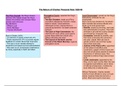
The Privy Council- the King’s chosen Prerogative Courts- asserted the King’s Local Government- carried out the King’s
advisors who helped shape the King’s authority. instructions, enforced his rule
wishes into policies and oversaw these • The Star Chamber: made up of Privy countrywide.
policies were enforced. councillors selected by monarch. Cases Each county was divided into ‘hundreds’-
Key Members: heard in secret. Could sentence each hundred had several officials who
• William Laud individuals to fines, imprisonment or made up its local government.
• Henry Montagu corporal punishment- not death sentence • Sheriffs: chosen by the King, main task
• Thomas Wentworth however. was administration of justice. They held
• The Court of High Commission: the criminals in jail until the country assizes
chief Church court, which Laud used to (court hearing). Unpopular role.
Book of Orders (1631) punish those within the Church who • Constables: selected by sheriffs, men
• An extension of regular contact with JP's defied uniformity and order. from local community who served for
- These required the JP's to provide regular • The Council of the North and the one year, unpaid. Main job was to
feedback to London about their local area. Council of the Welsh Marches: regional uphold common law and their loyalty
- This was a much needed attempt to prerogative courts. was to their local area.
streamline and speed up local administration • Justices of the Peace (JPs): appointed
- Was seen as an unnecessary interference on the advice of sheriffs+Lords
by many, especially in North and West. Lieutenants- judged criminal cases and
also met at half yearly assizes to discuss
importance of national cases. Also
expected to enforce King’s laws at local
level.
• Lords Lieutenants: appointed by the
King, one for each county. Main role was
to organise local defence, and in times
of national emergencies, mobilise the
local militia into a national army.
Without Parliament, Charles needed
cohorts of local officials to carry out royal
orders- however these did not form a
cohort. Most were loyal to local area.
The Privy Council- the King’s chosen Prerogative Courts- asserted the King’s Local Government- carried out the King’s
advisors who helped shape the King’s authority. instructions, enforced his rule
wishes into policies and oversaw these • The Star Chamber: made up of Privy countrywide.
policies were enforced. councillors selected by monarch. Cases Each county was divided into ‘hundreds’-
Key Members: heard in secret. Could sentence each hundred had several officials who
• William Laud individuals to fines, imprisonment or made up its local government.
• Henry Montagu corporal punishment- not death sentence • Sheriffs: chosen by the King, main task
• Thomas Wentworth however. was administration of justice. They held
• The Court of High Commission: the criminals in jail until the country assizes
chief Church court, which Laud used to (court hearing). Unpopular role.
Book of Orders (1631) punish those within the Church who • Constables: selected by sheriffs, men
• An extension of regular contact with JP's defied uniformity and order. from local community who served for
- These required the JP's to provide regular • The Council of the North and the one year, unpaid. Main job was to
feedback to London about their local area. Council of the Welsh Marches: regional uphold common law and their loyalty
- This was a much needed attempt to prerogative courts. was to their local area.
streamline and speed up local administration • Justices of the Peace (JPs): appointed
- Was seen as an unnecessary interference on the advice of sheriffs+Lords
by many, especially in North and West. Lieutenants- judged criminal cases and
also met at half yearly assizes to discuss
importance of national cases. Also
expected to enforce King’s laws at local
level.
• Lords Lieutenants: appointed by the
King, one for each county. Main role was
to organise local defence, and in times
of national emergencies, mobilise the
local militia into a national army.
Without Parliament, Charles needed
cohorts of local officials to carry out royal
orders- however these did not form a
cohort. Most were loyal to local area.