Chapter 15
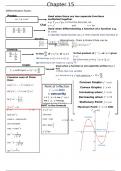
Differentiation Rules:
Produc Used when there are two separate functions
t ( uv )' =u' v +uv ' multiplied together
e.g. if y=x 4 lnx , to find the derivate, let:
Chai u = x 4 and v = lnx
dy dy du then
Usedfind u’ and
when v’ and sub into
differentiating a the formula
function ofto
a find the e.g.
function
= ×
dx du dx ln (cosx )
1) Identify inside function as u ( x ) then rewrite main function in
Quotie terms of u.
' Alternatively, Chain & Product Rule can be
f ( x ) f ( x ) g ( x ) −f ( x ) g ' (x)
nt
→ f (x ) −1
g ( x) 2
( g ( x )) used as =f ( x)( g ( x ) )
g ( x)
Inverse
Functions
dy 1 dy To find gradient of f −1 (x) at (a , b) given
= To find of y=f (x ) at (a , b):
dx dx dx f (x) :
dy (1) Rearrange y=f (x ) as x=f ( y ).
(1) Differentiate to find f ’ ( x ) at (b , a)
dx
(2) Differentiate with respect to y giving (2) .Reciprocal of this value is gradient of
Implic dy
Used when a function is not explicitly written in y =
it dx
' dySubstitute y=b tof(x)
(3) find at (a , b) .
f ( y ) with respect ¿ x=f ' ( y) Moredy than one variable
dx
2 dy
e.g. derivative of 4 y 3 with respect to x = 12 y
Common uses of Chain dx
Rule: dy
If is given/known (such as stationary points), substitute it into
dx Concave Graphs: f ' ' ( x )< 0
cos ( f ( x ) ) →−f ' ( x ) sin ( f ( x ) )
Point of Inflection Convex Graphs: f '' ( x )> 0
f ( x )=0 AND
''
sin ( f ( x ) ) → f ( x ) cos (f ( x ) )
'
Increasing when: f ' ( x ) >0
∆ concavity
'
f ( x) if f '' ( n ) =0, but f '' ( n+1 ) Decreasing when: f ' ( x ) <0
ln ( f x ) →
( ) ''
and f ( n−1 ) have no
f ( x)
change in sign, it is not a
Stationary Point: f ' ( x )=0
(In the
k formula (NOT in the formula
(f ( x ) ) → k ¿ Maximum Point: f ' ( x )=0 AND
booklet) booklet)
f (x) f ' (x) f ( x ) f ' ( x) f ' ' ( x )< 0
2
tanx sec x sinx cosx
cosecx−cosecxcotx cosx −sinx y=3 x 3−9 x
secx secxtanx 1
lnx∨lnax
x
cotx−cosec2 x
x x
a a lna
−1 1
sin x
√ 1−x 2
−1 1
cos x−
√ 1−x 2
−1 1
tan x 2
1+ x
Differentiation Rules:
Produc Used when there are two separate functions
t ( uv )' =u' v +uv ' multiplied together
e.g. if y=x 4 lnx , to find the derivate, let:
Chai u = x 4 and v = lnx
dy dy du then
Usedfind u’ and
when v’ and sub into
differentiating a the formula
function ofto
a find the e.g.
function
= ×
dx du dx ln (cosx )
1) Identify inside function as u ( x ) then rewrite main function in
Quotie terms of u.
' Alternatively, Chain & Product Rule can be
f ( x ) f ( x ) g ( x ) −f ( x ) g ' (x)
nt
→ f (x ) −1
g ( x) 2
( g ( x )) used as =f ( x)( g ( x ) )
g ( x)
Inverse
Functions
dy 1 dy To find gradient of f −1 (x) at (a , b) given
= To find of y=f (x ) at (a , b):
dx dx dx f (x) :
dy (1) Rearrange y=f (x ) as x=f ( y ).
(1) Differentiate to find f ’ ( x ) at (b , a)
dx
(2) Differentiate with respect to y giving (2) .Reciprocal of this value is gradient of
Implic dy
Used when a function is not explicitly written in y =
it dx
' dySubstitute y=b tof(x)
(3) find at (a , b) .
f ( y ) with respect ¿ x=f ' ( y) Moredy than one variable
dx
2 dy
e.g. derivative of 4 y 3 with respect to x = 12 y
Common uses of Chain dx
Rule: dy
If is given/known (such as stationary points), substitute it into
dx Concave Graphs: f ' ' ( x )< 0
cos ( f ( x ) ) →−f ' ( x ) sin ( f ( x ) )
Point of Inflection Convex Graphs: f '' ( x )> 0
f ( x )=0 AND
''
sin ( f ( x ) ) → f ( x ) cos (f ( x ) )
'
Increasing when: f ' ( x ) >0
∆ concavity
'
f ( x) if f '' ( n ) =0, but f '' ( n+1 ) Decreasing when: f ' ( x ) <0
ln ( f x ) →
( ) ''
and f ( n−1 ) have no
f ( x)
change in sign, it is not a
Stationary Point: f ' ( x )=0
(In the
k formula (NOT in the formula
(f ( x ) ) → k ¿ Maximum Point: f ' ( x )=0 AND
booklet) booklet)
f (x) f ' (x) f ( x ) f ' ( x) f ' ' ( x )< 0
2
tanx sec x sinx cosx
cosecx−cosecxcotx cosx −sinx y=3 x 3−9 x
secx secxtanx 1
lnx∨lnax
x
cotx−cosec2 x
x x
a a lna
−1 1
sin x
√ 1−x 2
−1 1
cos x−
√ 1−x 2
−1 1
tan x 2
1+ x