

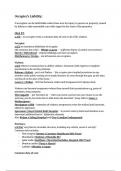
Occupier’s Liability:
D occupiers can be held liable under these acts for injury to person or property caused
by failure to take reasonable care with regard to the state of the premises.
OLA 57:
s.2(1) - an occupier owes a common duty of care to all of his visitors.
Occupier:
s.1(2) no statutory definition of occupier.
Old common law rules - Wheat v Lacon - ‘sufficient degree of control over premises.’
Harris v Birkenhead - empty buildings can have occupiers.
Matthewson v Crump - not all owners are occupiers.
Visitors:
s.1(2) refers to common law to define visitors. Someone with express or implied
permission to be on the premises.
Robson v Hallett - per Lord Parker - ‘the occupier gives implied permission to any
member of the public coming on his lawful business to come through the gate, up the steps
and knock on the door of his house.’
Lowery v Walker - the line between visitor and trespasser isn’t always clear.
Visitors can become trespassers where they exceed their permissions e.g. parts of
premises, time, purpose:
The Calgarth - per Scrutton LJ - ‘when you invite a person into your house to use the
stairway, you do not invite him to slide down the bannister.’ (may refer to Geary v
Wetherspoon).
Herrington v BRB - intention of visitors; trespassers cover the wicked and innocent,
objective approach.
Spearman v Royal United Bath Hospital - ‘a person’s state of mind and intention is an
important additional factor.’ Subjective element.
Also Kolasa v Ealing Hospital and Ovu v London Underground.
Premises:
s.1(3)(a) ‘any fixed or moveable structure, including any vehicle, vessel or aircraft.’
Common law includes:
- Fire escapes (Keown v Coventry Healthcare NHS Trust)
- Mountains (Simkiss v Rhondda BC)
- Splat walls (Gwilliam v West Hertfordshire Hospital NHS Trust)
- Bouncy castles (Perry v Harris)
- Ladders (Wheeler v Copas)
Common duty of care:
D occupiers can be held liable under these acts for injury to person or property caused
by failure to take reasonable care with regard to the state of the premises.
OLA 57:
s.2(1) - an occupier owes a common duty of care to all of his visitors.
Occupier:
s.1(2) no statutory definition of occupier.
Old common law rules - Wheat v Lacon - ‘sufficient degree of control over premises.’
Harris v Birkenhead - empty buildings can have occupiers.
Matthewson v Crump - not all owners are occupiers.
Visitors:
s.1(2) refers to common law to define visitors. Someone with express or implied
permission to be on the premises.
Robson v Hallett - per Lord Parker - ‘the occupier gives implied permission to any
member of the public coming on his lawful business to come through the gate, up the steps
and knock on the door of his house.’
Lowery v Walker - the line between visitor and trespasser isn’t always clear.
Visitors can become trespassers where they exceed their permissions e.g. parts of
premises, time, purpose:
The Calgarth - per Scrutton LJ - ‘when you invite a person into your house to use the
stairway, you do not invite him to slide down the bannister.’ (may refer to Geary v
Wetherspoon).
Herrington v BRB - intention of visitors; trespassers cover the wicked and innocent,
objective approach.
Spearman v Royal United Bath Hospital - ‘a person’s state of mind and intention is an
important additional factor.’ Subjective element.
Also Kolasa v Ealing Hospital and Ovu v London Underground.
Premises:
s.1(3)(a) ‘any fixed or moveable structure, including any vehicle, vessel or aircraft.’
Common law includes:
- Fire escapes (Keown v Coventry Healthcare NHS Trust)
- Mountains (Simkiss v Rhondda BC)
- Splat walls (Gwilliam v West Hertfordshire Hospital NHS Trust)
- Bouncy castles (Perry v Harris)
- Ladders (Wheeler v Copas)
Common duty of care:


