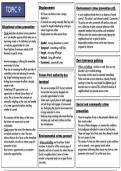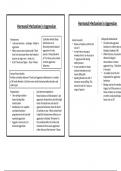
TOPIC 9 Displacement
- SCP does not reduce crime is simply
Environment crime prevention pt2.
- in such neighbourhoods there is an absence of social
displaces it control ( The police ) and informal control ( Community )
- If criminals are acting rationally then they will - The police are only concerned with serious crime and
Situational crime prevention respond to target hardening by moving to turn a blind eye to petty nuisance behaviour while
where targets are softer respected members feel powerless and intimidated.
- Clarke describes situational crime prevention - Displacement can take several forms : - Without action the situation deteriorates tipping the
as a pre emptive approach that relies not on neighbourhood into a spiral of decline.
improving society or its institutions but simply - - Respectable members move out the area becomes
Spatial , moving elsewhere to commit
on reducing opportunities for crime
- Temporal , committing at diff time magnets for deviants.
- Three features of measures aimed at SCP
- Directed at speci c crimes - Target , choosing diff target
- Tactical , Using diff method
- Involve managing or altering the immediate - Functional , commit diff crime
Zero tolerance policing
environment of crime - Wilson and kellings , solution to crack down on any
- They aim at increasing the effort and risks of
disorder is by a twofold strategy.
committing crime and reducing the rewards - Any broken window must be repaired immediately
- Eg. Target hardening measures such as Felson Port authority bus
- Police must take on zero tolerance, instead of merely
locking doors increase the effort a burglar terminal reacting to crime they must tackle the slightest sign of
needs to take
- this was an example SCP, the port authority disorder even not criminal This will halt the decline of
- Underlying SCP approaches is an
bus terminal was poorly designed and neighbourhood and prevent serious crime.
opportunity or rational choice theory of
crime. This is the view that criminals act provided opportunities for crime
rationally, weighing up the costs and bene ts - Toilets were a good place to steal luggage
of a crime opportunity before deciding and sell drugs and engage in homosexual Social and community crime
whether to commit sex. Reshaping the physical environment led
to large reduction in crime prevention
- This contrasts with the theory of the crime - Reducing large washing sinks meant that less - Place the emphasis rmly on the potential offender and
that stress root causes such as early homeless ppl could wash clothes and then their social context.
socialisation less homelessness - The aim of these strategies is to remove the conditions
- Clarke argues that most of the theories offer that predispose individuals to crime in the rst place.
no realistic solutions to crime. The most - These are longer term Strats since they attempt to tackle
obvious thing to do is focus on the immediate Environmental crime prevent the root causes of crime
crime situation, since this is where scope for - Wilson and kelling use the phrase broken - The causes of crime are often rooted in social conditions
prevention is best. windows to stand for all the various signs of such as poverty , more general social reform
- Most crime is opportunistic so we need to disorder and lack of concern for others that are programmes addressing these issues may have a crime
reduce the opportunities. found in neighbourhood. Leave a broken prevention role even if it is not the main focus
window un-repaired sends out a signal that no
one cares.
‘ ’ fi fi ’‘ fi
- SCP does not reduce crime is simply
Environment crime prevention pt2.
- in such neighbourhoods there is an absence of social
displaces it control ( The police ) and informal control ( Community )
- If criminals are acting rationally then they will - The police are only concerned with serious crime and
Situational crime prevention respond to target hardening by moving to turn a blind eye to petty nuisance behaviour while
where targets are softer respected members feel powerless and intimidated.
- Clarke describes situational crime prevention - Displacement can take several forms : - Without action the situation deteriorates tipping the
as a pre emptive approach that relies not on neighbourhood into a spiral of decline.
improving society or its institutions but simply - - Respectable members move out the area becomes
Spatial , moving elsewhere to commit
on reducing opportunities for crime
- Temporal , committing at diff time magnets for deviants.
- Three features of measures aimed at SCP
- Directed at speci c crimes - Target , choosing diff target
- Tactical , Using diff method
- Involve managing or altering the immediate - Functional , commit diff crime
Zero tolerance policing
environment of crime - Wilson and kellings , solution to crack down on any
- They aim at increasing the effort and risks of
disorder is by a twofold strategy.
committing crime and reducing the rewards - Any broken window must be repaired immediately
- Eg. Target hardening measures such as Felson Port authority bus
- Police must take on zero tolerance, instead of merely
locking doors increase the effort a burglar terminal reacting to crime they must tackle the slightest sign of
needs to take
- this was an example SCP, the port authority disorder even not criminal This will halt the decline of
- Underlying SCP approaches is an
bus terminal was poorly designed and neighbourhood and prevent serious crime.
opportunity or rational choice theory of
crime. This is the view that criminals act provided opportunities for crime
rationally, weighing up the costs and bene ts - Toilets were a good place to steal luggage
of a crime opportunity before deciding and sell drugs and engage in homosexual Social and community crime
whether to commit sex. Reshaping the physical environment led
to large reduction in crime prevention
- This contrasts with the theory of the crime - Reducing large washing sinks meant that less - Place the emphasis rmly on the potential offender and
that stress root causes such as early homeless ppl could wash clothes and then their social context.
socialisation less homelessness - The aim of these strategies is to remove the conditions
- Clarke argues that most of the theories offer that predispose individuals to crime in the rst place.
no realistic solutions to crime. The most - These are longer term Strats since they attempt to tackle
obvious thing to do is focus on the immediate Environmental crime prevent the root causes of crime
crime situation, since this is where scope for - Wilson and kelling use the phrase broken - The causes of crime are often rooted in social conditions
prevention is best. windows to stand for all the various signs of such as poverty , more general social reform
- Most crime is opportunistic so we need to disorder and lack of concern for others that are programmes addressing these issues may have a crime
reduce the opportunities. found in neighbourhood. Leave a broken prevention role even if it is not the main focus
window un-repaired sends out a signal that no
one cares.
‘ ’ fi fi ’‘ fi