
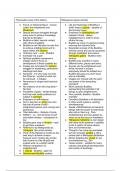
Theravadan (way of the elders) Mahayanan (great vehicle)
● Focus on historical figure - human ● Life and teachings of Buddha is
called ‘the enlightened one’ skilful means (upaya) - parable of
Shakununi the burning house
● Special because struggled through ● Emphasis on Bodhisattva path
many lives to achieve knowledge instead of arhat - delays
that led to liberation enlightenment in order to show
● Buddha is dead, beyond contact others the way
with others struggling ● Buddha as more of a glorious being,
● Buddha is rare because he was first reducing the historical side
to achieve enlightenment and to ● Expanded concept of the Buddha,
teach others the Dharma remains active and can be accessed
● ‘Ordinary man’ - cush - Buddha through meditation and visions.
● Exemplar not a god Tathagarta gabha - Buddha seed
● Spiritual qualities expressed in embryo
images used to focus on ● Buddha may manifest in many
development of those qualities too different forms, places and times
● Images are reminders for Gotama ● Anyone can be enlightened even
struggle for awakening, perfections, those involved in society -
teachings and ideal everybody should be treated as a
● Symbolic - ‘he who sees me sees Buddha because you don’t know
the Dharma’ - symbol of what can who is a Buddha
be achieved - 3 refuges ● Images are ‘infused with the spirit
● Reverence to stupas and historical and power of the being they
relies represent’
● No evidence of an all loving deity = ● More symbolic Buddha,
No God representing the potential of all
● Possibility of gods - limited beings beings to gain enlightenment
that help with small problems but ● Five symbolic Buddha - Buddha
subject to samsara mandala
● Emphasis on self-reliance ● Countless Buddhas in all directions
● Aim to become an arhat (one who in other world systems, existing
has lost all sense of self) - simultaneously
enlightened person (end craving and ● Speak of Bodhisattvas as heavenly
ignorance) beings with the power to help those
● Total dedication - lifestyle of monk who call on them e.g., Tara,
● Selfish? - no - lost all sense of self Avalokitesvara and can appear as
and selfish desires - compassion is vision or be the focus of meditation
key ● Hahayana multiverse is even larger
● Buddha gave map of nirvana - need with other world systems in addition
to get there ourselves to the 3 realms of sense-desire,
● Referred to by Mahayanists as form and formlessness.
‘Hinayana’ (the small vehicle) ● Thought of as more lay-orientated
● Think of the lifestyle of monks as the but the monastic sangha is still a
best way to achieve nirvana central part of Mahayana Buddhism
however even modern day monks ● Monks adapting the vinaya to suit
feel nirvana is a far-off goal and circumstances e.g., Zen
instead work on a better rebirth ● ‘Great vehicle’ - suitable for many
● Without compassion no cultures and spiritual developments
enlightenment and variety of teachings.
● 4 Jhanas - Buddha - past live
● Samma-sam-Buddha: perfect
, Buddha - 32 marks of a special
person in the Buddha
Trikaya - buddhahood can be seen in other ways - 3 aspects/bodies.
Nirmanakaya - transformation body- physical body that buddha uses to teach the Dharma, at
death the physical body falls and Buddha nature returns to the universe.
Dharmakaya- truth body. Buddha nature is the nature of life and is shared by all living things.
To reveal the truth body means enlightenment.
Sambhogakaya - enjoyment body refers to the Buddha or characteristics of the Buddha that
are seen in visions or meditation. It teaches the dharma directly to people regardless of time
and location. Not a physical body but no less real than the other kayas.
Buddha
Different names:
● Shakyamuni
● Tathagata - one who has gone beyond
● Sammasambuddha - refers to the unique qualities of the Buddha as only he was bale
to achieve enlightenment without being taught
The Buddha is understood as a being historical ( ‘a human being like ourselves’ Cush),
symbolic (‘he who sees the dhamma sees me) and cosmic (other world systems and other
Buddhas’ Cush)
Different status:
● An ordinary man
● Extra-ordinary man
➔ He is sammsam - enlightenment with no guidance
➔ 32 marks of existence
➔ Attains miraculous powers through enlightenment
● Semi-divine man
➔ Can manifest in many different forms
Buddha functioned as a
● Role model e.g., sangha try to follow his path
● An archetype - for the way to enlightenment
● A teacher - ‘given us a map’ Cush
● A refuge
● A constant source of wisdom
Dukkha
Noble Truths:
1. All life involves suffering – dukkha
2. The cause of suffering (dukkha) is craving (tanha)
, 3. The way to overcome dukkha is to overcome tanha
4. The way to overcome tanha is the Middle Way / Eightfold Path
Dukkha - Can be translated as frustration – du meaning difficult and kha meaning to
Endure. Often translated as suffering but this is does not convey the breadth of its
application to life.
Insight into dukkha comes from the Buddha’s experience of the four sights. Perhaps the four
sights were a realisation of suffering to the buddha - when he finally understood.
Buddha ‘age is dukkha, death is dukkha’
Cush and Rahula claim that Noble truth is like a doctor giving a diagnosis and dukkha is part
of this.
Dukkha-dukkha Viparinama-dukkha Sankhara-dukkha
● Dukkha of painful ● Changing nature of ● Basic
experiences thing unsatisfactoriness
● Physical and mental ● Everything is always pervading all forms
suffering of every changing and people of existence because
stage of life e.g., don’t like change all forms of life are
birth and death ● Even beautiful things changing, nothing is
● Frustration of coming decay and loved permanent
across desires ones die e.g., a rose ● A lack of satisfaction,
● The more ● Even when the a sense that things
sensitive/emotional a outside is constant, will never measure
person is, the more our feelings change up to our
suffering you are so even those that expectations or
aware of appear to have standard
everything also ● A subtle
suffer dissatisfaction with
life rather than a
specific problem
● The skandhas are
always changing.
This is why we are
deluded because we
are constantly trying
to make something
permanent out of
what is
impermanent.
Is Buddhism pessimistic in its outlook on life?
Yes No
, ● First Noble Truth – dukkha ● Mixture of emotions in life
● Enjoyment and pleasure leads to ● Positive movement away from
dukkha negative of dukkha
● Puritanical view of life ● Eightfold path leads away from
● Depends what your perspective is dukkha
on rebirth ● Depends what your perspective is
● Neither pessimistic or optimistic – on rebirth
realistic – see things as they truly ● Aim for happiness through
are enlightenment
The Pali Canon
● Written in Pali
● Derived from oral tradition going back to the time of the Buddha
● Preserved through communal chanting
● Most important for Theravadans
● Can be used for insights into the historical Buddha and his teachings, worship and
guidance
● Consists of three divisions or baskets (Tripitaka means 3 baskets and has this name
because the Pali Canon was originally written on palm leaf manuscripts
● Basis of Theravada teaching
● In Mahayana Buddhism, there is less certainty about how accurate the record is
(their belief in skilful means results in them taking the text and interpreting rather than
seeing it as the ultimate truth).
Tripitaka:
1. Vinaya Pitaka - contains teachings and code of conduct for the Sangha called
patimokkha and an account of the Buddha’s Life. Written after the death of The
Buddha - 3 councils
2. Sutta Pitaka contains discourses attribute to The Buddha including 4 Noble Truths, 8
Fold Path and the Dhammapada. Buddhavacana meaning the word/doctrine of the
Buddha. Extends to all Buddhists. Helps to build a picture of the historical Buddha
3. Abhidamma Pitaka - contains philosophical teachings that give the Buddhist
perspective on the world and reality. The Buddha taught it to his mother in the
heaven realm (there are six realms, animal, hell, ghosts, titans, humans and Gods).
Not the teachings of The Buddha, thought to be added at 3rd Council. Three works
contained in the Abhidhamma are: Dharmmasanga - manual of ethics for monks,
Vibhanga and Dhatukatha - analysis of elements including mental, Puggalapannatti -
human characteristics encountered in stages of Buddhist path, Kathavatthu - debates
on questions of doctrine.
Problems with the Pali Canon for Buddhists Today?:
● Vinaya Pitaka may seem outdated
● Limits of Abhidhamma Pitaka due to its philosophical nature
● Impact of oral transmission
● Impact of using vernacular rather than formal language – issues with translation
● Contradictory teachings as Buddha used skilful means
● Focus on historical figure - human ● Life and teachings of Buddha is
called ‘the enlightened one’ skilful means (upaya) - parable of
Shakununi the burning house
● Special because struggled through ● Emphasis on Bodhisattva path
many lives to achieve knowledge instead of arhat - delays
that led to liberation enlightenment in order to show
● Buddha is dead, beyond contact others the way
with others struggling ● Buddha as more of a glorious being,
● Buddha is rare because he was first reducing the historical side
to achieve enlightenment and to ● Expanded concept of the Buddha,
teach others the Dharma remains active and can be accessed
● ‘Ordinary man’ - cush - Buddha through meditation and visions.
● Exemplar not a god Tathagarta gabha - Buddha seed
● Spiritual qualities expressed in embryo
images used to focus on ● Buddha may manifest in many
development of those qualities too different forms, places and times
● Images are reminders for Gotama ● Anyone can be enlightened even
struggle for awakening, perfections, those involved in society -
teachings and ideal everybody should be treated as a
● Symbolic - ‘he who sees me sees Buddha because you don’t know
the Dharma’ - symbol of what can who is a Buddha
be achieved - 3 refuges ● Images are ‘infused with the spirit
● Reverence to stupas and historical and power of the being they
relies represent’
● No evidence of an all loving deity = ● More symbolic Buddha,
No God representing the potential of all
● Possibility of gods - limited beings beings to gain enlightenment
that help with small problems but ● Five symbolic Buddha - Buddha
subject to samsara mandala
● Emphasis on self-reliance ● Countless Buddhas in all directions
● Aim to become an arhat (one who in other world systems, existing
has lost all sense of self) - simultaneously
enlightened person (end craving and ● Speak of Bodhisattvas as heavenly
ignorance) beings with the power to help those
● Total dedication - lifestyle of monk who call on them e.g., Tara,
● Selfish? - no - lost all sense of self Avalokitesvara and can appear as
and selfish desires - compassion is vision or be the focus of meditation
key ● Hahayana multiverse is even larger
● Buddha gave map of nirvana - need with other world systems in addition
to get there ourselves to the 3 realms of sense-desire,
● Referred to by Mahayanists as form and formlessness.
‘Hinayana’ (the small vehicle) ● Thought of as more lay-orientated
● Think of the lifestyle of monks as the but the monastic sangha is still a
best way to achieve nirvana central part of Mahayana Buddhism
however even modern day monks ● Monks adapting the vinaya to suit
feel nirvana is a far-off goal and circumstances e.g., Zen
instead work on a better rebirth ● ‘Great vehicle’ - suitable for many
● Without compassion no cultures and spiritual developments
enlightenment and variety of teachings.
● 4 Jhanas - Buddha - past live
● Samma-sam-Buddha: perfect
, Buddha - 32 marks of a special
person in the Buddha
Trikaya - buddhahood can be seen in other ways - 3 aspects/bodies.
Nirmanakaya - transformation body- physical body that buddha uses to teach the Dharma, at
death the physical body falls and Buddha nature returns to the universe.
Dharmakaya- truth body. Buddha nature is the nature of life and is shared by all living things.
To reveal the truth body means enlightenment.
Sambhogakaya - enjoyment body refers to the Buddha or characteristics of the Buddha that
are seen in visions or meditation. It teaches the dharma directly to people regardless of time
and location. Not a physical body but no less real than the other kayas.
Buddha
Different names:
● Shakyamuni
● Tathagata - one who has gone beyond
● Sammasambuddha - refers to the unique qualities of the Buddha as only he was bale
to achieve enlightenment without being taught
The Buddha is understood as a being historical ( ‘a human being like ourselves’ Cush),
symbolic (‘he who sees the dhamma sees me) and cosmic (other world systems and other
Buddhas’ Cush)
Different status:
● An ordinary man
● Extra-ordinary man
➔ He is sammsam - enlightenment with no guidance
➔ 32 marks of existence
➔ Attains miraculous powers through enlightenment
● Semi-divine man
➔ Can manifest in many different forms
Buddha functioned as a
● Role model e.g., sangha try to follow his path
● An archetype - for the way to enlightenment
● A teacher - ‘given us a map’ Cush
● A refuge
● A constant source of wisdom
Dukkha
Noble Truths:
1. All life involves suffering – dukkha
2. The cause of suffering (dukkha) is craving (tanha)
, 3. The way to overcome dukkha is to overcome tanha
4. The way to overcome tanha is the Middle Way / Eightfold Path
Dukkha - Can be translated as frustration – du meaning difficult and kha meaning to
Endure. Often translated as suffering but this is does not convey the breadth of its
application to life.
Insight into dukkha comes from the Buddha’s experience of the four sights. Perhaps the four
sights were a realisation of suffering to the buddha - when he finally understood.
Buddha ‘age is dukkha, death is dukkha’
Cush and Rahula claim that Noble truth is like a doctor giving a diagnosis and dukkha is part
of this.
Dukkha-dukkha Viparinama-dukkha Sankhara-dukkha
● Dukkha of painful ● Changing nature of ● Basic
experiences thing unsatisfactoriness
● Physical and mental ● Everything is always pervading all forms
suffering of every changing and people of existence because
stage of life e.g., don’t like change all forms of life are
birth and death ● Even beautiful things changing, nothing is
● Frustration of coming decay and loved permanent
across desires ones die e.g., a rose ● A lack of satisfaction,
● The more ● Even when the a sense that things
sensitive/emotional a outside is constant, will never measure
person is, the more our feelings change up to our
suffering you are so even those that expectations or
aware of appear to have standard
everything also ● A subtle
suffer dissatisfaction with
life rather than a
specific problem
● The skandhas are
always changing.
This is why we are
deluded because we
are constantly trying
to make something
permanent out of
what is
impermanent.
Is Buddhism pessimistic in its outlook on life?
Yes No
, ● First Noble Truth – dukkha ● Mixture of emotions in life
● Enjoyment and pleasure leads to ● Positive movement away from
dukkha negative of dukkha
● Puritanical view of life ● Eightfold path leads away from
● Depends what your perspective is dukkha
on rebirth ● Depends what your perspective is
● Neither pessimistic or optimistic – on rebirth
realistic – see things as they truly ● Aim for happiness through
are enlightenment
The Pali Canon
● Written in Pali
● Derived from oral tradition going back to the time of the Buddha
● Preserved through communal chanting
● Most important for Theravadans
● Can be used for insights into the historical Buddha and his teachings, worship and
guidance
● Consists of three divisions or baskets (Tripitaka means 3 baskets and has this name
because the Pali Canon was originally written on palm leaf manuscripts
● Basis of Theravada teaching
● In Mahayana Buddhism, there is less certainty about how accurate the record is
(their belief in skilful means results in them taking the text and interpreting rather than
seeing it as the ultimate truth).
Tripitaka:
1. Vinaya Pitaka - contains teachings and code of conduct for the Sangha called
patimokkha and an account of the Buddha’s Life. Written after the death of The
Buddha - 3 councils
2. Sutta Pitaka contains discourses attribute to The Buddha including 4 Noble Truths, 8
Fold Path and the Dhammapada. Buddhavacana meaning the word/doctrine of the
Buddha. Extends to all Buddhists. Helps to build a picture of the historical Buddha
3. Abhidamma Pitaka - contains philosophical teachings that give the Buddhist
perspective on the world and reality. The Buddha taught it to his mother in the
heaven realm (there are six realms, animal, hell, ghosts, titans, humans and Gods).
Not the teachings of The Buddha, thought to be added at 3rd Council. Three works
contained in the Abhidhamma are: Dharmmasanga - manual of ethics for monks,
Vibhanga and Dhatukatha - analysis of elements including mental, Puggalapannatti -
human characteristics encountered in stages of Buddhist path, Kathavatthu - debates
on questions of doctrine.
Problems with the Pali Canon for Buddhists Today?:
● Vinaya Pitaka may seem outdated
● Limits of Abhidhamma Pitaka due to its philosophical nature
● Impact of oral transmission
● Impact of using vernacular rather than formal language – issues with translation
● Contradictory teachings as Buddha used skilful means


