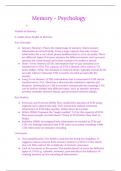
Memory - Psychology
○
Models of Memory
A. Multi-Store Model of Memory
Key Concepts:
● Sensory Memory: This is the initial stage of memory where sensory
information is stored briefly. It has a large capacity but only retains
information for a very short period (milliseconds to a few seconds). There
are different types of sensory memory for different senses, such as iconic
memory for visual stimuli and echoic memory for auditory stimuli.
● Short-Term Memory (STM): Information that we pay attention to is
transferred to STM. The capacity of STM is limited, often cited as 7±2
items (Miller, 1956). The duration is relatively short, typically around 18-30
seconds without rehearsal. STM is mainly encoded acoustically (by
sound).
● Long-Term Memory (LTM): Information that is rehearsed in STM can be
transferred to LTM, which has a theoretically unlimited capacity and
duration. Information in LTM is encoded semantically (by meaning). LTM
can be further divided into different types, such as episodic memory
(events), semantic memory (facts), and procedural memory (skills).
Key Studies:
● Peterson and Peterson (1959): They studied the duration of STM using
trigrams and a distraction task. They found that without rehearsal,
information in STM fades quickly, within about 18 seconds.
● Miller (1956): Proposed the "magic number" 7±2 for the capacity of STM.
This means people can hold about 7 items in STM before they start to
forget.
● Baddeley (1966): Investigated how information is encoded in STM and
LTM. His findings indicated that STM relies on acoustic encoding, while
LTM relies more on semantic encoding.
Criticisms:
● Oversimplification: The MSM is criticised for being too simplistic. It
suggests a linear process from sensory memory to STM to LTM, which
may not fully capture the complexity of memory processes.
● Lack of Attention to Processes: The model doesn't account for different
types of LTM (e.g., episodic, semantic, procedural) or the influence of
working memory on the encoding of information.
, B. Working Memory Model
Key Concepts:
● Central Executive: The component that controls and coordinates the
activities of the two subsystems (the phonological loop and the visuo-
spatial sketchpad). It is responsible for attention and cognitive control but
is considered to be a limited and somewhat vague construct.
● Phonological Loop: Handles auditory information. It consists of:
○ Phonological Store: Holds verbal information briefly.
○ Articulatory Control Process: Rehearses information to keep it in
the phonological store.
● Visuo-Spatial Sketchpad: Handles visual and spatial information, such as
recalling the layout of a room or visualising a route.
● Episodic Buffer: A later addition to the model by Baddeley (2000), it
integrates information from the phonological loop, visuo-spatial
sketchpad, and LTM into a coherent episode.
Key Studies:
● Baddeley and Hitch (1974): Introduced the Working Memory Model,
providing evidence through dual-task studies showing that people can
perform two tasks simultaneously if they use different components of
working memory (e.g., a visual task and a verbal task).
● Baddeley (1996): Found that the phonological loop and visuo-spatial
sketchpad are separate systems because people can handle tasks
involving both visual and verbal processing simultaneously but struggle
with tasks that use the same system. He also distinguished himself
through certain things, such as: the psychological or certain memory .
Criticisms:
● Central Executive: The concept of the central executive is considered too
vague and lacks empirical evidence regarding its structure and function.
● Integration of LTM: The model doesn’t fully explain how working memory
interacts with LTM or how episodic memory is managed.
○
Models of Memory
A. Multi-Store Model of Memory
Key Concepts:
● Sensory Memory: This is the initial stage of memory where sensory
information is stored briefly. It has a large capacity but only retains
information for a very short period (milliseconds to a few seconds). There
are different types of sensory memory for different senses, such as iconic
memory for visual stimuli and echoic memory for auditory stimuli.
● Short-Term Memory (STM): Information that we pay attention to is
transferred to STM. The capacity of STM is limited, often cited as 7±2
items (Miller, 1956). The duration is relatively short, typically around 18-30
seconds without rehearsal. STM is mainly encoded acoustically (by
sound).
● Long-Term Memory (LTM): Information that is rehearsed in STM can be
transferred to LTM, which has a theoretically unlimited capacity and
duration. Information in LTM is encoded semantically (by meaning). LTM
can be further divided into different types, such as episodic memory
(events), semantic memory (facts), and procedural memory (skills).
Key Studies:
● Peterson and Peterson (1959): They studied the duration of STM using
trigrams and a distraction task. They found that without rehearsal,
information in STM fades quickly, within about 18 seconds.
● Miller (1956): Proposed the "magic number" 7±2 for the capacity of STM.
This means people can hold about 7 items in STM before they start to
forget.
● Baddeley (1966): Investigated how information is encoded in STM and
LTM. His findings indicated that STM relies on acoustic encoding, while
LTM relies more on semantic encoding.
Criticisms:
● Oversimplification: The MSM is criticised for being too simplistic. It
suggests a linear process from sensory memory to STM to LTM, which
may not fully capture the complexity of memory processes.
● Lack of Attention to Processes: The model doesn't account for different
types of LTM (e.g., episodic, semantic, procedural) or the influence of
working memory on the encoding of information.
, B. Working Memory Model
Key Concepts:
● Central Executive: The component that controls and coordinates the
activities of the two subsystems (the phonological loop and the visuo-
spatial sketchpad). It is responsible for attention and cognitive control but
is considered to be a limited and somewhat vague construct.
● Phonological Loop: Handles auditory information. It consists of:
○ Phonological Store: Holds verbal information briefly.
○ Articulatory Control Process: Rehearses information to keep it in
the phonological store.
● Visuo-Spatial Sketchpad: Handles visual and spatial information, such as
recalling the layout of a room or visualising a route.
● Episodic Buffer: A later addition to the model by Baddeley (2000), it
integrates information from the phonological loop, visuo-spatial
sketchpad, and LTM into a coherent episode.
Key Studies:
● Baddeley and Hitch (1974): Introduced the Working Memory Model,
providing evidence through dual-task studies showing that people can
perform two tasks simultaneously if they use different components of
working memory (e.g., a visual task and a verbal task).
● Baddeley (1996): Found that the phonological loop and visuo-spatial
sketchpad are separate systems because people can handle tasks
involving both visual and verbal processing simultaneously but struggle
with tasks that use the same system. He also distinguished himself
through certain things, such as: the psychological or certain memory .
Criticisms:
● Central Executive: The concept of the central executive is considered too
vague and lacks empirical evidence regarding its structure and function.
● Integration of LTM: The model doesn’t fully explain how working memory
interacts with LTM or how episodic memory is managed.