Functionalist View
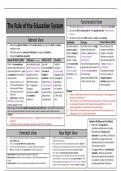
The Role of the Education System 1.
2.
Educations plays a part in secondary socialisation – passing on core values
Educations sifts & sorts people for the appropriate jobs – the allocation
function
3. Educations teaches the skills needed in work & the economy
Marxist View Durkheim: Parsons: Davis & Moore (1945):
1. Education prepares children for the world of work by giving them skills and values Education passes on Describes school as a bridge Every society sorts its
employers need norms & values in between the family and members into different
2. Education passes on ruling class ideology that supports capitalism order to integrate society – schools pass on a positions – they think
3. Education legitimises inequality individuals into universal value of that there are rules for
Bowels & Gintis (1976): Althusser: NEO-MARXIST Willis (1977): Bourdieu: society – it helps achievement. how education does this
There’s a correspondence Sees education as part Says that Used the create social order He says that education selects > called ‘principles of
between pupil experiences of of the ‘ideological state education doesn’t concept of based on value appropriate roles because it’s stratification’.
school and adult work – pupils apparatus’ - a tool of turn out an cultural capital consensus, & to meritocratic (best students They believe that there
are prepared for the world of capitalism which is obedient (language, skills, strengthen social rise to the top). has to be a system of
work by school: used to pass on the workforce – some knowledge & solidarity. Agrees with Durkheim that it unequal rewards to
• Taught to accept hierarchy belief that society is kids form an anti- attitudes) to teaches norms & values. motivate people to train
• Are motivated by grades to fair – it legitimises school subculture explain how for top positions.
do boring work (like pay) inequality. and cope with m/c children
• School day is broken into It produces a docile school and then generally go on Criticisms
small units and obedient adult work by to fill the top 1. Evidence of differential achievement in terms of class, gender & ethnicity suggests that
• Subservience is rewarded education is not meritocratic
workforce. mucking about. jobs. 2. ‘Who you know’ is still more important than what you know – allocation is not working
The hidden curriculum also
prepares people for work. 3. Can be argued that education doesn’t prepare you adequately for work – lack of
Marxists argue that education legitimises inequality through meritocracy – they claim that meritocracy is a engineering graduates > it’s what the economy needs though?
myth, so w/c pupils are blamed for their poor results, when it’s actually a result of their social class. 4. It doesn’t look at how education may serve the interests of particular groups in terms
Criticisms of ideology and values – it doesn’t explain conflict.
1. Marxists assume people are passive victims – it exaggerates how much w/c pupils are socialised into
obedience Similarities & Differences (Func & Marx)
2. Most people are aware of inequality in education and don’t think it’s legitimate 1. Both look at the big picture –
institutions and the whole of society,
Feminists View New Right View they both tend to ignore social
interaction – except Willis, and both say
1. Some feminists argue that the hidden curriculum unofficially reinforces 1. Believe in the power of individual choice, & prefer this to the state
education has a huge impact on the
gender differences intervening in their lives
2. There are still gender differences in subject choice 2. They claim the role of the school should be more like a business – individual and that it’s closely linked to
3. Girls are now outperforming boys – but boys still need more attention businesses have to compete with one another to attract customers the economy and work.
4. Men seem to dominate the top positions in schools & universities & provide the customers with products they want and need – 2. The biggest difference is how they see
forces them to continually improve their standards inequality – Marxists say education
Liberal Feminists – want equal access to education for both sexes 3. State schools are run by the state, so they don’t have to compete
Radical Feminists – believe men are a bad influence – want female-centred education helps breed inequality & functionalists
with each other – they say this has caused poor standards – they
for girls say it passes on values of meritocracy
want to accelerate the creation of an ‘education market’ where the
Marxist Feminists – wants to consider gender inequalities with class and ethnicity
school’s role is to provide what it’s community wants and needs
and lets people better themselves.
, Internal Factors Affecting Achievement
Class & Differential Achievement in Education Negative labelling of students can lead to a self-fulfilling prophecy
of failure
Becker (1971)
Social Class • Teachers tend to evaluate pupils in comparison to an
Social class tends to affect educational achievement imaginary ‘ideal’ pupil – by looking at social class, appearance
• Pupils from a professional background are way more likely to enter higher education etc.
• Pupils from a m/c family are more likely to take A-levels whereas pupils from a w/c background are more likely to take Ball (1981)
vocational subjects
• Found that the pupils in top streams tended to be from a
• Pupils from a disadvantaged background are more likely to start school unable to read
higher social class
• Pupils from unskilled backgrounds on average achieve lower scores in SATs & GCSEs and are more likely to be placed in
lower sets Woods (1983)
Browne (2008) • As a response to negative labelling & frustration with low
W/C students compared to same ability m/c students are: status, pupils may form anti-social subcultures
• More likely to start school unable to read • Non-conformist reactions are most likely to come from w/c
• Won’t get a place in top schools students
• Achieve lower exam results (3 4 m/c got A-Cs compared to 1 3 w/c)
• Less likely to go to higher education (in 2006, 60% of HE students were m/c)
External Factors Affecting Achievement
Cultural Deprivation Material Deprivation Cultural Capital
Bernstein (1975) – sociolinguistics Lacking the necessary material & economic means The right language, skills, knowledge & attitudes to succeed -
W/c & m/c use different language codes: to function comfortably & efficiently typically m/c and higher
w/c m/c Bourdieu (1984) – cultural capital
• Limited vocab • Large vocab Douglas (1964) – the home & the school See the culture of education giving an inbuilt advantage to the
• Simple grammar • Complex grammar
L/c children living in poor conditions are m/c – each social class has a cultural framework called a
• Gesticulations • Universalistic
• Disadvantaged as unable to • Advantaged as education uses disadvantaged: habitus
fully engage in class elaborated code • Overcrowded home M/C have HIGH cultural capital / W/C have LOW cultural capital
• Poor diet W/C habitus:
Hyman & Sugarman (1967, 1970)
• Low income • m/c attitudes
Factors that affect educational performance:
• Part-time job • m/c beliefs
• Restricted language code
• Working class parents
Bull (1980) – the cost of education • m/c values
‘Free schooling’ is never actually free – hidden costs: • m/c language
• Working class attitudes Education favours & rewards m/c cultural traits and look
• Working class subcultures • Books, trips, food, uniform etc.
The financial burden of education might deter negatively & punishes w/c cultural traits
Bernstein • w/c experience cultural clash
• KEDDIE (1973) – CD theories are just a way of victim blaming – students from HE & FE
w/c culture is different not deficient
• It ignores w/c families that do have a cultural capital
Webb (2008) • Not all w/c students fail even if they don’t have
• TROYNA & WILLIAMS (1986) – it is the teacher’s reactions to
different language styles that is to blame cultural capital
In 2006, only 33% of students getting free school
Hyman & Sugarman • HALSEY ET AL (1980) – material factors are also
meals achieved 5 or more GCSE grades of A*-C
• BLACKSTONE & MORTIMORE (1994) – w/c parents are not important & lack of money makes transport hard
90% of failing schools are in deprived areas
disinterested but often cannot make meetings etc. due to work
The Role of the Education System 1.
2.
Educations plays a part in secondary socialisation – passing on core values
Educations sifts & sorts people for the appropriate jobs – the allocation
function
3. Educations teaches the skills needed in work & the economy
Marxist View Durkheim: Parsons: Davis & Moore (1945):
1. Education prepares children for the world of work by giving them skills and values Education passes on Describes school as a bridge Every society sorts its
employers need norms & values in between the family and members into different
2. Education passes on ruling class ideology that supports capitalism order to integrate society – schools pass on a positions – they think
3. Education legitimises inequality individuals into universal value of that there are rules for
Bowels & Gintis (1976): Althusser: NEO-MARXIST Willis (1977): Bourdieu: society – it helps achievement. how education does this
There’s a correspondence Sees education as part Says that Used the create social order He says that education selects > called ‘principles of
between pupil experiences of of the ‘ideological state education doesn’t concept of based on value appropriate roles because it’s stratification’.
school and adult work – pupils apparatus’ - a tool of turn out an cultural capital consensus, & to meritocratic (best students They believe that there
are prepared for the world of capitalism which is obedient (language, skills, strengthen social rise to the top). has to be a system of
work by school: used to pass on the workforce – some knowledge & solidarity. Agrees with Durkheim that it unequal rewards to
• Taught to accept hierarchy belief that society is kids form an anti- attitudes) to teaches norms & values. motivate people to train
• Are motivated by grades to fair – it legitimises school subculture explain how for top positions.
do boring work (like pay) inequality. and cope with m/c children
• School day is broken into It produces a docile school and then generally go on Criticisms
small units and obedient adult work by to fill the top 1. Evidence of differential achievement in terms of class, gender & ethnicity suggests that
• Subservience is rewarded education is not meritocratic
workforce. mucking about. jobs. 2. ‘Who you know’ is still more important than what you know – allocation is not working
The hidden curriculum also
prepares people for work. 3. Can be argued that education doesn’t prepare you adequately for work – lack of
Marxists argue that education legitimises inequality through meritocracy – they claim that meritocracy is a engineering graduates > it’s what the economy needs though?
myth, so w/c pupils are blamed for their poor results, when it’s actually a result of their social class. 4. It doesn’t look at how education may serve the interests of particular groups in terms
Criticisms of ideology and values – it doesn’t explain conflict.
1. Marxists assume people are passive victims – it exaggerates how much w/c pupils are socialised into
obedience Similarities & Differences (Func & Marx)
2. Most people are aware of inequality in education and don’t think it’s legitimate 1. Both look at the big picture –
institutions and the whole of society,
Feminists View New Right View they both tend to ignore social
interaction – except Willis, and both say
1. Some feminists argue that the hidden curriculum unofficially reinforces 1. Believe in the power of individual choice, & prefer this to the state
education has a huge impact on the
gender differences intervening in their lives
2. There are still gender differences in subject choice 2. They claim the role of the school should be more like a business – individual and that it’s closely linked to
3. Girls are now outperforming boys – but boys still need more attention businesses have to compete with one another to attract customers the economy and work.
4. Men seem to dominate the top positions in schools & universities & provide the customers with products they want and need – 2. The biggest difference is how they see
forces them to continually improve their standards inequality – Marxists say education
Liberal Feminists – want equal access to education for both sexes 3. State schools are run by the state, so they don’t have to compete
Radical Feminists – believe men are a bad influence – want female-centred education helps breed inequality & functionalists
with each other – they say this has caused poor standards – they
for girls say it passes on values of meritocracy
want to accelerate the creation of an ‘education market’ where the
Marxist Feminists – wants to consider gender inequalities with class and ethnicity
school’s role is to provide what it’s community wants and needs
and lets people better themselves.
, Internal Factors Affecting Achievement
Class & Differential Achievement in Education Negative labelling of students can lead to a self-fulfilling prophecy
of failure
Becker (1971)
Social Class • Teachers tend to evaluate pupils in comparison to an
Social class tends to affect educational achievement imaginary ‘ideal’ pupil – by looking at social class, appearance
• Pupils from a professional background are way more likely to enter higher education etc.
• Pupils from a m/c family are more likely to take A-levels whereas pupils from a w/c background are more likely to take Ball (1981)
vocational subjects
• Found that the pupils in top streams tended to be from a
• Pupils from a disadvantaged background are more likely to start school unable to read
higher social class
• Pupils from unskilled backgrounds on average achieve lower scores in SATs & GCSEs and are more likely to be placed in
lower sets Woods (1983)
Browne (2008) • As a response to negative labelling & frustration with low
W/C students compared to same ability m/c students are: status, pupils may form anti-social subcultures
• More likely to start school unable to read • Non-conformist reactions are most likely to come from w/c
• Won’t get a place in top schools students
• Achieve lower exam results (3 4 m/c got A-Cs compared to 1 3 w/c)
• Less likely to go to higher education (in 2006, 60% of HE students were m/c)
External Factors Affecting Achievement
Cultural Deprivation Material Deprivation Cultural Capital
Bernstein (1975) – sociolinguistics Lacking the necessary material & economic means The right language, skills, knowledge & attitudes to succeed -
W/c & m/c use different language codes: to function comfortably & efficiently typically m/c and higher
w/c m/c Bourdieu (1984) – cultural capital
• Limited vocab • Large vocab Douglas (1964) – the home & the school See the culture of education giving an inbuilt advantage to the
• Simple grammar • Complex grammar
L/c children living in poor conditions are m/c – each social class has a cultural framework called a
• Gesticulations • Universalistic
• Disadvantaged as unable to • Advantaged as education uses disadvantaged: habitus
fully engage in class elaborated code • Overcrowded home M/C have HIGH cultural capital / W/C have LOW cultural capital
• Poor diet W/C habitus:
Hyman & Sugarman (1967, 1970)
• Low income • m/c attitudes
Factors that affect educational performance:
• Part-time job • m/c beliefs
• Restricted language code
• Working class parents
Bull (1980) – the cost of education • m/c values
‘Free schooling’ is never actually free – hidden costs: • m/c language
• Working class attitudes Education favours & rewards m/c cultural traits and look
• Working class subcultures • Books, trips, food, uniform etc.
The financial burden of education might deter negatively & punishes w/c cultural traits
Bernstein • w/c experience cultural clash
• KEDDIE (1973) – CD theories are just a way of victim blaming – students from HE & FE
w/c culture is different not deficient
• It ignores w/c families that do have a cultural capital
Webb (2008) • Not all w/c students fail even if they don’t have
• TROYNA & WILLIAMS (1986) – it is the teacher’s reactions to
different language styles that is to blame cultural capital
In 2006, only 33% of students getting free school
Hyman & Sugarman • HALSEY ET AL (1980) – material factors are also
meals achieved 5 or more GCSE grades of A*-C
• BLACKSTONE & MORTIMORE (1994) – w/c parents are not important & lack of money makes transport hard
90% of failing schools are in deprived areas
disinterested but often cannot make meetings etc. due to work